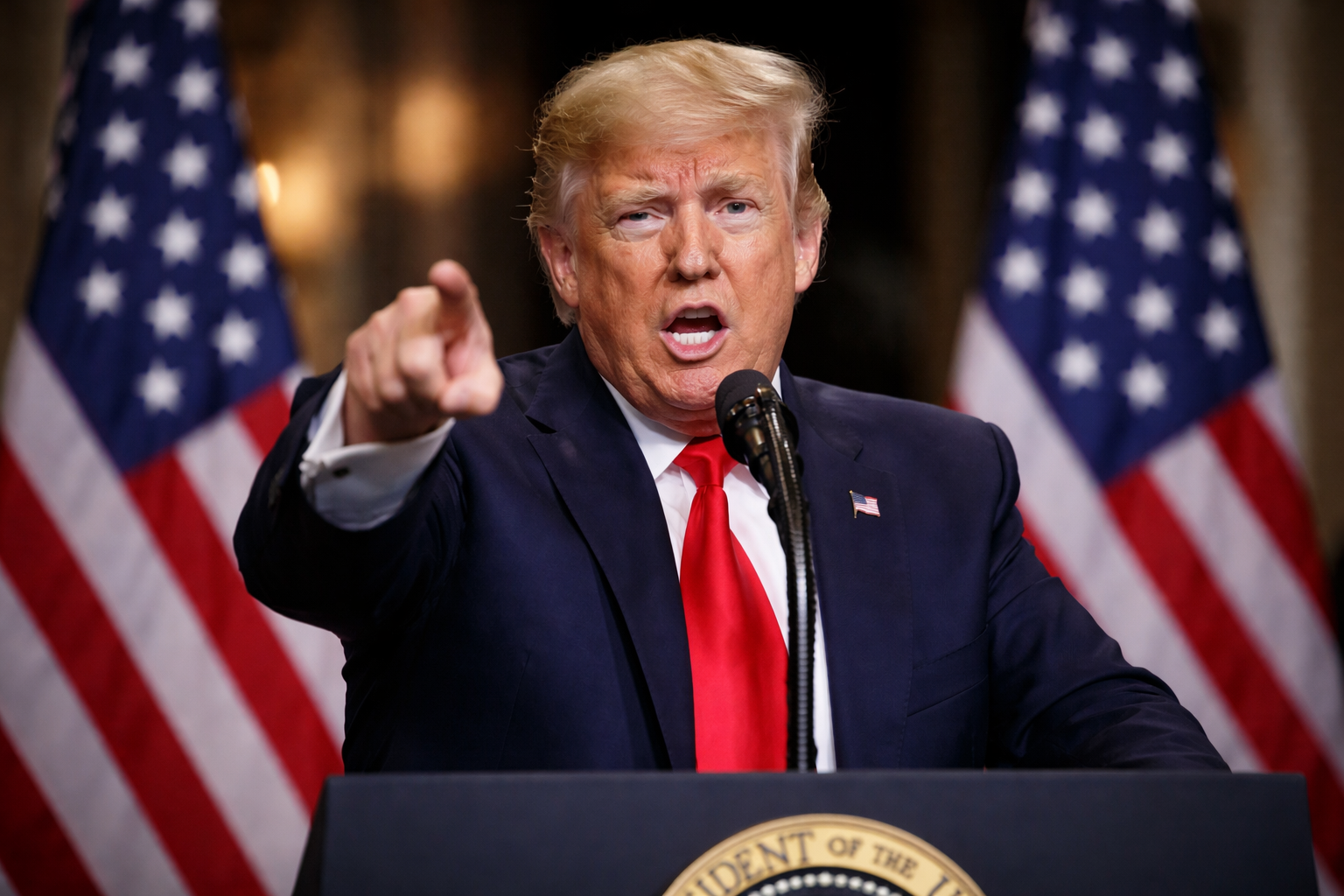
Geopolitical risk has returned to the center of market conversations as 2026 begins. In his first national statement of the new year, former U.S. President Donald Trump issued a public warning to Iran, condemning potential crackdowns on protest movements and pledging U.S. support for demonstrators if violence escalates. The remarks, first reported by the Financial Times, have quickly drawn attention across global markets, where investors are recalibrating risk exposure amid renewed uncertainty in the Middle East.
While the statement does not represent formal U.S. government policy, markets are highly sensitive to geopolitical rhetoric tied to Iran, energy security, and regional stability. Historically, even verbal escalations involving Iran have influenced oil prices, emerging market assets, and defense-sector equities — making this development particularly relevant for investors early in the year.
Why This Matters for Investors
Iran sits at the heart of several global risk vectors: energy supply routes, regional security dynamics, and sanctions-linked trade flows. According to the Financial Times’ FirstFT briefing, Trump’s comments have revived concerns about heightened geopolitical friction just as markets were showing signs of renewed risk appetite following a volatile end to 2025.
For investors, such developments matter because markets often price in geopolitical risk well before any concrete policy action occurs. Increased uncertainty can lead to:
- Higher volatility in oil and gas markets
- Widening risk premiums for emerging market assets
- Renewed demand for safe-haven investments such as gold and U.S. Treasuries
Even absent immediate escalation, rhetoric alone can influence short-term asset allocation decisions.
Energy Markets in Focus
Energy markets are typically the first to react to Middle East tensions. Iran remains a major player in global oil dynamics, both directly and through its influence on key shipping routes and regional alliances.
Analysts cited by the Financial Times note that heightened geopolitical rhetoric often creates a risk premium in crude prices, particularly when combined with existing supply constraints or OPEC+ policy uncertainty. For investors, this raises the possibility of short-term upside volatility in oil-linked equities, energy ETFs, and commodities futures.
At the same time, sustained geopolitical stress can pressure energy-importing economies, complicating the broader inflation outlook — a key variable markets are watching closely in 2026.
Broader Market Implications
Beyond energy, geopolitical uncertainty tends to ripple across asset classes. Equity markets often rotate defensively during periods of elevated tension, favoring sectors with stable cash flows or government-linked demand.
Defense and aerospace stocks historically attract attention during such periods, as increased geopolitical risk can translate into higher defense spending expectations. Meanwhile, emerging market equities and currencies may face pressure, particularly in regions sensitive to energy prices or capital flows.
Safe-haven assets also tend to benefit. Gold has already been a focal point for investors seeking protection against macro and geopolitical uncertainty, while U.S. Treasury demand often rises during risk-off episodes — a trend closely monitored by fixed-income markets.
The Geopolitical Context Investors Are Watching
Trump’s statement comes at a time when global investors are already navigating a complex landscape marked by:
- Persistent geopolitical flashpoints across multiple regions
- Uncertainty around global monetary policy trajectories
- Fragile risk sentiment following sharp market swings in 2025
According to Financial Times reporting, markets are increasingly sensitive to political signals that could alter trade relationships, sanctions frameworks, or regional stability — even when those signals originate outside formal government channels.
This sensitivity underscores how interconnected political developments and financial markets have become, particularly in an era of rapid information flow and algorithmic trading.
Future Trends to Watch
Looking ahead, investors are likely to focus on several key developments:
- Energy Price Volatility: Any escalation in rhetoric or action involving Iran could quickly impact oil markets.
- Safe-Haven Demand: Gold, Treasuries, and the U.S. dollar may see inflows during heightened uncertainty.
- Sector Rotation: Defense, energy, and commodities could outperform during risk-averse periods.
- Emerging Market Exposure: Geopolitical stress often leads to capital outflows from higher-risk regions.
Monitoring official policy responses — or the lack thereof — will be critical in determining whether this episode remains rhetorical or evolves into a broader market-moving event.
Key Investment Insight
Geopolitical rhetoric can act as a catalyst for short-term volatility even without immediate policy changes. Investors may benefit from reviewing portfolio exposure to energy prices, emerging markets, and defensive assets. Maintaining diversification and selectively incorporating hedges such as commodities or high-quality fixed income can help manage downside risk during periods of heightened geopolitical uncertainty.
Staying Ahead of Global Market Risks
As political signals intersect with already-fragile macro conditions, investors are being reminded that geopolitical risk remains a powerful driver of market behavior. Understanding how these developments influence asset prices — and positioning accordingly — can be critical in navigating early 2026.
Stay connected with MoneyNews.Today for daily, investor-focused coverage on global politics, market-moving developments, and the trends shaping capital markets worldwide.