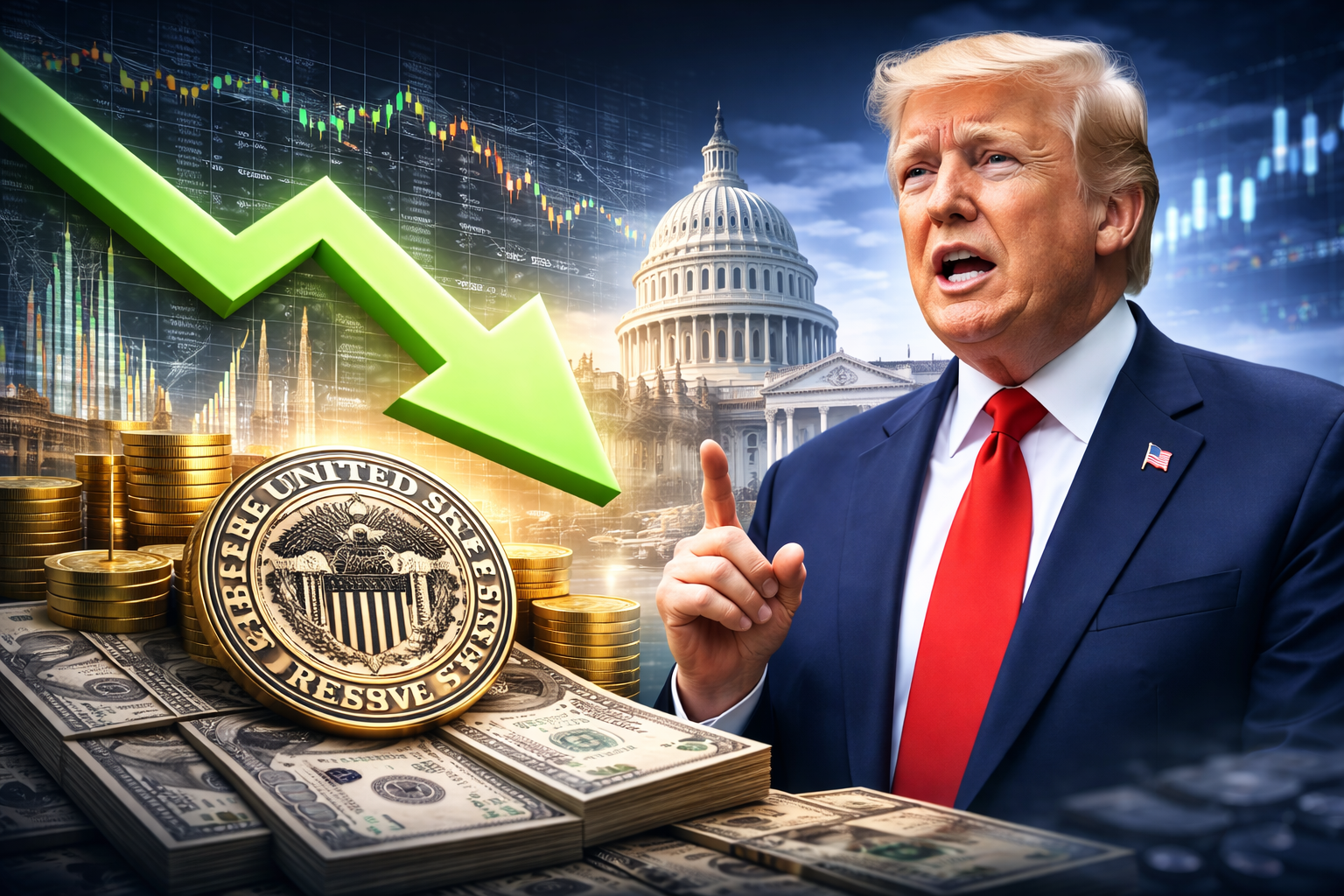
Interest-rate policy is once again at the center of market debate after President Donald Trump publicly called for the United States to have the lowest interest rates globally—comments that have quickly drawn scrutiny from investors and economists alike. According to Reuters, Trump’s remarks come as recent inflation and economic growth data suggest the Federal Reserve may keep rates elevated longer than some market participants had anticipated.
For Wall Street, the tension between political pressure and central bank independence is more than headline noise—it has real implications for bonds, equities, currencies, and global capital flows.
A Collision Between Politics and Monetary Policy
The President’s push for ultra-low rates reflects a longstanding belief that cheaper borrowing costs can stimulate economic expansion, support equity markets, and enhance U.S. competitiveness. However, the Federal Reserve operates independently and is guided by its dual mandate: price stability and maximum employment.
Recent U.S. economic data complicates the picture. Labor market resilience and firm consumer demand—widely reported by Reuters and Bloomberg—have reduced recession fears. At the same time, inflation readings remain above the Fed’s long-term 2% target, according to official Bureau of Labor Statistics releases.
In this environment, aggressive rate cuts could risk reigniting inflationary pressures. That’s why markets appear skeptical that the Fed would pivot sharply lower simply in response to political rhetoric.
Treasury yields, a real-time gauge of rate expectations, have reflected this uncertainty. While bond markets have priced in some easing over the coming year, futures markets tracked by CME FedWatch tools indicate expectations are more measured than political calls for ultra-low rates would imply.
Why This Matters for Investors
Interest rates are the gravitational force of financial markets. They influence everything from mortgage costs to corporate borrowing, equity valuations, and currency strength.
If the Fed were to significantly lower rates:
- Bond prices would likely rally.
- Growth stocks—particularly technology and other long-duration assets—could benefit from lower discount rates.
- The U.S. dollar might weaken, affecting multinational earnings and commodity pricing.
However, if inflation remains persistent and the Fed holds rates steady or eases only gradually, markets may need to recalibrate expectations.
This divergence between political messaging and central bank action increases volatility risk.
Equity markets have historically reacted sharply to shifts in rate expectations. As seen in prior cycles, even small changes in forward guidance can trigger sector rotations between growth and value stocks.
Bond Markets in Focus
Fixed-income investors may feel the impact first.
When rate policy becomes uncertain, yield curves can steepen or flatten rapidly depending on economic data. Duration risk—the sensitivity of bond prices to interest-rate changes—becomes a central concern.
Long-duration bonds are more vulnerable to unexpected rate increases or delays in easing. Investors holding extended-maturity Treasuries or corporate bonds may face price swings if rate expectations shift suddenly.
At the same time, shorter-duration instruments and floating-rate securities may offer relative insulation in a volatile policy environment.
Institutional investors often respond to such uncertainty by diversifying across maturities and maintaining liquidity buffers.
Equity Implications: Growth vs. Cyclicals
The political pressure for lower rates adds another layer to the ongoing debate about sector leadership.
Technology stocks, which often benefit from lower rates due to their reliance on future earnings growth, could see renewed interest if markets anticipate easing. Conversely, financial institutions might face margin pressure if rates fall sharply.
Meanwhile, cyclical sectors tied to economic strength—industrials, energy, consumer discretionary—may continue to perform if growth remains stable and rates decline only modestly.
According to Reuters’ broader market analysis, investors are currently balancing optimism about economic resilience with caution about inflation persistence. That balancing act explains why markets have not fully embraced the ultra-low-rate narrative.
Future Trends to Watch
Several catalysts could shape the path forward:
Inflation Data: Monthly CPI and PCE reports will heavily influence Fed policy decisions.
Federal Reserve Commentary: Speeches and official minutes will clarify the central bank’s stance amid political pressure.
Treasury Yield Movements: Bond market reactions often precede equity adjustments.
Global Rate Differentials: If U.S. rates remain higher than global peers, capital inflows could strengthen the dollar.
Investors should also consider geopolitical and fiscal developments that may impact deficit spending and long-term bond supply.
Key Investment Insight
Rate policy uncertainty tends to amplify market swings.
Investors may benefit from maintaining balanced exposure—combining quality equities with diversified fixed-income holdings. Assessing duration risk in bond portfolios is particularly important in this environment. Shorter maturities, laddered bond strategies, or inflation-protected securities may help mitigate volatility.
Above all, portfolio decisions should be guided by economic fundamentals rather than political headlines. While policy commentary can influence sentiment, the Federal Reserve’s actions will ultimately depend on data.
As markets navigate the intersection of politics and monetary policy, clarity may take time to emerge. Staying informed about rate expectations, economic indicators, and sector trends is critical for disciplined investing.
Follow MoneyNews.Today for timely, fact-driven coverage of political developments and their impact on markets—your trusted source for daily investor intelligence.