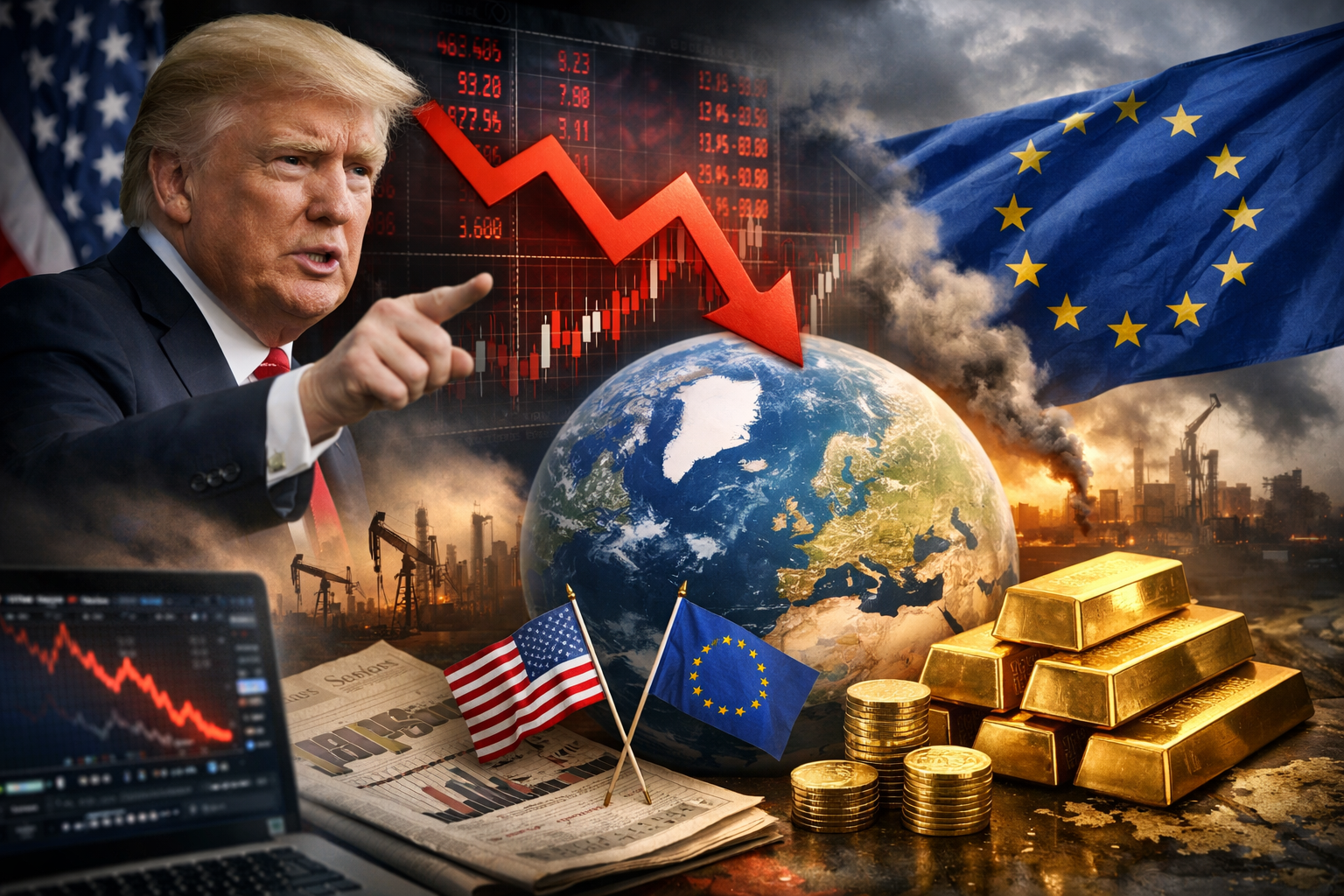
Global markets entered a renewed risk-off phase after U.S. President Donald Trump warned of sweeping tariffs against multiple European countries, tying the measures to negotiations over a proposed U.S. acquisition of Greenland. The unexpected escalation sent shockwaves through equities, pressured risk assets, and sparked a sharp rally in traditional safe havens — underscoring how quickly geopolitics can reshape investor sentiment.
European equity markets led global declines, U.S. stock futures weakened, and gold surged as investors reassessed geopolitical and trade risks. The episode highlights a growing reality for markets in 2026: policy-driven volatility is once again a dominant macro force.
Why This Matters for Investors
Trade policy uncertainty has re-emerged as a key driver of market direction. According to Reuters, Trump’s tariff threats targeted several European economies, raising concerns about retaliatory measures, disrupted supply chains, and a potential slowdown in global trade. Markets reacted swiftly, signaling investor unease over renewed protectionism.
Historically, tariff escalations have had outsized impacts on cyclical sectors such as industrials, autos, and technology hardware, while boosting demand for defensive assets. The immediate rally in gold — often viewed as a hedge against geopolitical instability — reflects this shift in positioning.
The International Monetary Fund (IMF) has warned that rising geopolitical fragmentation and trade barriers could weaken global growth prospects. In recent commentary cited by global media, IMF officials emphasized that increased economic nationalism may reduce cross-border investment flows and slow productivity gains — outcomes markets are now beginning to price in.
Market Reaction: Risk-Off Takes Hold
The response across asset classes was swift and telling:
- Equities: European stocks underperformed global peers, while U.S. equity futures turned lower as investors anticipated spillover effects.
- Commodities: Gold and silver surged as safe-haven demand intensified, reinforcing their role during periods of political uncertainty.
- Currencies: The U.S. dollar showed mixed movement, reflecting competing forces between safe-haven demand and concerns about trade disruptions.
- Volatility: Implied volatility indices ticked higher, signaling increased hedging activity among institutional investors.
According to The Guardian, market participants remain concerned that even the threat of tariffs — regardless of implementation — can weigh heavily on business confidence and capital expenditure decisions.
Geopolitics Returns as a Market Driver
The tariff announcement underscores a broader trend: geopolitics is reclaiming center stage in market analysis. Unlike traditional economic cycles, geopolitical risk can emerge abruptly and override fundamentals in the short term.
Strategists at major investment banks have repeatedly cautioned that political unpredictability — particularly involving trade, energy, and defense — can introduce sudden dislocations across markets. In this case, linking tariffs to territorial negotiations adds another layer of uncertainty, complicating diplomatic and economic forecasting alike.
For investors, the key concern is not just tariffs themselves, but the precedent they set. Rising protectionism increases the likelihood of retaliatory measures, fractured alliances, and prolonged negotiations — all of which can weigh on global growth expectations.
Future Trends Investors Should Watch
Several themes are now moving to the forefront:
- Defensive Rotation: Utilities, consumer staples, healthcare, and dividend-paying stocks often outperform during periods of elevated political risk.
- Commodities as Hedges: Precious metals and select industrial metals may continue attracting flows if geopolitical tensions persist.
- Trade-Sensitive Sectors: Industrials, exporters, and multinational manufacturers could face earnings pressure if tariff rhetoric escalates further.
- Policy Signaling: Any clarification, escalation, or de-escalation from U.S. or European officials could rapidly shift market sentiment.
As noted by analysts cited in Reuters, markets remain highly sensitive to policy headlines, meaning volatility may persist even in the absence of concrete action.
Key Investment Insight
Investors should treat rising trade tension as a macro risk factor rather than a short-lived headline. Portfolio resilience becomes critical in such environments. Diversification across asset classes, selective exposure to commodities, and an emphasis on quality balance sheets can help mitigate downside risk.
Rather than reacting emotionally to volatility, long-term investors may find opportunities in oversold assets — but only with disciplined risk management and close attention to policy developments.
Geopolitics is once again shaping the global investment landscape, reminding markets that political decisions can be just as impactful as earnings and economic data. Stay ahead of these shifts with MoneyNews.Today, your trusted source for daily investor insights, market-moving developments, and strategic analysis.