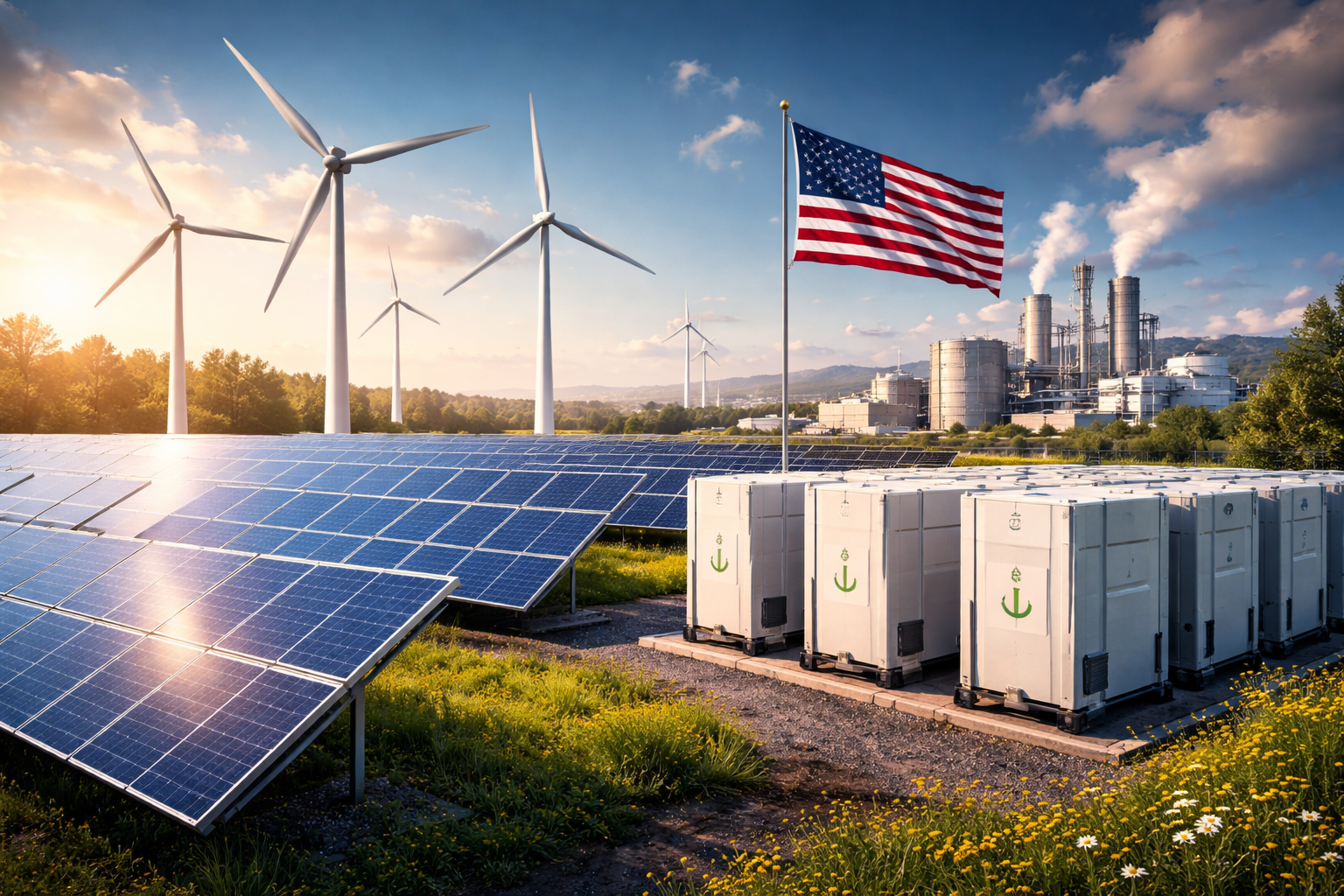
A powerful shift is underway in global markets—and it’s being driven as much by government policy as by innovation. From battery plants in the Midwest to hydrogen hubs along the Gulf Coast, capital is rapidly flowing into clean energy infrastructure across the United States. For investors, the message is becoming increasingly clear: the energy transition is no longer just a long-term theme—it’s an actively funded, policy-backed investment cycle unfolding in real time.
Recent reporting from Reuters and releases from the U.S. Department of Energy highlight a surge in investments across battery storage, hydrogen production, and electric vehicle (EV) supply chains. At the center of this momentum is a coordinated industrial policy push aimed at strengthening domestic manufacturing, securing supply chains, and accelerating decarbonization.
For markets, this represents a structural reallocation of capital—one that is reshaping industries and creating new opportunities across the investment landscape.
Policy Is Driving the Next Phase of Energy Investment
Unlike previous clean energy cycles driven primarily by market forces or environmental concerns, the current wave is being powered by policy at an unprecedented scale.
Government-backed incentives, tax credits, and subsidies are catalyzing private-sector investment in critical areas such as:
- Battery manufacturing and storage systems
- Hydrogen production and infrastructure
- EV manufacturing and supply chains
- Renewable energy deployment
The U.S. government’s strategy is clear: reduce reliance on foreign supply chains, particularly in critical minerals and energy technologies, while positioning the country as a global leader in clean energy innovation.
According to the U.S. Department of Energy, billions of dollars are being allocated to support projects that enhance grid resilience, expand energy storage capacity, and develop next-generation fuels like green hydrogen.
For investors, this level of policy support significantly reduces risk while increasing the potential for long-term returns.
Battery Storage: The Backbone of the Energy Transition
One of the most critical areas of investment is battery storage. As renewable energy sources like wind and solar become more prevalent, the need for efficient energy storage solutions is growing rapidly.
Battery systems allow excess energy generated during peak production periods to be stored and used when demand is high, improving grid stability and reliability.
Major corporations, including Tesla, are expanding their energy storage divisions to capitalize on this demand. At the same time, new entrants are emerging, supported by government incentives and private capital.
Industry analysts cited by Bloomberg note that the global battery market is expected to grow at a double-digit annual rate over the next decade, driven by both EV adoption and grid-scale storage needs.
This makes battery technology not just a supporting player, but a central pillar of the clean energy ecosystem.
Hydrogen: The Next Frontier
Hydrogen is quickly gaining traction as a key component of the future energy mix, particularly for industries that are difficult to electrify, such as heavy manufacturing and transportation.
Government-backed hydrogen hubs are being developed across the U.S., with funding aimed at scaling production, reducing costs, and building infrastructure.
Companies like Plug Power are at the forefront of this movement, investing heavily in hydrogen production and distribution networks.
Reuters reports that hydrogen projects are attracting significant investor interest, as advancements in technology and policy support improve the economic viability of the sector.
While still in its early stages, hydrogen represents a high-growth opportunity with the potential to transform multiple industries.
EV Supply Chains Are Being Rebuilt Domestically
The electric vehicle revolution is another major driver of clean energy investment, but the focus is shifting beyond vehicle production to the broader supply chain.
From lithium mining to battery assembly, companies are working to localize production and reduce dependence on international suppliers.
This has led to a wave of new manufacturing projects across the U.S., supported by government incentives designed to encourage domestic production.
Tesla continues to expand its manufacturing footprint, while traditional automakers and new entrants are investing heavily in EV infrastructure.
The result is a more integrated and resilient supply chain—one that could provide long-term competitive advantages for U.S.-based companies.
Why This Matters for Investors
The acceleration of clean energy investment is not just an environmental story—it’s a market story with far-reaching implications.
First, it highlights the growing influence of government policy on capital allocation. Sectors that align with policy priorities are likely to attract sustained investment and outperform over time.
Second, it expands the investment universe. Opportunities are emerging not only in renewable energy companies, but also in materials, industrials, and infrastructure firms that support the energy transition.
Third, it introduces a new risk dynamic. While policy support reduces certain risks, it also creates dependency on government programs, which can change over time.
For investors, understanding the intersection of policy and market forces is becoming increasingly important.
Future Trends to Watch
As this trend continues to evolve, several key developments will shape the investment landscape:
1. Expansion of Incentive Programs
Further government support could accelerate investment even more, particularly in emerging technologies like hydrogen and carbon capture.
2. Technological Innovation
Advances in battery efficiency, hydrogen production, and renewable energy could lower costs and improve scalability.
3. Supply Chain Localization
Efforts to secure critical minerals and components domestically will remain a priority, influencing global trade dynamics.
4. Private Capital Participation
Institutional investors are increasingly allocating capital to clean energy projects, adding another layer of momentum to the sector.
Credible Signals from the Market
Reports from Reuters and official releases from the U.S. Department of Energy underscore the scale and urgency of this investment wave. Analysts from major financial institutions have also pointed to clean energy as one of the most attractive long-term growth themes.
According to industry estimates, global clean energy investment is expected to reach trillions of dollars over the next decade, with the U.S. playing a leading role.
This level of capital commitment is rare—and it signals a fundamental shift in how energy systems are built and financed.
Key Investment Insight
The clean energy transition is entering a new phase—one defined by policy-driven growth and large-scale capital deployment.
For investors, the opportunity lies in identifying companies that are directly benefiting from government incentives and positioned to scale in this environment.
Key areas to focus on include:
- Battery manufacturers and storage technology providers
- Hydrogen production and infrastructure companies
- EV supply chain participants, including materials and components
- Industrial firms supporting energy infrastructure development
At the same time, diversification remains critical. While the long-term outlook is strong, the sector is still evolving, and not all players will succeed.
Investors should prioritize companies with strong fundamentals, clear growth strategies, and the ability to navigate both market and policy dynamics.
The convergence of policy, technology, and capital is reshaping the energy landscape—and creating one of the most compelling investment themes of the decade. As clean energy investments accelerate, the ripple effects will continue to influence markets across sectors.
Stay informed and ahead of the curve with MoneyNews.Today—your trusted source for daily investor insights and market-moving trends.