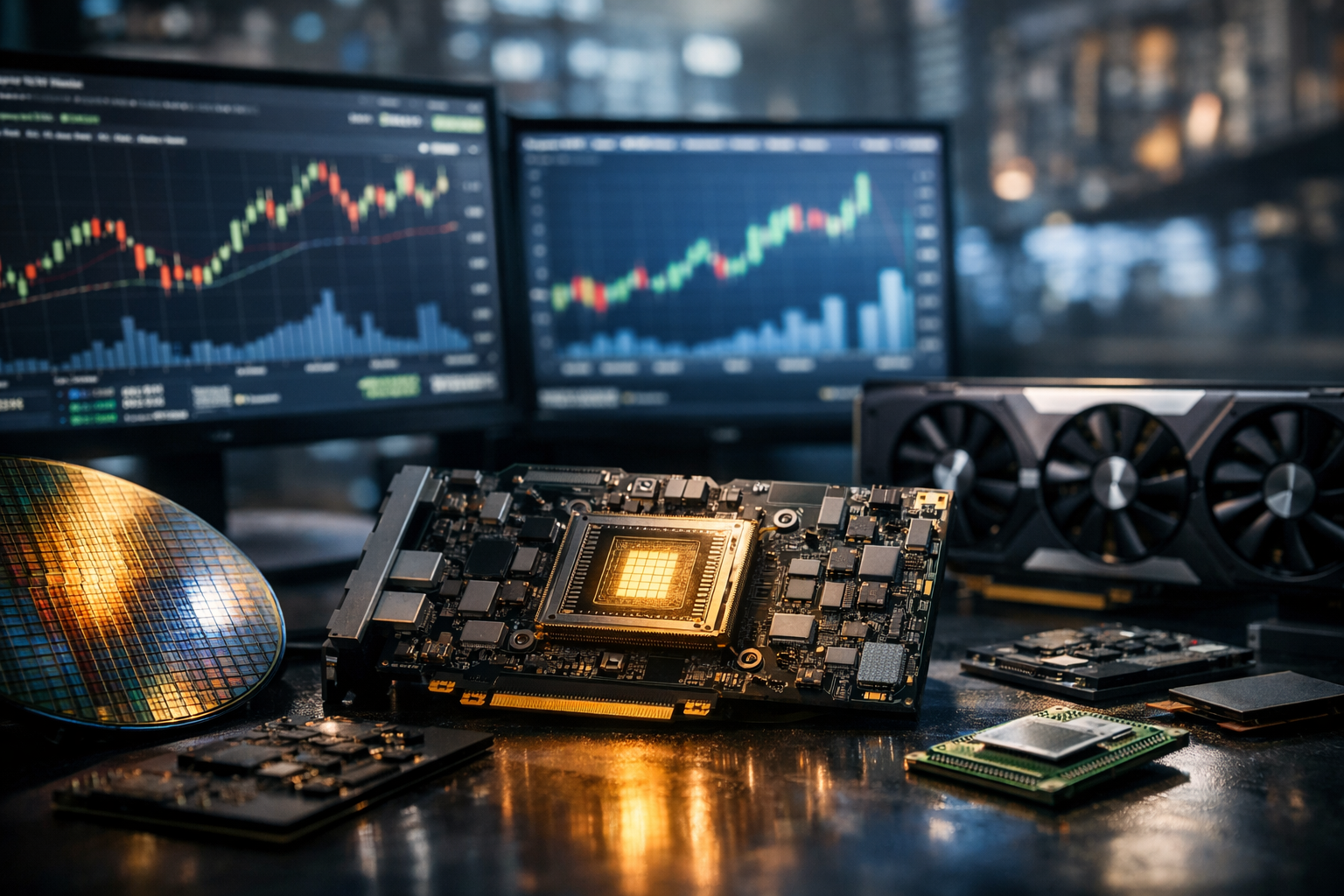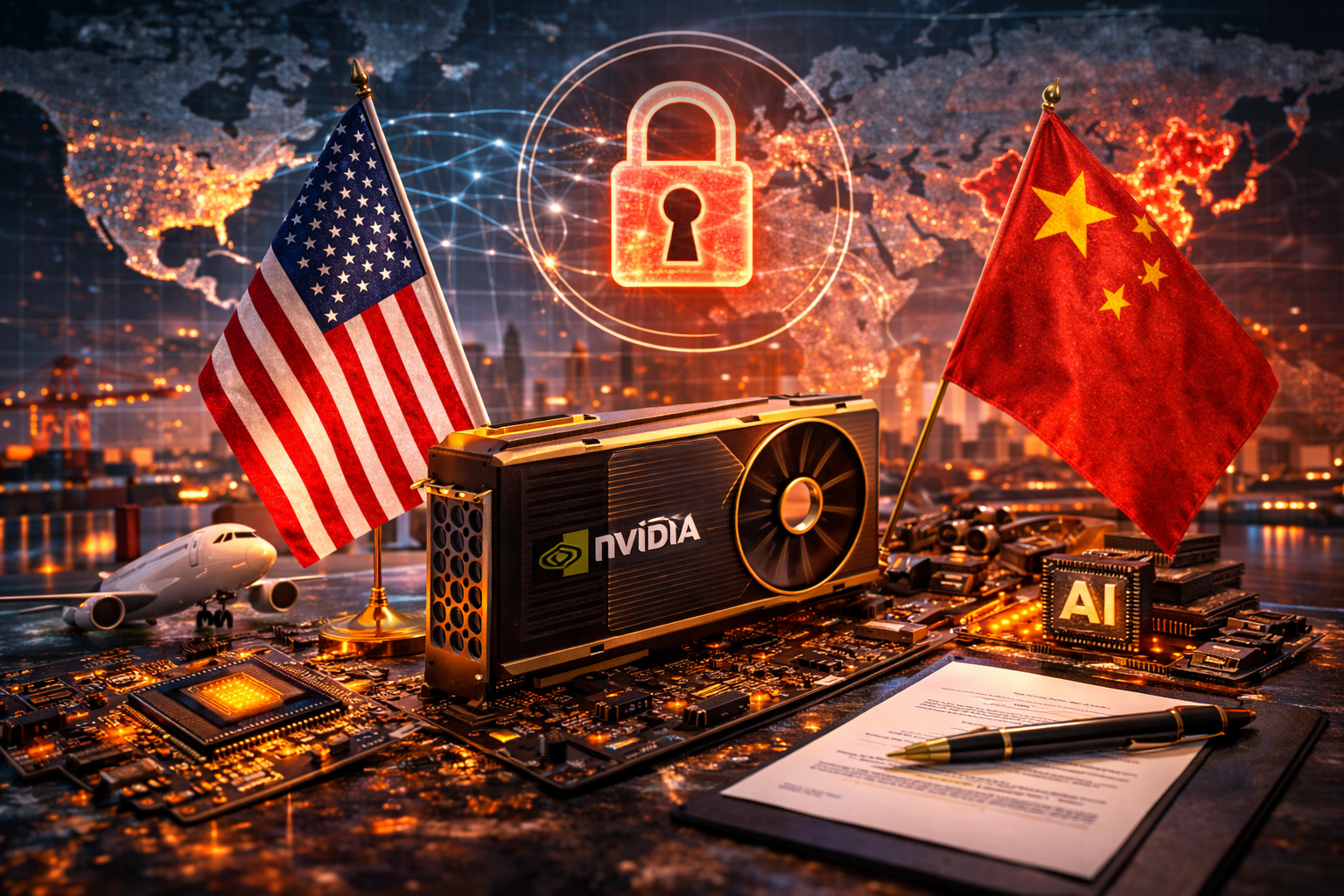
Artificial intelligence stocks have powered much of the market’s momentum over the past year—but now geopolitics is threatening to redraw the growth map.
Reports that U.S. officials are weighing new limits on exports of advanced AI chips to China have sent a clear signal to investors: the global AI boom is no longer just a technology story, it’s a policy risk story. According to the Global Times, citing people familiar with discussions reported by Bloomberg, Washington is considering caps on shipments of Nvidia’s H200 AI accelerators to Chinese buyers, with similar limits potentially extending to rival products from Advanced Micro Devices.
For investors, this is not a marginal policy tweak. China remains one of the world’s largest end markets for data center infrastructure and AI hardware. Any restriction on access to that demand could reshape revenue trajectories, competitive dynamics, and long-term valuations across the AI supply chain.
Why This Matters for Investors Right Now
The timing of these discussions is critical. AI-related equities—particularly semiconductor and infrastructure names—have become core holdings in many institutional and retail portfolios. Earnings growth expectations for leading chipmakers already embed aggressive assumptions about global AI deployment.
When export policy enters the equation, those assumptions deserve reassessment.
The proposed measures reportedly focus on limiting the number of high-end AI accelerators Chinese firms can purchase, rather than imposing an outright ban. While that approach aims to strike a balance between national security and commercial interests, markets tend to price uncertainty quickly.
In short: even partial caps could meaningfully alter the near- to medium-term growth outlook for some of the market’s most influential stocks.
The Chips at the Center of the Debate
At the heart of the discussion is Nvidia’s H200 accelerator, a flagship product designed for large-scale AI training and inference workloads. The chip is widely viewed as a cornerstone of next-generation data centers, particularly for generative AI and advanced analytics.
Nvidia has benefited enormously from global AI adoption, with data center revenue becoming the dominant driver of its valuation. China has historically been a significant contributor to that demand, even as U.S. export rules have tightened over recent years.
Reports suggest that Washington is now exploring mechanisms to cap total unit volumes sold into China annually. Importantly, the discussions may also include similar products from Advanced Micro Devices, signaling a broader policy approach rather than a single-company action.
For investors, this raises a key question: how much future growth is already priced into these stocks that assumes continued access to Chinese buyers?
Revenue Exposure and Market Sensitivity
While Nvidia does not break out China-specific revenue in detail, analysts have long estimated that the region accounts for a meaningful share of its data center sales. Even modest reductions in shipments could ripple through quarterly forecasts.
From a valuation perspective, high-growth AI stocks are particularly sensitive to changes in long-term revenue assumptions. When growth visibility narrows, multiples often compress—sometimes sharply.
AMD faces a similar challenge as it pushes deeper into the AI accelerator market. While its overall exposure to China may be smaller than Nvidia’s, any policy that places its products under the same export framework limits its ability to gain share in one of the world’s most competitive AI ecosystems.
Balancing National Security and Commercial Reality
U.S. policymakers have increasingly framed AI as a strategic technology with military, intelligence, and economic implications. Limiting China’s access to cutting-edge compute power has become a central pillar of that strategy.
At the same time, outright bans carry economic consequences:
- Reduced revenue for U.S. chipmakers
- Potential retaliation affecting other industries
- Accelerated efforts by China to develop domestic alternatives
This balancing act explains why current discussions appear focused on caps rather than blanket prohibitions. For investors, however, the distinction may matter less than the signal itself: AI hardware supply is now explicitly subject to geopolitical negotiation.
Winners, Losers, and Second-Order Effects
Potential Losers: Global AI Hardware Leaders
Companies most directly exposed to Chinese AI demand face near-term uncertainty. Even if caps are modest, the precedent increases regulatory risk premiums across the sector.
That doesn’t mean these companies lose their long-term leadership positions—but growth paths may become less linear.
Potential Beneficiaries: Domestic & Allied Supply Chains
Export constraints can redirect demand toward:
- U.S.-based cloud providers expanding domestic AI infrastructure
- Allied markets in Europe, Japan, and the Middle East
- Alternative hardware ecosystems supported by government incentives
Policy-driven reshoring and “friend-shoring” trends may support capital investment in regions considered strategically aligned with U.S. interests.
The China Response: Accelerated Self-Reliance
Restrictions often produce unintended consequences. One of the clearest lessons from prior semiconductor export controls is that they tend to accelerate domestic development efforts.
China has already invested heavily in homegrown AI chips and semiconductor manufacturing. While performance gaps remain at the high end, policy pressure can shorten development timelines and mobilize state-backed capital.
For global investors, this suggests a longer-term bifurcation of AI ecosystems:
- One centered around U.S. and allied technology stacks
- Another increasingly self-contained within China
Such fragmentation could reduce total addressable markets for leading Western firms over time, even as global AI adoption continues to expand.
Broader Market Implications
AI stocks are not isolated. Export policy headlines can influence:
- Equity indices: Large-cap AI names carry significant index weight
- Supply chains: Foundries, memory suppliers, and equipment makers may see shifting order patterns
- Currencies: Heightened trade tension often supports the U.S. dollar
- Risk sentiment: Tech-led volatility can spill into broader markets
Investors should view AI export controls not just as a sector-specific issue, but as part of a broader macro and geopolitical framework influencing global capital flows.
Future Trends to Watch
1. Scope and Enforcement Details
Markets will look for clarity on unit limits, product categories, and compliance mechanisms. Ambiguity tends to increase volatility.
2. Earnings Commentary
Management guidance from AI chipmakers will be closely scrutinized for references to China demand, alternative markets, and inventory dynamics.
3. Policy Escalation or Stabilization
Whether these discussions remain targeted or expand into wider tech restrictions will shape medium-term sector sentiment.
Key Investment Insight
Export caps may slow—but are unlikely to stop—the global AI investment cycle.
For investors, the more durable trend remains explosive demand for compute power driven by generative AI, automation, and data-intensive applications. However, the geographic distribution of that demand is becoming more politically defined.
Prudent strategies may include:
- Diversifying AI exposure across hardware, software, and cloud infrastructure
- Monitoring policy developments alongside earnings fundamentals
- Avoiding overconcentration in any single geopolitical outcome
In an environment where policy decisions can materially alter growth paths, risk management matters as much as technological leadership.
The U.S. consideration of limits on AI chip exports to China underscores a defining reality of modern markets: technological dominance and geopolitical strategy are increasingly inseparable.
While Nvidia and AMD remain central players in the AI revolution, their future growth will be shaped not only by innovation cycles, but by diplomatic and regulatory decisions made far from Silicon Valley.
For investors, staying informed on these policy shifts is essential—not just to manage risk, but to identify where capital and innovation may flow next.
Stay ahead of market-moving AI, technology, and policy developments with MoneyNews.Today, your trusted source for clear, timely, and actionable investor intelligence.