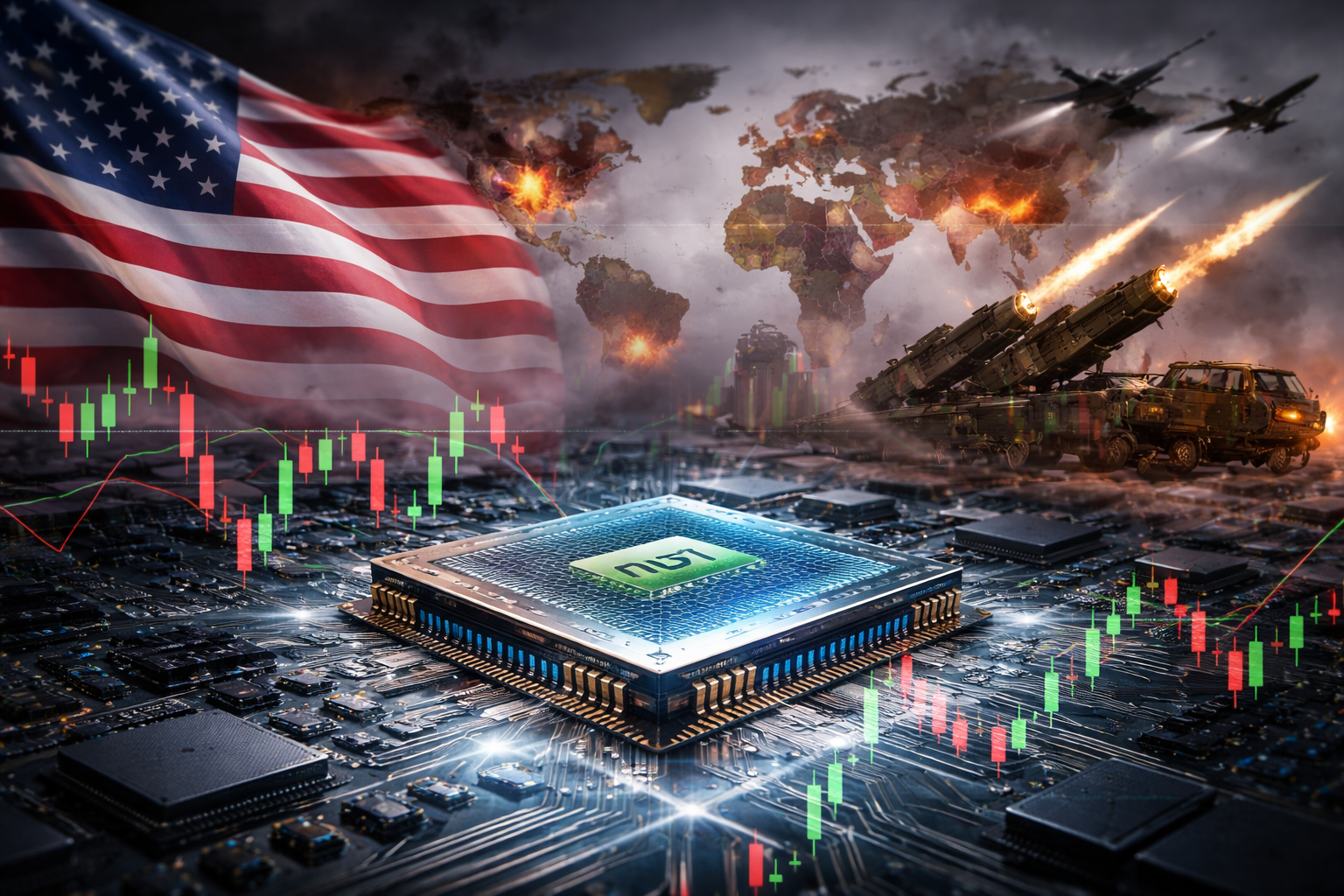
U.S. equity markets are entering 2026 with a familiar tension: optimism around artificial intelligence colliding with renewed geopolitical and policy uncertainty. While global stock indexes have shown signs of cooling amid rising geopolitical risks and mixed macroeconomic data, AI-linked technology stocks continue to anchor broader market confidence — underscoring the sector’s growing role as both a growth engine and a risk concentration point for investors.
Recent market action reflects this dual narrative. According to Reuters market wrap coverage, investors are navigating softer global equity performance while selectively bidding up AI leaders, most notably Nvidia, whose expanding role in AI compute infrastructure continues to reinforce the long-term investment case for the sector.
Why AI Remains Central to Market Leadership
Despite short-term volatility, artificial intelligence remains one of the most influential forces shaping U.S. equity performance. Nvidia’s presence at CES reinforced its leadership in high-performance compute, data center acceleration, and AI model training — areas that remain critical as enterprises scale generative AI adoption.
Industry data cited by Reuters and AP shows that hyperscalers and enterprise clients continue to prioritize AI-related capital expenditures, even as they moderate spending elsewhere. Analysts point to sustained demand for GPUs, networking hardware, and AI-optimized infrastructure as evidence that AI investment cycles remain in an expansion phase rather than peaking.
For investors, this explains why AI-heavy indexes and mega-cap tech stocks continue to outperform during periods of broader market hesitation. The AI narrative is no longer speculative — it is increasingly embedded in earnings growth, capex planning, and productivity expectations across sectors.
Policy and Geopolitics Add a New Layer of Risk
At the same time, macro and policy pressures are reshaping investor sentiment. Rising geopolitical tensions, ongoing U.S. trade considerations, and uncertainty around industrial policy have introduced fresh volatility into global markets. According to Reuters, investors are closely watching how U.S. policy decisions — from semiconductor manufacturing incentives to export controls — could influence both supply chains and valuation multiples for AI-linked firms.
Inflation dynamics and interest rate expectations remain another key variable. While markets are not pricing in immediate policy tightening, elevated rates continue to challenge equity valuations, particularly for high-growth technology stocks. Even AI leaders are not immune to multiple compression if macro conditions tighten or risk appetite shifts.
This has led to more selective positioning among institutional investors, favoring companies with strong balance sheets, pricing power, and visible demand rather than broad exposure to speculative AI themes.
Market Signals Investors Are Watching Closely
Several indicators are shaping near-term AI and tech sentiment:
- Earnings Quality: Investors are increasingly focused on whether AI-driven revenue growth is translating into sustainable margins and free cash flow.
- Government Policy Direction: U.S. industrial and technology policy — particularly around domestic chip production and national security — remains a major swing factor.
- Geopolitical Stability: Any escalation affecting global trade routes, energy markets, or semiconductor supply chains could quickly ripple through tech valuations.
- Capital Spending Trends: Continued commitment from cloud providers and enterprise customers will be critical to sustaining AI infrastructure demand.
Reuters notes that while the broader market has shown signs of fatigue, AI remains one of the few areas where long-term growth expectations continue to rise rather than flatten.
What This Means for Investors
AI’s dominance in market leadership is both a strength and a vulnerability. On one hand, structural demand for compute power, automation, and data-driven decision-making provides a durable growth runway. On the other, heavy concentration in a narrow group of mega-cap names raises exposure to policy shocks, geopolitical events, or earnings disappointments.
For investors, the opportunity lies in balancing exposure — maintaining participation in AI’s upside while managing downside risk tied to macro uncertainty. This may include favoring companies with diversified revenue streams, monitoring policy developments closely, and avoiding overextension into purely narrative-driven AI trades.
Key Investment Insight
Artificial intelligence continues to underpin U.S. market leadership, but 2026 is shaping up to be a year where policy awareness and risk management matter as much as growth potential. Investors should view AI not as a standalone trade, but as part of a broader portfolio strategy that accounts for interest rates, geopolitics, and regulatory direction.
Markets may fluctuate, but AI’s role in reshaping productivity and capital allocation remains intact — making disciplined exposure more important than ever.
Stay ahead of the trends shaping global markets with MoneyNews.Today, your trusted source for daily investor insights across technology, policy, and emerging industries.