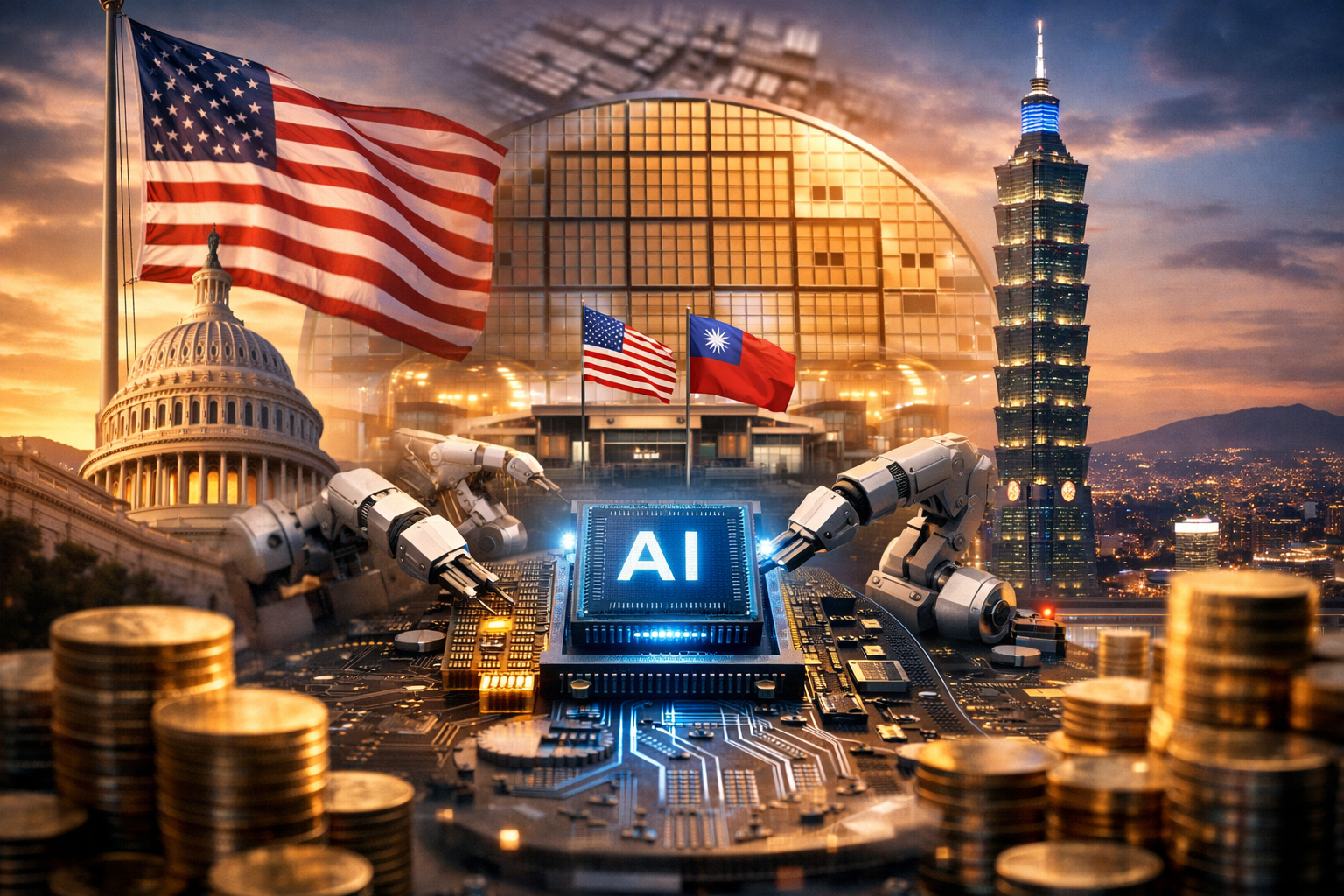
Global markets are recalibrating around artificial intelligence, and investors are paying close attention to where the next wave of capital will land. That focus sharpened this week after the United States and Taiwan finalized a landmark trade agreement expected to unlock $250 billion in semiconductor and AI-related investment into the U.S. economy, according to Reuters. The deal reinforces Washington’s push to secure AI supply chains while reshaping long-term investment opportunities across semiconductors, advanced manufacturing, and critical materials.
At a time when AI infrastructure spending is accelerating and geopolitical risk remains elevated, the agreement signals a strategic pivot that could influence markets for years.
Why This Deal Is Resonating With Investors
Semiconductors sit at the heart of the AI boom, powering everything from cloud data centers to autonomous systems and defense applications. The U.S.–Taiwan pact strengthens economic and technological cooperation with Taiwan—home to Taiwan Semiconductor Manufacturing Company (TSMC), the world’s largest contract chipmaker and a cornerstone of global AI hardware production.
According to Reuters, a substantial portion of the $250 billion investment will support continued U.S. expansion by Taiwanese firms, including TSMC’s advanced fabrication facilities in Arizona. These projects align with broader U.S. policy goals outlined in the CHIPS and Science Act, which aims to reduce reliance on overseas chip manufacturing and bolster domestic capacity.
For investors, this convergence of policy support, capital investment, and AI demand represents a powerful tailwind.
Strengthening the U.S. AI Hardware Supply Chain
The agreement goes beyond headline investment figures. It addresses one of the most pressing concerns facing markets today: supply-chain concentration risk.
Analysts have repeatedly warned that advanced chip production is geographically concentrated, creating vulnerabilities during geopolitical tensions. By incentivizing Taiwanese semiconductor leaders to expand U.S. operations, the deal diversifies manufacturing locations while accelerating the build-out of AI-ready infrastructure.
Industry data cited by Bloomberg shows that AI data-center spending is expected to grow at a double-digit annual rate through the end of the decade. Meeting that demand requires not only cutting-edge chips, but also massive investments in fabrication equipment, specialty chemicals, silicon wafers, and power-intensive facilities—each representing a potential investment opportunity.
Winners Beyond the Chipmakers
While semiconductor giants are the most visible beneficiaries, the ripple effects extend far beyond chip production.
Capital equipment suppliers, including lithography, testing, and packaging firms, are poised to benefit as new fabs ramp up construction. Materials providers, particularly those supplying copper, rare gases, and advanced chemicals, stand to gain from sustained demand tied to AI infrastructure build-out. Construction, industrial automation, and energy-management firms could also see increased activity as new facilities come online.
According to McKinsey research on AI infrastructure, every dollar invested in advanced semiconductor manufacturing generates multiple dollars of downstream economic activity—a multiplier effect investors are increasingly factoring into long-term portfolio strategies.
Policy, Geopolitics, and Market Confidence
From a policy standpoint, the trade deal reinforces U.S. commitment to technological self-reliance while deepening ties with a critical strategic partner. That clarity matters to markets.
Trade and industrial policy uncertainty has weighed on semiconductor valuations in recent years. By contrast, this agreement provides a clearer framework for long-term investment planning, potentially reducing risk premiums applied to AI-linked equities.
Market strategists quoted by Reuters note that sustained government backing often acts as a catalyst for private capital deployment, particularly in capital-intensive sectors like semiconductors and advanced manufacturing.
Future Trends Investors Should Watch
Looking ahead, investors will be monitoring several key developments:
- Execution of announced investments, including construction timelines and capacity targets for new U.S. fabs
- AI-driven demand trends, particularly from cloud providers and enterprise adoption
- Supply-chain diversification efforts, including domestic sourcing of materials and equipment
- Policy follow-through, including incentives, tax credits, and regulatory support
Any acceleration—or delay—in these areas could influence sector performance and valuation multiples.
Key Investment Insight
The U.S.–Taiwan trade deal strengthens the structural foundation of the AI economy. For investors, the opportunity is not limited to headline chipmakers. Semiconductor capital-expenditure plays, equipment suppliers, materials producers, and infrastructure enablers are positioned to benefit as AI hardware investment scales over the coming decade. Diversified exposure across this ecosystem may offer a more resilient way to participate in the AI growth cycle.
As global capital continues to chase AI-driven growth, understanding where investment flows are heading is critical. Stay ahead of the market with MoneyNews.Today, your trusted source for timely, data-driven investor insights shaping tomorrow’s opportunities.