Artificial intelligence has been the market’s most powerful tailwind over the past year — but this week, it’s also becoming a source of turbulence.
U.S. equities are entering a pivotal stretch as investors weigh AI-driven valuation extremes against incoming labor market data that could reshape expectations for Federal Reserve policy. According to Reuters, Wall Street is bracing for heightened volatility as traders digest both the disruptive economic implications of artificial intelligence and the looming U.S. jobs report — one of the most closely watched indicators for monetary policy direction.
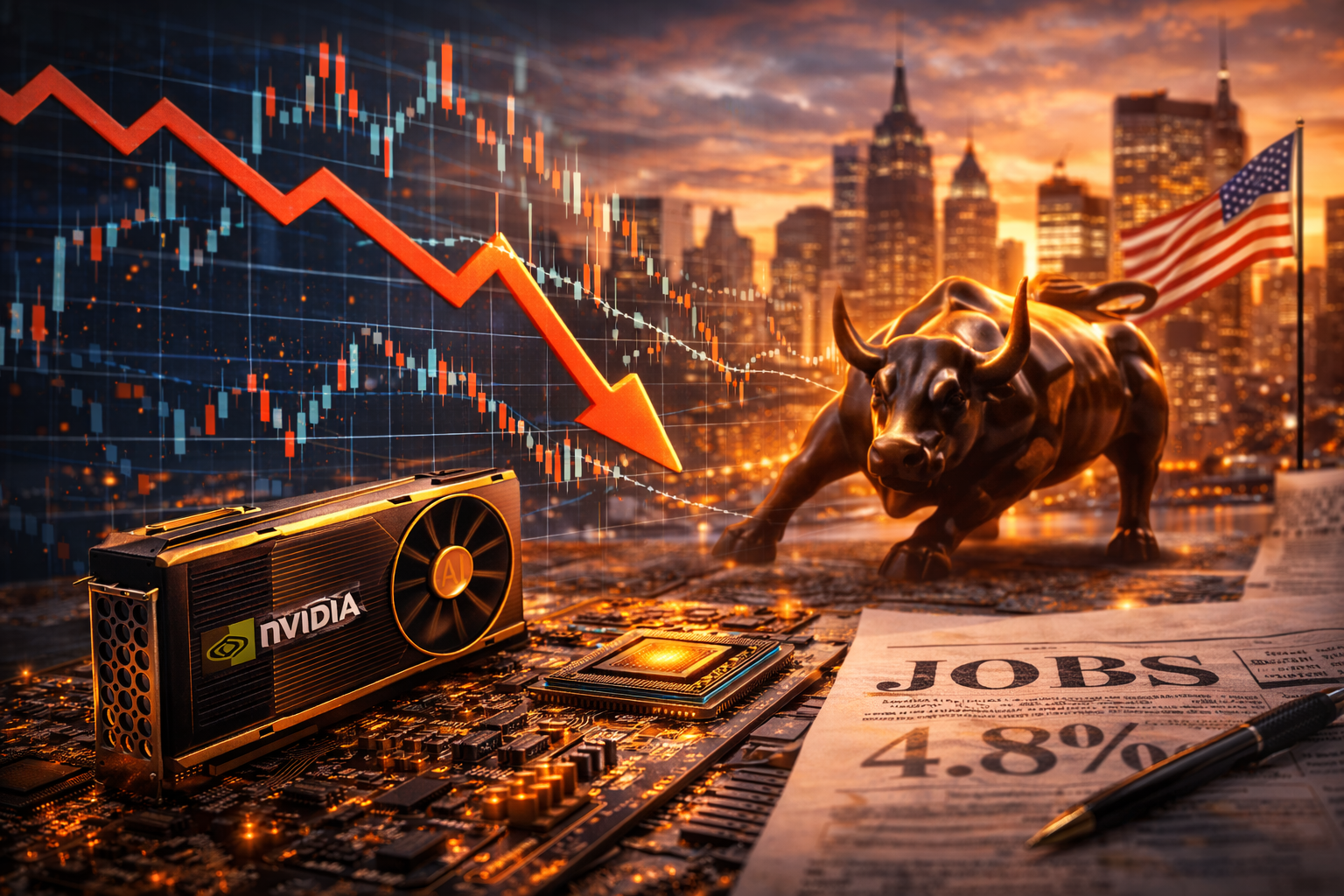
Recent share price pullbacks in AI bellwethers like Nvidia underscore the tension: the long-term AI growth narrative remains intact, but near-term economic uncertainty is forcing investors to reassess risk.
For market participants, the convergence of macro data and AI sentiment may determine the next leg of the rally — or the start of a broader repricing.
AI Euphoria Meets Macro Reality
The AI trade has dominated capital flows across global markets. Semiconductor manufacturers, hyperscale cloud providers, and AI infrastructure firms have driven index performance, pushing major benchmarks higher and compressing volatility — until recently.
But markets are forward-looking mechanisms. As valuations stretch and macro data looms, even the strongest narratives face stress tests.
The U.S. jobs report — issued monthly by the Bureau of Labor Statistics — carries outsized influence because it shapes expectations for interest rate policy. Strong employment numbers can reinforce inflationary pressure concerns, potentially delaying rate cuts. Weak data, on the other hand, could signal economic softening, prompting easier monetary policy but also raising fears of slowdown.
AI stocks sit directly at this crossroads.
High-growth technology companies are particularly sensitive to interest rates. Their valuations often depend on discounted future cash flows. When yields rise, those future earnings become less valuable in present terms — a dynamic that has repeatedly pressured tech stocks during tightening cycles.
The result: AI equities are increasingly trading not just on innovation milestones, but on macroeconomic sensitivity.
Why This Matters for Investors
1. Valuation Compression Risk
Companies tied to AI infrastructure have seen exponential revenue growth, but multiples have expanded in tandem. According to analysis cited by Reuters and echoed across major Wall Street research desks, some semiconductor stocks are trading at elevated forward earnings ratios relative to historical norms.
If jobs data strengthens and Treasury yields move higher, valuation compression could accelerate — even if long-term AI demand remains robust.
This is not necessarily a bearish signal for the AI sector. Rather, it reflects a recalibration phase after an extraordinary rally.
2. Fed Policy as the Swing Factor
The Federal Reserve remains the ultimate macro variable.
Strong payroll growth could delay anticipated rate cuts, keeping financial conditions tighter for longer. Conversely, weaker employment data could revive expectations for monetary easing — potentially supportive for growth stocks but concerning if tied to broader economic deterioration.
The market’s reaction function matters more than the headline number itself. Investors should monitor:
- Wage growth trends
- Labor force participation rates
- Revisions to prior payroll data
Each component influences rate expectations differently.
3. AI’s Broader Economic Impact
Beyond stock prices, there is a deeper question investors are wrestling with: how quickly will AI reshape productivity and employment?
Research from consulting firms like McKinsey has projected that generative AI could meaningfully boost global productivity over the next decade. However, short-term displacement fears remain part of the narrative.
If labor markets begin to soften, debates may intensify around whether AI adoption is contributing to structural shifts in employment patterns. While current evidence does not conclusively support large-scale displacement, the perception risk can influence sector rotation and investor psychology.
The Nvidia Signal
Recent declines in Nvidia’s shares illustrate the fragile balance between optimism and caution.
Nvidia has been the flagship AI stock, representing both explosive demand for data center chips and the broader market’s appetite for AI exposure. When Nvidia’s stock pulls back meaningfully, it often reverberates through:
- Semiconductor peers
- Data center equipment providers
- AI software platforms
- Major indices due to its market capitalization
Because of its weighting in major benchmarks, fluctuations in Nvidia can influence overall market sentiment, even when underlying fundamentals remain strong.
The current pullback does not necessarily signal deteriorating demand. Instead, it reflects investors hedging macro uncertainty ahead of jobs data and reassessing positioning after substantial gains.
Defensive Rotation: A Temporary Theme?
Periods of macro-driven volatility often spark rotation into defensive sectors such as:
- Utilities
- Consumer staples
- Healthcare
If jobs data disappoints and recession concerns intensify, these sectors may outperform in the short term.
However, structural growth themes like AI rarely disappear due to one data print. Instead, markets often oscillate between growth enthusiasm and macro caution.
For investors, the question is not whether AI remains transformative — it almost certainly does — but how much volatility one can tolerate while the macro backdrop stabilizes.
Future Trends to Watch
1. Bond Market Reaction
Treasury yields will likely be the first and most immediate signal following jobs data. Growth stocks tend to move inversely with yields. A spike higher could pressure tech; a drop could provide relief.
2. Earnings Revisions
Watch for analyst revisions in the weeks following labor data. If economic concerns rise, forward earnings estimates may adjust — affecting valuations across sectors.
3. AI Capex Guidance
Corporate capital expenditure plans, particularly from hyperscalers and enterprise technology buyers, will remain critical. Continued investment in AI infrastructure would reinforce long-term demand regardless of short-term volatility.
Key Investment Insight
AI remains one of the most powerful structural investment themes of this decade — but macro forces are reasserting themselves.
Investors may consider:
- Maintaining diversified exposure across both growth and defensive sectors
- Monitoring labor market data as a leading indicator for Fed policy shifts
- Evaluating entry points in high-quality AI names during pullbacks
- Avoiding over-leverage in volatile macro environments
Short-term volatility does not negate long-term opportunity. However, disciplined risk management becomes essential when valuations are elevated and macro uncertainty increases.
The Bigger Picture
Markets are entering a phase where two powerful forces intersect: transformative technological change and traditional economic cycles.
AI has the potential to redefine productivity, reshape industries, and generate enormous shareholder value. At the same time, employment data, inflation readings, and central bank policy remain dominant drivers of asset pricing.
The coming jobs report is more than a monthly statistic — it’s a catalyst that could recalibrate expectations across equities, bonds, and currencies.
Investors who understand both narratives — the AI revolution and the macro cycle — will be best positioned to navigate what comes next.
Stay informed on the market-moving stories shaping global capital flows with MoneyNews.Today, your trusted source for timely, data-driven investor intelligence.