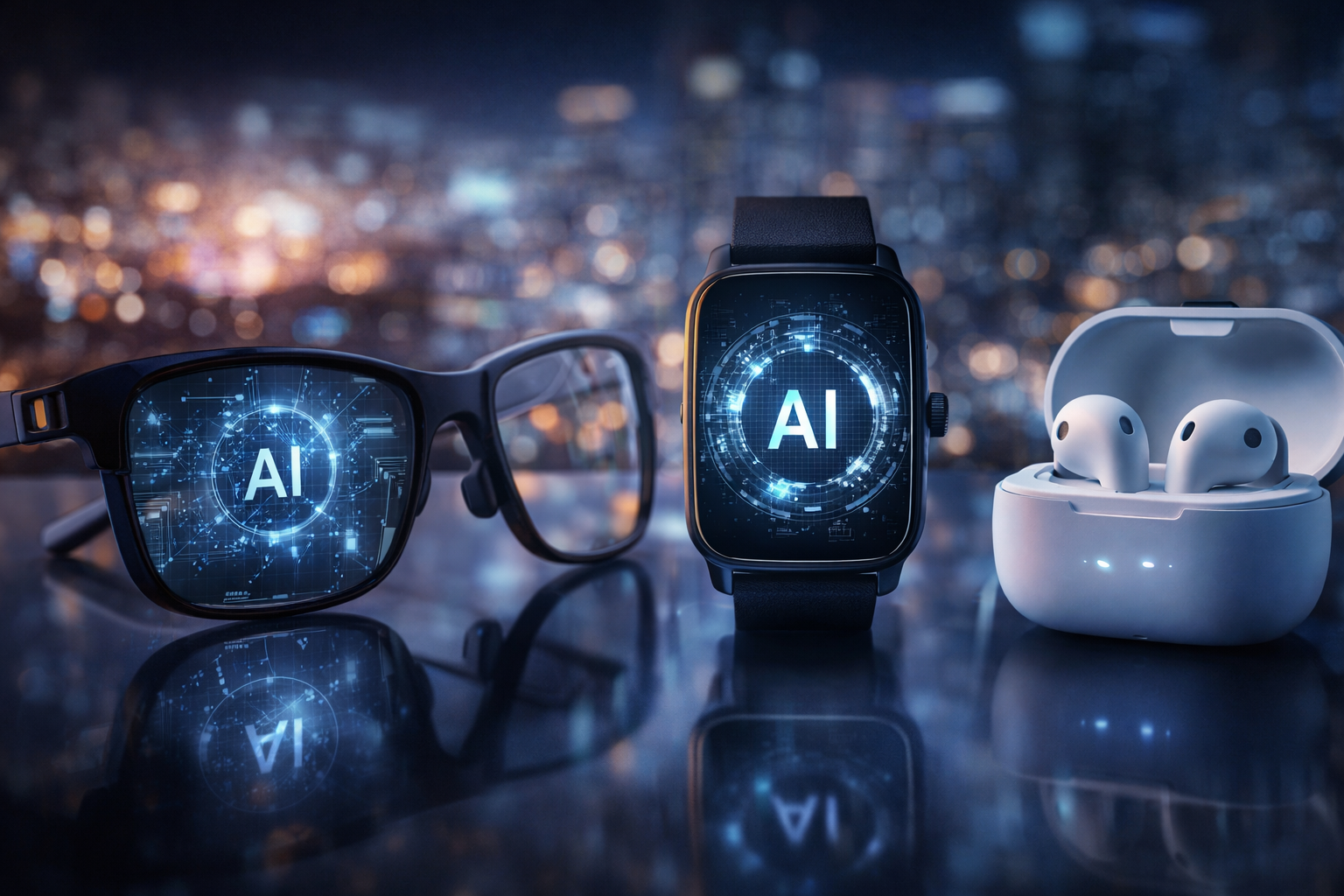
The next frontier of artificial intelligence may not live in massive data centers or powerful cloud platforms—it may sit on your wrist, in your glasses, or even embedded in your clothing.
A new report highlighted by Yahoo Finance (April 1, 2026) projects that the global wearable AI devices market will surge from roughly $70 billion today to more than $270 billion by 2036. That kind of growth—nearly a 4x expansion—signals more than just a trend. It marks the emergence of a new computing paradigm: AI at the edge.
For investors, this shift is critical. While mega-cap AI stocks have dominated headlines, the wearable AI segment represents a less crowded, high-growth opportunity with the potential to deliver outsized returns over the next decade.
The Rise of AI at the Edge
For years, AI innovation has been centralized—built around cloud computing, hyperscale data centers, and massive training models. But as technology evolves, the industry is moving toward decentralization, where AI processing happens closer to the user.
This is where wearable AI comes in.
Wearable AI devices include:
- Smart glasses with real-time translation and contextual awareness
- Health-monitoring wearables powered by predictive analytics
- Industrial wearables for safety, productivity, and training
- Consumer devices like AI-enhanced earbuds and smartwatches
Unlike traditional devices, these products rely on edge AI, meaning they process data locally rather than sending everything to the cloud. This enables:
- Faster response times
- Improved privacy
- Lower latency
- Reduced bandwidth usage
According to industry research from firms like McKinsey & Company and Gartner, edge AI is expected to become a dominant force in the next phase of digital transformation, particularly in sectors where real-time decision-making is critical.
Why This Matters for Investors
1. A High-Growth Market Still in Early Stages
The projected growth from $70B to $270B by 2036 implies a strong compound annual growth rate (CAGR), placing wearable AI among the fastest-growing segments within the broader AI ecosystem.
Unlike saturated areas such as cloud infrastructure or large-cap AI software, wearable AI remains:
- Underpenetrated
- Fragmented
- Innovation-driven
This creates opportunities for early positioning before the market fully matures.
2. Expanding Use Cases Across Multiple Industries
One of the most compelling aspects of wearable AI is its cross-sector applicability.
Healthcare
Wearables are transforming healthcare through:
- Continuous health monitoring
- Early disease detection
- AI-driven diagnostics
Companies are increasingly integrating AI into devices that track heart rate variability, glucose levels, sleep patterns, and more—turning wearables into preventive healthcare tools.
Consumer Technology
Tech giants are racing to embed AI into everyday devices:
- Smart glasses with augmented reality (AR) capabilities
- AI-powered assistants integrated into earbuds
- Personalized fitness and lifestyle recommendations
This convergence of AI and consumer electronics could redefine how users interact with technology.
Industrial and Enterprise Applications
In sectors like manufacturing, logistics, and construction, wearable AI is being used to:
- Enhance worker safety
- Improve productivity
- Deliver real-time guidance and training
These enterprise applications often provide higher margins and recurring revenue opportunities, making them particularly attractive for investors.
3. The Hardware + Software Convergence
Wearable AI represents a convergence of multiple technological layers:
- Hardware (devices, sensors)
- Software (AI models, operating systems)
- Connectivity (5G, IoT)
This ecosystem approach creates multiple investment entry points.
For example:
- Semiconductor companies benefit from demand for low-power AI chips
- Sensor manufacturers gain from increased device complexity
- Software developers monetize AI-driven applications
According to Gartner, the number of connected IoT devices is expected to exceed 25 billion globally by the end of the decade, many of which will incorporate AI capabilities—further reinforcing this trend.
Credible Signals Driving Market Expansion
Several key data points reinforce the bullish outlook for wearable AI:
- Yahoo Finance (April 1, 2026): Projects wearable AI market growth from ~$70B to $270B by 2036
- McKinsey & Company: Highlights edge AI as a major driver of next-generation digital transformation
- Gartner: Forecasts rapid expansion in connected devices and AI-enabled endpoints
- Healthcare research firms: Point to increasing adoption of AI-powered diagnostics and monitoring tools
Together, these sources paint a clear picture: wearable AI is not speculative—it is already scaling and accelerating.
Future Trends to Watch
1. Smart Glasses Could Be the Next Smartphone
Smart glasses are widely seen as a potential successor—or complement—to smartphones. With built-in AI capabilities, they could:
- Deliver real-time information overlays
- Enable hands-free communication
- Transform navigation, shopping, and entertainment
Major tech players are already investing heavily in this space, suggesting a new platform shift may be underway.
2. Healthcare Will Lead Early Adoption
Healthcare is likely to remain the largest and fastest-growing segment of wearable AI due to:
- Aging populations
- Rising healthcare costs
- Demand for preventive care
AI-powered wearables could reduce hospital visits and improve outcomes—creating strong incentives for adoption.
3. Battery and Chip Innovation Will Be Key
One of the biggest challenges in wearable AI is balancing performance with power efficiency.
Advancements in:
- Low-power AI chips
- Battery technology
- Edge computing optimization
will determine which companies lead the market.
4. Privacy and Regulation Will Shape Growth
As wearable devices collect sensitive personal data, regulatory frameworks will become increasingly important.
Governments and regulators may introduce:
- Data protection requirements
- AI usage guidelines
- Medical device standards
Companies that can navigate these regulations effectively will gain a competitive advantage.
Key Investment Insight
Wearable AI represents a second wave of the AI boom—one that is more distributed, more personal, and potentially more scalable.
For investors, the opportunity lies beyond mega-cap tech.
Consider focusing on:
- Small- and mid-cap innovators in wearable technology
- Sensor and semiconductor companies enabling edge AI
- Healthcare tech firms integrating AI into diagnostics and monitoring
- Industrial solution providers leveraging wearable AI for enterprise use
The biggest gains may come from companies that are building the ecosystem, not just the end products.
Strategic Perspective
The projected growth of the wearable AI market is a clear signal that the AI revolution is entering a new phase.
From centralized computing to edge intelligence, from software dominance to hardware integration, the landscape is shifting rapidly.
Investors who recognize this transition early—and position themselves accordingly—stand to benefit from one of the most dynamic and underappreciated growth stories in technology.
The next generation of AI winners may not just be the companies training massive models—but those putting intelligence directly into the hands, eyes, and lives of users.
Stay ahead of emerging trends and uncover tomorrow’s investment opportunities with MoneyNews.Today—your trusted source for daily investor insights.