
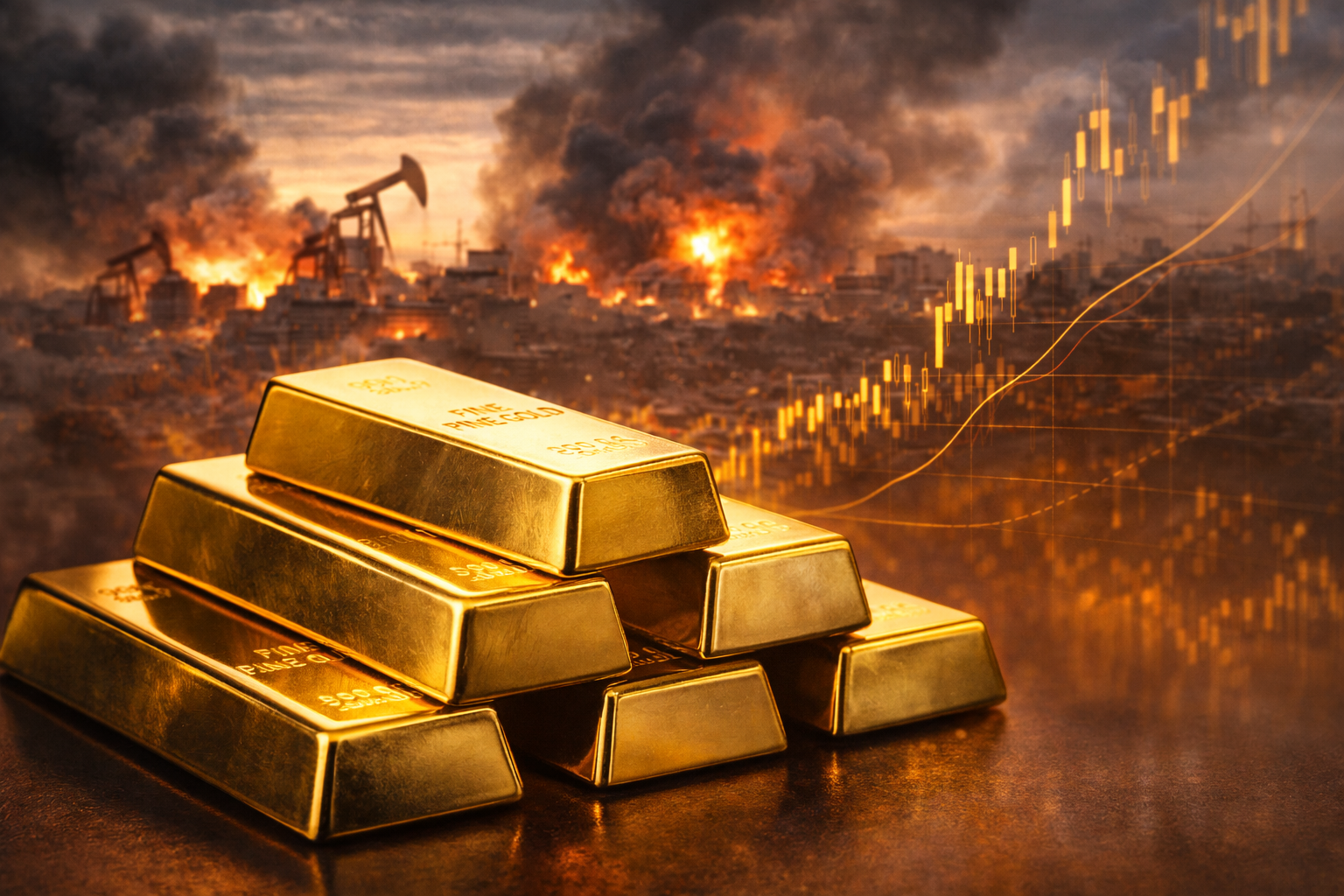
Global investors are once again turning to one of the world’s oldest financial safe havens. As geopolitical tensions escalate and uncertainty spreads across energy markets and global supply chains, gold prices are climbing—signaling a shift in investor sentiment toward assets historically associated with stability during crises.
The latest rally in gold comes amid rising oil prices, geopolitical risks, and renewed concerns about inflationary pressures across major economies. According to Reuters commodities coverage, precious metals have gained momentum as traders hedge against potential disruptions tied to global conflicts and volatile commodity markets.
While equities in North America have remained relatively stable, the strength in gold and broader commodity markets suggests investors are quietly positioning for potential economic shocks.
For investors, the current environment highlights an important truth that has held for decades: during periods of geopolitical instability, precious metals often re-emerge as a critical component of portfolio risk management.
Safe-Haven Demand Pushes Gold Higher
Gold has long been viewed as a store of value during times of financial or political uncertainty. When investors grow concerned about geopolitical risks, currency volatility, or inflation, capital frequently flows into the precious metal.
The latest price gains reflect exactly that dynamic.
As global tensions rise and energy markets react to potential supply disruptions, traders have increased allocations to gold as a hedge against uncertainty.
Gold is unique among commodities because its value is driven less by industrial demand and more by investor psychology and macroeconomic conditions. During crises, gold often benefits from three key factors:
- Increased demand for safe-haven assets
- Currency volatility in global markets
- Inflation concerns tied to rising commodity prices
Recent market movements suggest that all three factors are currently influencing investor behavior.
Oil prices have climbed amid fears of supply disruptions in geopolitically sensitive regions, and higher energy costs often translate into broader inflationary pressures across the global economy.
In such environments, gold frequently serves as a hedge against both geopolitical instability and inflation.
Commodities React to Geopolitical Uncertainty
Gold is not the only commodity responding to the current global climate.
Energy markets have been particularly sensitive to geopolitical developments. Rising oil prices reflect concerns about potential supply disruptions in key producing regions and strategic shipping routes.
Higher energy prices can have ripple effects across the global economy, influencing transportation costs, manufacturing expenses, and consumer inflation.
Meanwhile, industrial metals have shown mixed performance.
Copper—often considered a bellwether for global economic growth—has experienced volatility as investors balance geopolitical risk against broader economic outlooks.
Strong demand from infrastructure development and electrification trends continues to support copper prices, but uncertainty around global growth has created short-term fluctuations.
According to data from the International Energy Agency (IEA) and commodities market analysts cited by Reuters, the combination of energy price increases and geopolitical instability has created a supportive environment for precious metals.
For investors, the broader commodities landscape is becoming increasingly interconnected with geopolitical developments.
Why This Matters for Investors
Gold’s recent momentum highlights a recurring pattern in global financial markets: during periods of geopolitical stress, investors often rotate toward defensive assets.
Understanding this rotation can help investors position portfolios more effectively during volatile market conditions.
Gold as a Portfolio Hedge
One of gold’s primary roles in investment portfolios is diversification.
Unlike equities or bonds, gold often moves independently of traditional financial markets. This makes it a valuable hedge during periods of uncertainty or market stress.
According to research from the World Gold Council, gold has historically performed well during periods of geopolitical crises and high inflation.
During market downturns or geopolitical shocks, the metal often attracts significant capital inflows.
Mining Stocks and Precious Metals Producers
Another way investors gain exposure to gold is through mining companies.
When gold prices rise, mining firms often benefit from improved profit margins and stronger investor demand. Production costs for gold mines are relatively stable compared to the volatility of gold prices, meaning higher prices can significantly boost profitability.
Many major gold mining companies operate in resource-rich regions such as Canada, Australia, and Latin America.
These companies play a key role in supplying global markets with precious metals.
Gold ETFs and Commodity Funds
Exchange-traded funds (ETFs) linked to gold have become increasingly popular among investors seeking convenient exposure to precious metals.
These funds allow investors to track the price of gold without directly purchasing physical bullion.
Gold ETFs have seen growing interest during recent periods of market volatility as institutional investors seek diversification tools.
Canada’s Role in the Global Gold Market
Canada plays a particularly important role in the global gold industry.
The country is home to several of the world’s largest gold mining companies and hosts major mining exchanges that attract global investment capital.
The Toronto Stock Exchange (TSX) is widely regarded as one of the world’s leading hubs for mining and resource companies.
Many gold producers and exploration firms are listed on Canadian exchanges, making the country a key center for precious metals investment.
When gold prices rise, Canadian mining stocks often attract increased investor attention due to their leverage to precious metal markets.
This dynamic can create opportunities for investors seeking exposure to commodity cycles through equity markets.
Future Trends to Watch
Several macroeconomic and geopolitical trends could influence gold prices in the months ahead.
Geopolitical Developments
Global conflicts and political instability remain among the strongest drivers of safe-haven demand.
Investors will continue monitoring geopolitical developments that could influence commodity markets and financial stability.
Inflation and Interest Rates
Gold prices are also sensitive to monetary policy.
When interest rates rise significantly, gold can face pressure because it does not generate yield. However, during periods of inflation or economic uncertainty, gold often regains appeal as a store of value.
Central bank policies from institutions such as the Federal Reserve remain a major factor influencing precious metals markets.
Central Bank Gold Purchases
Central banks around the world have been increasing their gold reserves in recent years as part of diversification strategies.
According to the World Gold Council, central bank purchases have been one of the largest sources of gold demand in the past several years.
This institutional demand could continue supporting long-term price trends.
The Energy Transition and Metals Demand
While gold is primarily a financial asset, the broader metals sector is experiencing structural demand growth driven by electrification and clean energy technologies.
Metals such as copper, lithium, and nickel are essential for renewable energy infrastructure, electric vehicles, and battery technologies.
Investors tracking metals and mining markets should consider both safe-haven demand and long-term industrial trends shaping commodity markets.
Key Investment Insight
The recent rise in gold prices highlights the metal’s enduring role as a defensive asset in uncertain times.
For investors, precious metals can serve as a valuable tool for managing risk during periods of geopolitical instability, market volatility, or inflationary pressure.
Potential ways to gain exposure include:
- Gold mining companies
- Precious metals ETFs
- Diversified mining producers
- Physical gold or bullion-backed funds
While gold does not always outperform during strong economic growth periods, its role as a portfolio hedge can become particularly valuable when geopolitical risks escalate.
Balancing exposure between growth-oriented assets and defensive commodities may help investors navigate volatile market environments more effectively.
As geopolitical tensions reshape global markets and commodity prices react to shifting supply dynamics, precious metals are once again capturing investor attention. Understanding these market forces is essential for investors seeking to protect portfolios while identifying opportunities within the evolving commodities landscape.




