
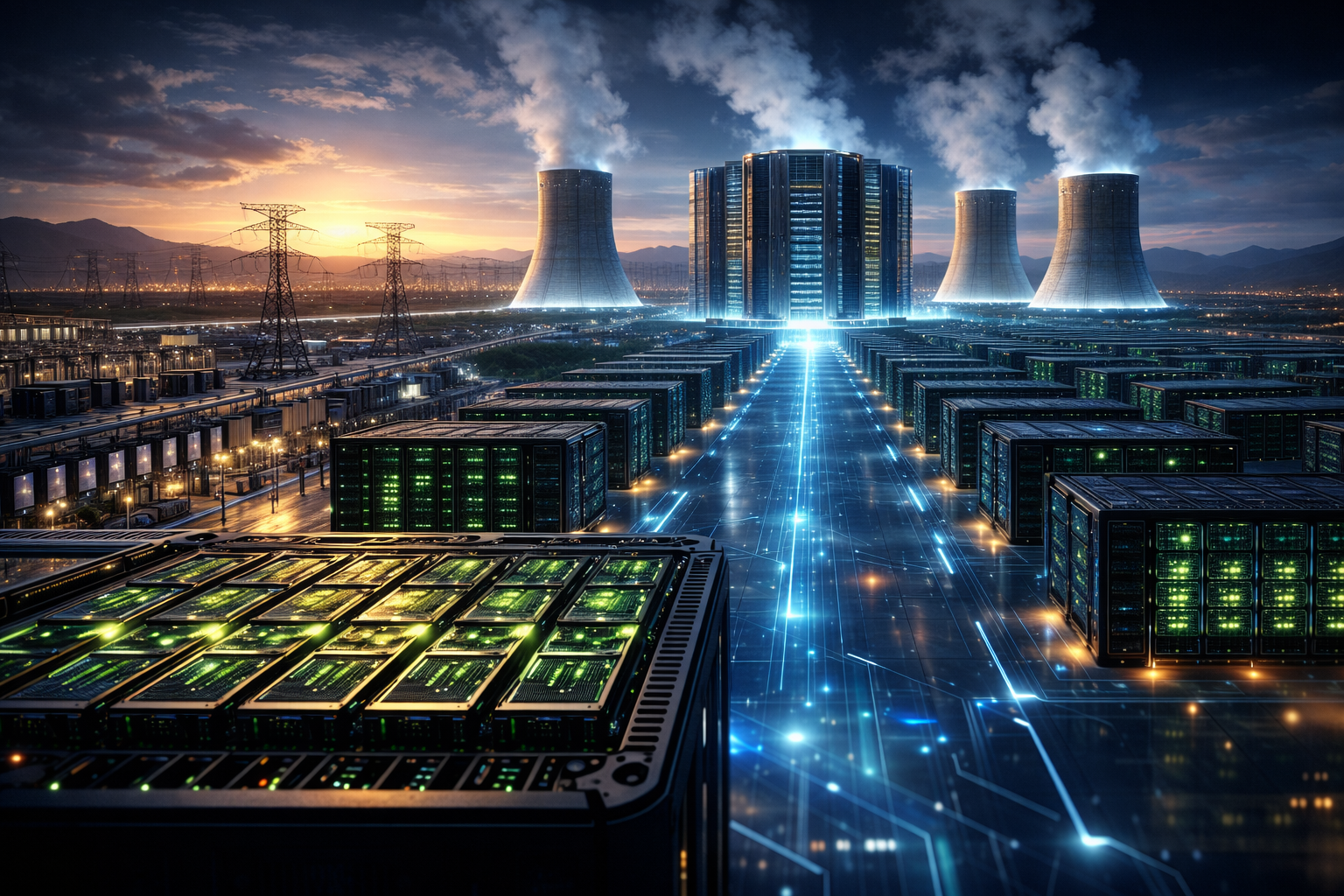
The artificial intelligence revolution is no longer just about algorithms or software breakthroughs—it’s about infrastructure. As generative AI adoption accelerates across industries, technology giants and investors are pouring tens of billions of dollars into building the physical backbone of the AI economy: massive data centers designed specifically for artificial intelligence workloads.
From Silicon Valley to Europe and Asia, hyperscale cloud providers are racing to construct AI-ready data centers equipped with powerful GPUs, advanced cooling systems, and enormous electricity capacity. According to recent reporting from S&P Global Market Intelligence and Bloomberg, global spending on AI-focused data centers has surged dramatically as companies prepare for the next wave of AI-driven applications.
For investors, the implications are profound. The AI boom is expanding far beyond chipmakers and software developers, creating opportunities across an entire ecosystem of infrastructure providers—including power utilities, cooling technology firms, semiconductor packaging companies, and data center real estate investment trusts (REITs).
In short, the race to build AI infrastructure could become one of the most lucrative investment trends of the decade.
The Infrastructure Behind the AI Revolution
The rapid rise of generative AI tools—from AI copilots to autonomous agents—has dramatically increased demand for computing power.
Training modern AI models requires enormous processing capacity and energy resources. Large language models and advanced AI systems often run on tens of thousands of high-performance GPUs, consuming significant amounts of electricity and generating substantial heat.
As a result, companies deploying AI solutions must build or access specialized infrastructure capable of handling these intense workloads.
This has triggered a global buildout of AI-focused data centers, with major cloud providers including:
- Microsoft
- Alphabet
- Amazon
investing heavily in next-generation computing facilities.
These companies are competing to provide AI infrastructure to enterprises developing advanced applications in sectors such as healthcare, finance, manufacturing, and autonomous systems.
The scale of these investments is staggering. According to industry analysts, hyperscalers could spend hundreds of billions of dollars over the next decade to expand their AI infrastructure capabilities.
Why AI Data Centers Are Different
Traditional cloud data centers were designed primarily for storage and general computing tasks. AI workloads, however, require an entirely different type of architecture.
AI data centers must be built to support:
Massive GPU clusters
High-performance processors from companies such as Nvidia and Advanced Micro Devices are essential for training and running AI models.
Advanced cooling systems
AI servers generate enormous heat, requiring innovative cooling technologies including liquid cooling systems and advanced thermal management.
High-speed networking
AI models require extremely fast data transfers between thousands of processors.
Extreme power capacity
Large AI facilities often require hundreds of megawatts of electricity—equivalent to powering tens of thousands of homes.
Because of these requirements, AI data centers are becoming some of the most complex infrastructure projects in the technology industry.
The Global Race for AI Compute Power
Governments and corporations around the world are recognizing that access to AI computing power will be a strategic advantage in the coming decades.
Countries including the United States, Canada, and members of the European Union are investing heavily in AI infrastructure to ensure domestic access to advanced computing resources.
Private companies are also aggressively expanding their infrastructure footprints.
Cloud providers are building massive data center campuses in regions where power availability, land, and cooling resources can support large-scale AI operations. Popular locations include Texas, Virginia, Quebec, and Northern Europe due to favorable energy infrastructure.
According to Bloomberg Intelligence, global data center spending could surpass $1 trillion by the early 2030s, with AI workloads representing one of the fastest-growing segments.
This surge in infrastructure investment reflects a fundamental reality: AI cannot scale without massive physical computing resources.
Why This Matters for Investors
While much of the AI investment conversation has focused on semiconductor leaders such as Nvidia, the infrastructure supporting AI workloads represents an equally compelling investment opportunity.
The AI ecosystem extends across a wide supply chain that includes multiple industries.
Power and Energy Providers
AI data centers consume enormous amounts of electricity. As the number of facilities grows, demand for reliable energy sources is expected to rise significantly.
Utilities and renewable energy developers could benefit from the increasing power requirements of AI infrastructure.
Cooling Technology Companies
Managing heat generated by AI processors is becoming a major engineering challenge.
Companies specializing in advanced cooling technologies—including liquid cooling systems—may experience strong demand as AI data centers scale globally.
Semiconductor Packaging and Equipment Firms
AI chips require sophisticated manufacturing processes and packaging technologies.
Companies providing semiconductor equipment and advanced chip packaging solutions may see increased demand as GPU production accelerates.
Data Center REITs
Real estate investment trusts that specialize in data center facilities are also positioned to benefit from the AI boom.
Some prominent operators include:
- Digital Realty
- Equinix
These companies lease space to cloud providers and technology firms, generating recurring revenue from long-term infrastructure demand.
The Energy Challenge of AI
One of the biggest obstacles to AI expansion is energy availability.
AI data centers require far more electricity than traditional computing facilities, and the global power grid may need significant upgrades to support future demand.
According to research cited by Bloomberg and S&P Global, AI-related data center growth could dramatically increase electricity consumption in major technology hubs over the next decade.
This challenge is driving innovation in several areas:
- Renewable energy integration
- Nuclear energy investments
- Grid modernization technologies
- Energy-efficient computing systems
Companies that can help solve these energy challenges may become critical players in the AI infrastructure ecosystem.
Future Trends to Watch
The AI data center boom is still in its early stages. Several trends could shape how the infrastructure landscape evolves in the coming years.
Specialized AI Data Centers
New facilities are being designed specifically for AI workloads rather than general cloud computing.
These centers prioritize GPU density, advanced cooling, and ultra-fast networking.
Regional AI Infrastructure Hubs
Governments are increasingly supporting domestic AI infrastructure development to strengthen technological sovereignty.
This could lead to the emergence of regional AI computing hubs around the world.
Edge AI Computing
While large centralized data centers will remain critical, smaller distributed facilities may emerge to support real-time AI applications closer to end users.
Sustainable AI Infrastructure
Environmental concerns are pushing companies to develop more energy-efficient data centers powered by renewable energy sources.
Key Investment Insight
For investors, the rapid expansion of AI data centers represents one of the most important structural shifts in the technology industry.
The opportunity extends well beyond AI software companies and semiconductor manufacturers.
Instead, the broader AI infrastructure supply chain—including power providers, cooling technology companies, semiconductor equipment firms, and data center REITs—could capture significant value as global computing capacity expands.
Investors looking to capitalize on the AI boom may want to monitor companies involved in building and operating the physical backbone of artificial intelligence.
As AI adoption accelerates across industries, demand for computing infrastructure is likely to grow for years to come.
The AI revolution is rapidly transforming global technology markets, and the infrastructure powering that transformation is becoming a major investment theme.
Stay informed with MoneyNews.Today for daily insights into the industries, technologies, and global trends shaping the future of investing.




