
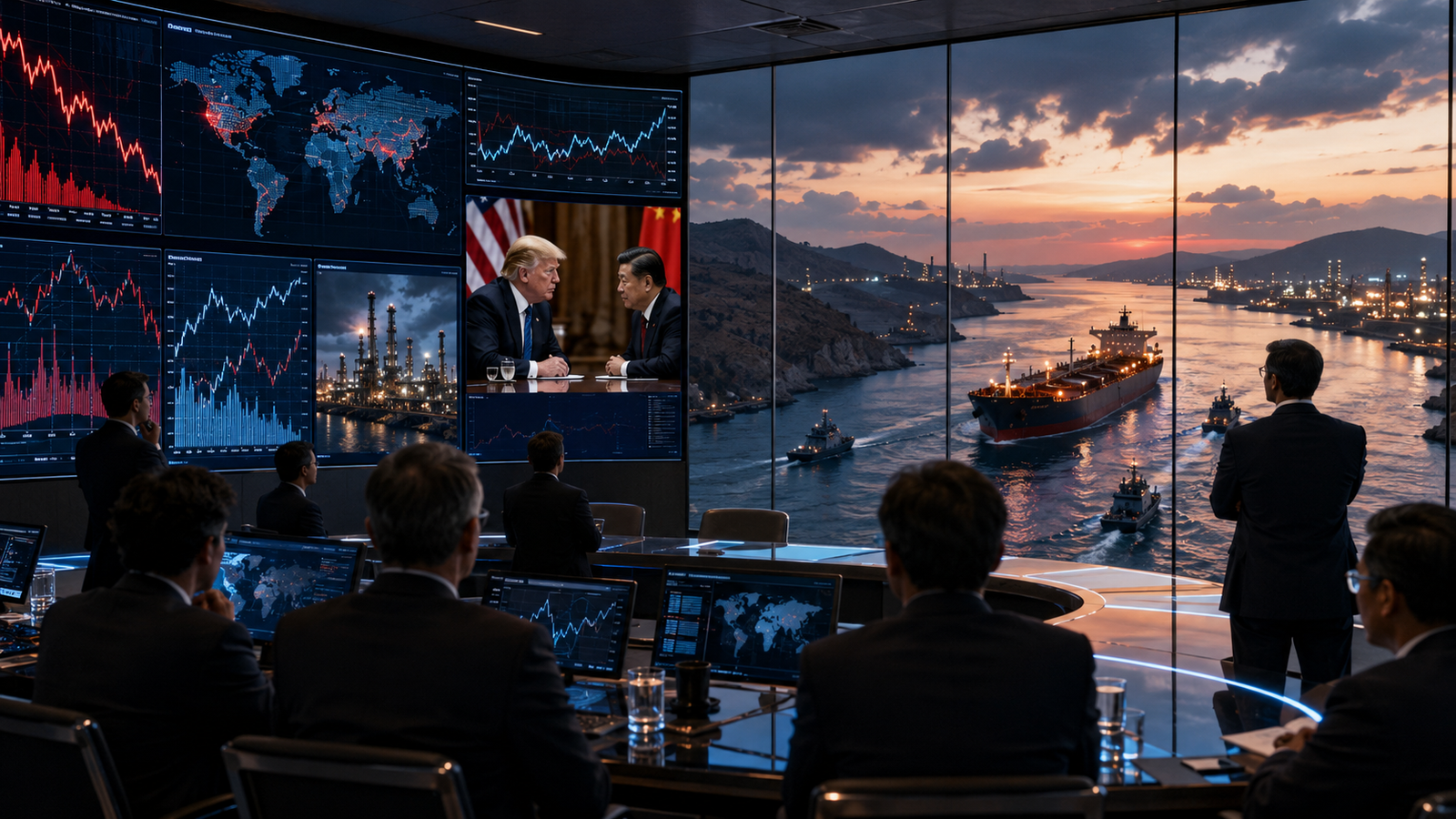
Global markets are entering a new era where geopolitics may once again matter as much as corporate earnings and central bank policy.
Investors hoping for a breakthrough in high-level talks between U.S. President Donald Trump and Chinese President Xi Jinping were left disappointed this week after negotiations produced limited signs of meaningful progress on trade, technology restrictions, and economic cooperation. At the same time, escalating tensions in the Middle East — particularly concerns surrounding energy security and shipping routes near the Strait of Hormuz — added another layer of uncertainty to already fragile global markets.
The combined effect sent equities lower, pushed oil prices higher, and intensified concerns that inflationary pressures could remain elevated longer than expected. According to Reuters geopolitical market analysis and recent Wall Street Journal coverage, investors are increasingly recognizing that geopolitical risk is no longer a secondary market concern — it is rapidly becoming one of the defining forces shaping investment strategy in 2026.
For investors, this shift carries major implications across sectors ranging from semiconductors and artificial intelligence to energy, defense, commodities, and international trade-sensitive industries.
The global economy is once again being shaped not only by economic fundamentals, but also by political power struggles, strategic alliances, and geopolitical uncertainty.
U.S.-China Relations Remain a Major Market Risk
The relationship between the United States and China continues to represent one of the most significant long-term risks for global investors.
While markets had hoped recent Trump-Xi discussions might ease trade tensions and reduce uncertainty surrounding tariffs and technology restrictions, the lack of substantial progress reinforced concerns that strategic competition between the world’s two largest economies is becoming increasingly entrenched.
Trade disputes between Washington and Beijing are no longer limited to tariffs on consumer goods. The rivalry now extends deeply into artificial intelligence, semiconductors, advanced manufacturing, cybersecurity, clean energy technologies, and critical mineral supply chains.
This shift has enormous implications for global markets.
Technology companies remain particularly vulnerable because many of the world’s largest semiconductor and electronics supply chains depend heavily on Chinese manufacturing and Asian trade networks. Export restrictions, sanctions, or tighter regulations surrounding advanced AI chips could significantly impact revenues and long-term growth projections for major U.S. technology firms.
Companies tied to cloud computing, artificial intelligence infrastructure, and semiconductor manufacturing are now operating within an increasingly politicized environment.
For investors, this means geopolitical developments can rapidly influence market valuations even when company fundamentals remain strong.
Semiconductors Are at the Center of the Global Power Struggle
Few industries illustrate the geopolitical stakes more clearly than semiconductors.
The semiconductor sector has become strategically vital because advanced chips power everything from AI systems and cloud infrastructure to defense technology and consumer electronics. Governments worldwide increasingly view semiconductor independence as a national security priority.
The United States continues pushing policies aimed at strengthening domestic semiconductor manufacturing while limiting China’s access to cutting-edge AI chips and advanced computing technologies. China, meanwhile, is accelerating efforts to build its own independent semiconductor ecosystem.
This geopolitical competition is creating both risks and opportunities for investors.
On one hand, export controls and trade restrictions create uncertainty for chipmakers that rely heavily on international sales. On the other hand, government-backed investments in domestic manufacturing are fueling enormous capital spending cycles that could benefit equipment makers, industrial automation firms, and infrastructure providers.
The result is a market environment where political decisions increasingly influence semiconductor valuations alongside earnings reports and product demand.
Investors should expect semiconductor policy announcements to remain major market-moving catalysts throughout 2026.
Middle East Tensions Are Reigniting Energy Market Fears
At the same time U.S.-China tensions are weighing on investor sentiment, rising instability in the Middle East is amplifying concerns surrounding global energy security.
The Strait of Hormuz remains one of the world’s most important energy transit routes, handling a substantial portion of global oil shipments. Any threat to shipping activity in the region can quickly send oil prices sharply higher.
Recent geopolitical developments have already triggered significant moves in energy markets, with crude oil prices rising as traders price in potential supply disruptions.
This matters far beyond the energy sector itself.
Higher oil prices increase transportation costs, manufacturing expenses, and inflation pressures across the global economy. They also complicate central bank efforts to stabilize prices and reduce inflation.
According to Reuters and Wall Street Journal market reports, investors are increasingly worried that sustained energy price increases could force the Federal Reserve and other central banks to maintain restrictive monetary policy longer than expected.
That creates pressure on equities, particularly high-growth sectors that depend heavily on future earnings expectations.
Inflation Is Once Again Becoming a Market Driver
One of the most important consequences of rising geopolitical tension is its effect on inflation expectations.
Markets entered 2026 believing inflation pressures were gradually easing after years of aggressive central bank tightening. However, higher energy prices and renewed supply chain uncertainty are challenging that narrative.
If oil prices remain elevated due to geopolitical instability, inflation could become more persistent across transportation, logistics, manufacturing, and consumer goods sectors.
This has already begun influencing bond markets.
U.S. Treasury yields have climbed in recent weeks as investors reassess expectations for future Federal Reserve rate cuts. Rising yields create additional pressure on growth-oriented assets such as technology and AI stocks, which have led the market rally over the past year.
For investors, this creates a difficult balancing act:
- AI and technology remain powerful long-term growth themes.
- But higher inflation and rising yields reduce support for premium valuations.
This dynamic could increase market volatility significantly in the months ahead.
Defense and Energy Stocks Are Regaining Investor Attention
As geopolitical risks intensify, sectors tied directly to national security and energy infrastructure are beginning to attract renewed investor interest.
Defense contractors may benefit from rising global military spending as governments respond to growing geopolitical instability. Increased defense budgets often support demand for aerospace systems, cybersecurity infrastructure, missile defense technologies, and advanced communications systems.
Energy companies are also regaining momentum as oil prices rise.
Integrated oil majors, exploration and production firms, and energy infrastructure companies could benefit if geopolitical tensions continue supporting higher crude prices. At the same time, energy volatility may create opportunities within commodities and alternative energy sectors.
However, investors should recognize that geopolitical rallies can reverse quickly if diplomatic conditions improve.
The current environment rewards flexibility and disciplined risk management.
Why This Matters for Investors
The biggest market takeaway from recent events is that geopolitics is no longer a background issue for investors — it is becoming a central driver of global asset prices.
Political negotiations, trade restrictions, military tensions, and energy security concerns are increasingly influencing inflation, interest rates, supply chains, and corporate profitability.
This environment creates heightened uncertainty, but it also reshapes investment opportunities.
Sectors connected to strategic national priorities — including semiconductors, artificial intelligence infrastructure, energy security, cybersecurity, commodities, and defense technology — are likely to remain highly sensitive to geopolitical developments.
Meanwhile, companies with diversified supply chains, strong domestic manufacturing capabilities, and resilient balance sheets may prove more attractive during periods of elevated global uncertainty.
Investors should also expect increased volatility across international markets, currencies, commodities, and trade-sensitive equities as geopolitical developments evolve.
Future Trends Investors Should Watch
Several major themes are likely to dominate investor attention through the remainder of 2026:
1. U.S.-China Trade Policy
Any escalation involving tariffs, export controls, or semiconductor restrictions could significantly impact global technology markets.
2. Oil Market Volatility
Energy prices remain highly sensitive to Middle East developments and shipping disruptions near key trade routes.
3. Federal Reserve Policy
Persistent inflation tied to energy prices could delay potential rate cuts and pressure growth-stock valuations.
4. Defense Spending
Rising geopolitical instability may continue supporting defense-sector investment and government contracts.
5. Supply Chain Realignment
Companies accelerating reshoring or supply chain diversification efforts may gain long-term strategic advantages.
Key Investment Insight
Geopolitics is rapidly re-emerging as one of the most important variables influencing global markets in 2026. Investors should prepare for heightened volatility across energy, semiconductors, commodities, defense, and trade-sensitive industries as U.S.-China relations and Middle East tensions continue evolving.
Monitoring oil prices, Treasury yields, inflation data, and geopolitical negotiations will become increasingly important for portfolio positioning. Investors may benefit from maintaining diversified exposure while focusing on companies with resilient supply chains, strong pricing power, and strategic importance in critical industries.
The market environment is shifting from one dominated purely by economic growth and AI enthusiasm to one increasingly shaped by global political risk — and that transition could redefine investment leadership in the months ahead.
Stay with MoneyNews.Today for more daily investor insights, geopolitical market analysis, and breaking financial news shaping global markets.




