
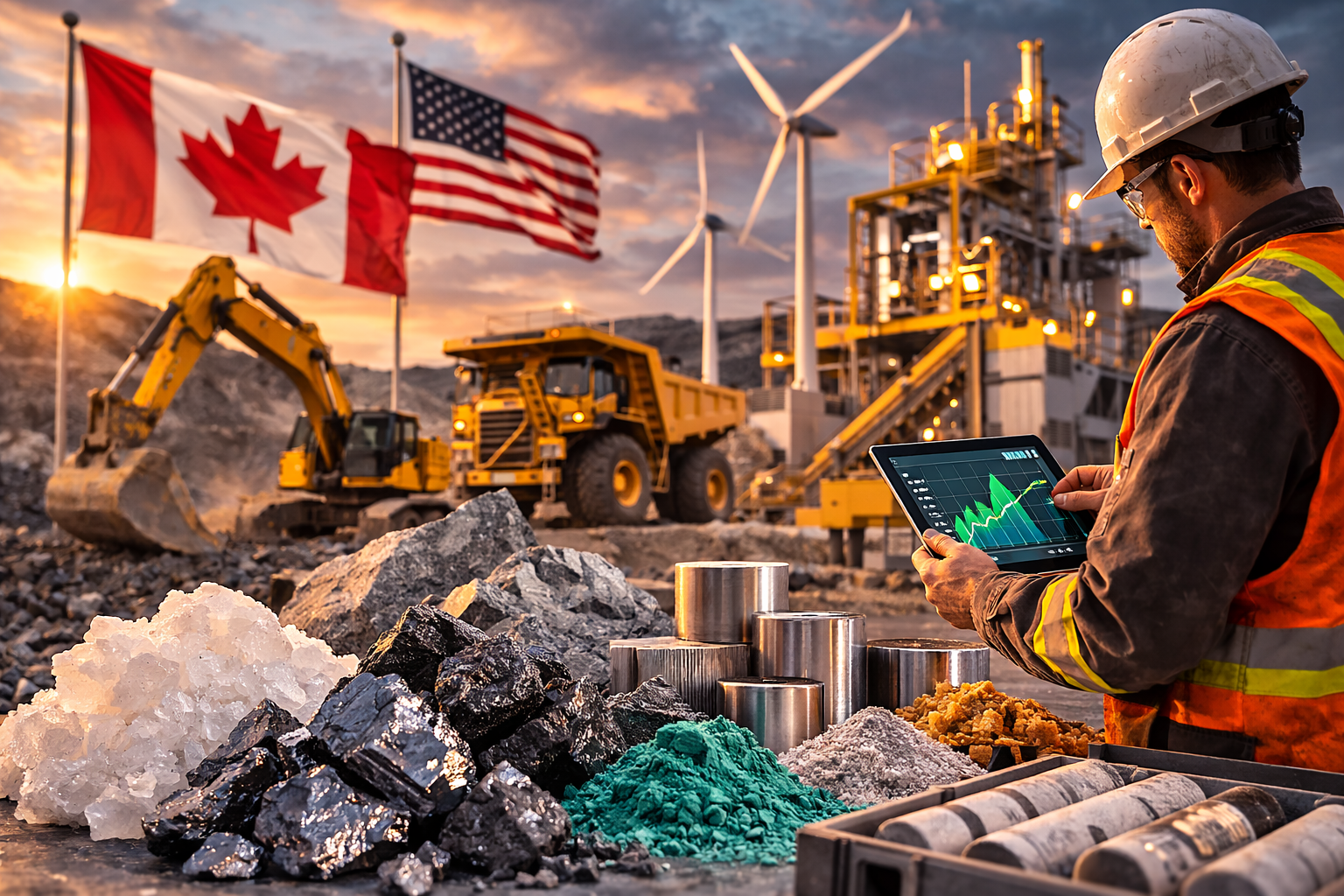
The global race for critical minerals is accelerating—and for investors, it may become one of the most important commodity stories of the decade.
Governments and industry leaders across the United States and Canada are intensifying efforts to reshore and secure supply chains for strategic minerals including lithium, rare earth elements, and titanium. These materials are essential components of the technologies shaping the modern economy, from electric vehicles and renewable energy systems to advanced semiconductors and defense equipment.
According to Reuters and multiple industry reports, policymakers are increasingly concerned about the concentration of global mineral processing and mining capacity in a small number of countries. As a result, both Washington and Ottawa are prioritizing domestic production and partnerships with allied nations to strengthen supply chains.
For investors, the shift signals a potential long-term opportunity in mining companies, strategic metals producers, and infrastructure projects tied to the emerging critical minerals economy.
Why Critical Minerals Matter More Than Ever
Critical minerals form the backbone of several fast-growing industries driving the global energy and technology transition.
Lithium, for example, is a key component in lithium-ion batteries used in electric vehicles and energy storage systems. Rare earth elements are essential for producing high-performance magnets used in wind turbines, electric motors, and defense technologies. Titanium plays a crucial role in aerospace manufacturing and military equipment due to its strength, durability, and resistance to corrosion.
As demand for these materials rises, governments are increasingly recognizing their strategic importance.
According to research cited by Bloomberg and McKinsey, global demand for several critical minerals could increase four to six times by 2040 as electrification, renewable energy adoption, and advanced manufacturing accelerate.
This surge in demand is already influencing government policy.
The United States has identified dozens of minerals as strategically important, while Canada has launched its own national strategy focused on expanding domestic production and refining capabilities.
The Supply Chain Challenge
Despite their importance, many critical minerals are produced and processed in highly concentrated supply chains.
For example, China currently dominates the processing of rare earth elements and several other key minerals. This concentration has raised concerns among Western policymakers about supply disruptions and geopolitical vulnerabilities.
In response, governments across North America are taking steps to diversify supply sources and strengthen domestic mining capabilities.
The United States has introduced several initiatives to support domestic mineral production, including funding programs and partnerships aimed at expanding mining and refining capacity.
Canada has also announced plans to invest billions of dollars in developing its critical minerals sector, recognizing the country’s vast geological resources.
These initiatives are designed to ensure stable supply chains for industries that depend on these materials—including electric vehicle manufacturing, aerospace production, and advanced electronics.
Mining Companies Positioned to Benefit
The renewed focus on critical minerals is creating opportunities for mining companies involved in strategic resource development.
Several major companies operating in North America are already active in this space, including:
- Albemarle Corporation – one of the world’s largest lithium producers
- MP Materials – a major rare earth mining and processing company in the United States
- Livent Corporation – a lithium technology company supplying battery manufacturers
Canada is also home to several mining firms focused on strategic minerals, including companies developing lithium and rare earth projects in provinces such as Quebec and Ontario.
These companies could benefit from increasing government support, including tax incentives, grants, and long-term supply agreements with manufacturers.
In many cases, policymakers view domestic mining projects as critical components of national security and economic strategy.
The Role of Clean Energy and EV Demand
One of the biggest drivers behind the surge in demand for critical minerals is the rapid expansion of electric vehicles and renewable energy infrastructure.
Electric vehicles require significantly more minerals than traditional internal combustion engine vehicles. Lithium, nickel, cobalt, and graphite are all essential components of EV batteries.
According to the International Energy Agency, global EV sales are expected to continue growing rapidly as governments implement stricter emissions regulations and consumers shift toward electric mobility.
At the same time, renewable energy technologies such as wind turbines and solar panels rely heavily on critical minerals.
Wind turbines, for example, often use rare earth magnets in their generators to maximize efficiency and performance.
As countries accelerate the transition toward cleaner energy systems, the demand for these materials is likely to increase dramatically.
Defense and Aerospace Add Another Layer of Demand
Beyond clean energy and electric vehicles, critical minerals are also essential to the defense and aerospace sectors.
Materials such as titanium and rare earth elements are used in military aircraft, missile systems, satellites, and other advanced technologies.
Governments increasingly view access to these materials as a strategic issue tied directly to national security.
In the United States, policymakers have highlighted the importance of ensuring reliable supplies of critical minerals for defense manufacturing.
Canada has similarly emphasized the role its mining sector can play in supporting allied supply chains.
This dual demand—from both clean energy technologies and defense industries—could further strengthen the long-term outlook for the critical minerals sector.
Future Trends to Watch
Several emerging trends could shape the evolution of the critical minerals market over the coming decade.
Expansion of Domestic Mining Projects
Governments are expected to accelerate approvals and funding for new mining projects aimed at reducing reliance on foreign suppliers.
Growth in Mineral Processing and Refining
Beyond mining, countries are investing in processing facilities capable of refining raw materials into usable components for manufacturing.
Strategic Partnerships Between Governments and Industry
Public-private partnerships may play a key role in developing new supply chains and infrastructure.
Recycling and Circular Supply Chains
Efforts to recover critical minerals from used electronics and batteries could become an increasingly important source of supply.
These developments could reshape global commodity markets and influence investment flows into the mining sector.
Key Investment Insight
The growing strategic importance of critical minerals suggests the sector could become one of the defining investment themes of the next decade.
As governments prioritize supply chain security and clean energy transitions accelerate, companies involved in mining and processing strategic metals may benefit from:
- Long-term government support
- Increased global demand
- Strategic partnerships with manufacturers and technology companies
Investors looking to gain exposure to the critical minerals boom may want to monitor companies operating in lithium, rare earth elements, and other strategic metals.
While commodity markets can be volatile, the structural demand drivers behind these materials—electric vehicles, renewable energy, and advanced technology manufacturing—are expected to remain strong for years to come.
The race to secure critical mineral supply chains is reshaping the global mining industry and redefining the strategic value of natural resources.
As governments and corporations compete to secure the materials needed for the technologies of the future, the companies producing those resources could become some of the most important players in the global economy.
For daily insights into the market forces shaping commodities, technology, and global investing, stay connected with MoneyNews.Today, your trusted source for investor-focused financial news.




