
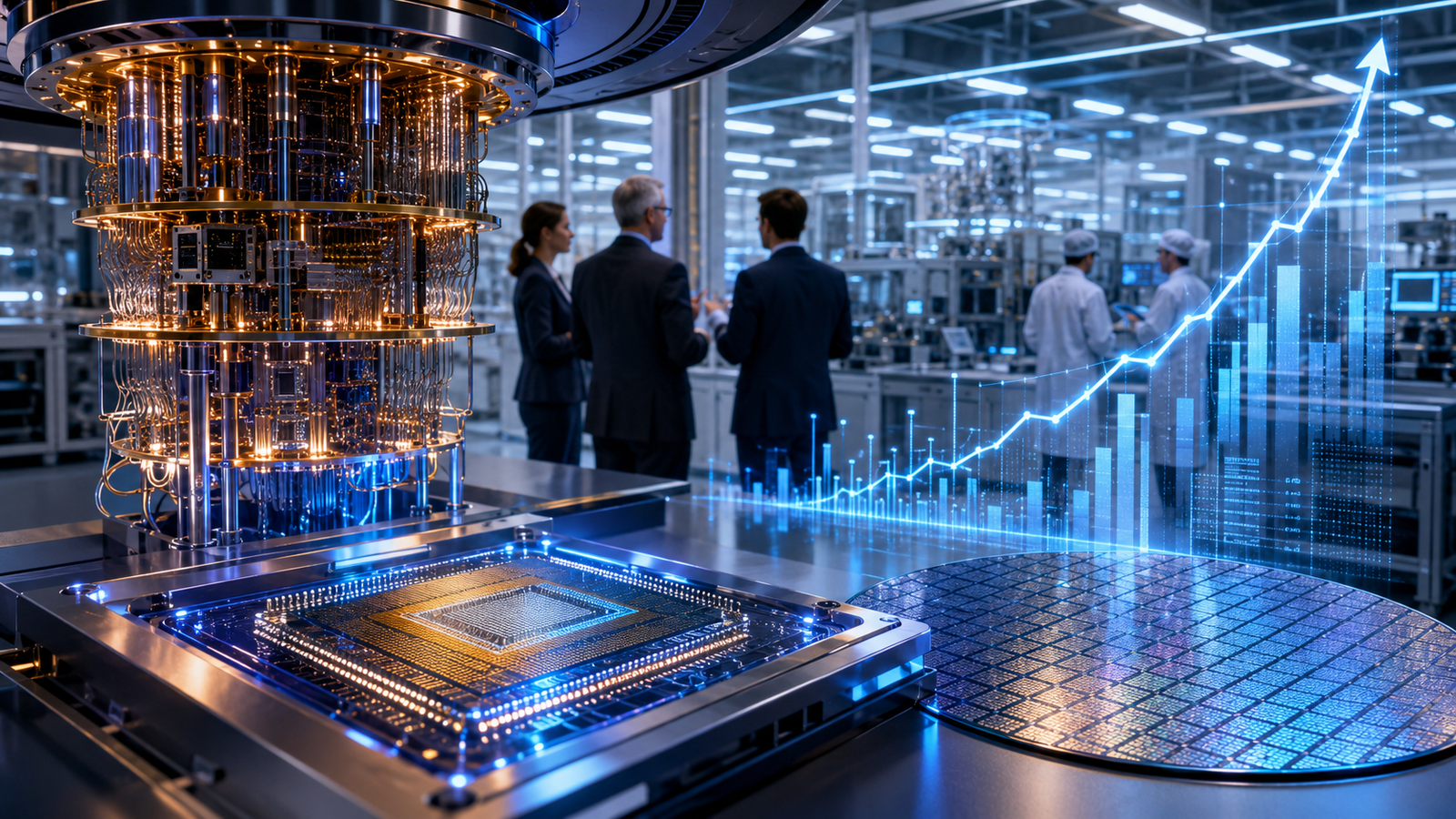
The next major technology investment wave after artificial intelligence may already be taking shape — and Wall Street is beginning to pay attention.
Quantum computing stocks surged this week after shareholders approved IonQ’s acquisition deal involving SkyWater Technology, a transaction valued at approximately $1.8 billion. The deal, first highlighted by TS2 Tech and widely discussed across investor communities and technology circles, represents far more than a routine corporate acquisition.
For investors, the move signals something bigger: quantum computing is rapidly evolving from a speculative research concept into a developing industrial ecosystem with growing commercial relevance.
The agreement strengthens IonQ’s semiconductor manufacturing capabilities while reinforcing investor confidence that the quantum computing industry is moving closer to scalable commercialization. It also reflects a broader market trend in which institutional investors are increasingly searching for the “next AI” — a transformational technology platform capable of reshaping industries over the coming decade.
That search is now putting quantum computing squarely in the spotlight.
Why Investors Are Suddenly Paying Attention to Quantum Computing
Quantum computing has long been viewed as one of the most promising — and misunderstood — emerging technologies in the world.
Unlike traditional computers that process information in binary bits, quantum computers use quantum bits, or qubits, which can exist in multiple states simultaneously. This capability theoretically allows quantum systems to solve highly complex problems dramatically faster than classical computers in areas such as materials science, cryptography, logistics, drug discovery, climate modeling, and artificial intelligence optimization.
For years, however, commercialization remained limited due to hardware instability, error correction challenges, and the enormous technical complexity required to scale quantum systems.
Now, investor sentiment is beginning to shift.
Several developments are driving renewed enthusiasm:
- Rapid advances in quantum hardware
- Increased government funding
- Rising enterprise experimentation
- Growing semiconductor integration
- The success of AI-related infrastructure investing
The IonQ-SkyWater deal arrives at a time when investors are actively looking beyond generative AI toward the next major computing platform capable of creating long-term economic disruption.
The transaction also reinforces a growing realization across markets: advanced computing technologies increasingly depend on semiconductor manufacturing control, specialized hardware ecosystems, and domestic supply-chain resilience.
Why the SkyWater Acquisition Matters
At first glance, the acquisition may appear niche compared to the multitrillion-dollar AI market dominating headlines. But investors are focusing on the strategic implications behind the deal.
SkyWater Technology operates as a U.S.-based semiconductor foundry specializing in advanced manufacturing, defense-related applications, and customized chip development. By deepening ties with semiconductor production capabilities, IonQ gains a stronger foundation for scaling quantum hardware development domestically.
That matters because quantum computing is not purely a software story.
The sector depends heavily on highly specialized manufacturing processes, photonic systems, cryogenic technologies, advanced materials, and precision semiconductor engineering. As competition intensifies globally, control over hardware infrastructure may become one of the defining competitive advantages in quantum development.
The acquisition also aligns with broader U.S. industrial policy trends emphasizing domestic technology manufacturing and strategic independence from overseas semiconductor supply chains.
Governments worldwide increasingly view quantum technology as strategically important for national security, cybersecurity, defense, and economic competitiveness.
According to McKinsey & Company, quantum computing could create up to $1.3 trillion in economic value by 2035 across industries including pharmaceuticals, financial services, chemicals, logistics, and energy.
That long-term opportunity is helping attract growing institutional attention despite the sector’s elevated risk profile.
The “Next AI” Narrative Is Fueling Speculation
One reason quantum computing stocks are experiencing sharp moves is the growing comparison to the early stages of the AI boom.
Over the last several years, investors watched companies tied to artificial intelligence infrastructure — including semiconductors, cloud computing, and networking hardware — generate enormous returns as AI adoption accelerated globally.
Now, speculative capital is increasingly flowing toward emerging technologies perceived as having similar transformative potential.
Quantum computing sits near the top of that list.
Social media discussions, hedge fund commentary, and retail investor forums are increasingly framing quantum computing as the next frontier after generative AI. That narrative has helped drive elevated trading activity across quantum-related equities, particularly companies involved in hardware systems, photonics, quantum networking, and specialized semiconductor manufacturing.
Still, investors should recognize a critical distinction: quantum computing remains significantly earlier in its commercialization cycle than AI.
Many quantum firms continue operating with limited revenue, high research costs, and long timelines before achieving widespread enterprise adoption. Volatility remains extremely high across the sector, and speculative momentum can shift rapidly.
However, history shows that markets often reward infrastructure leaders early during transformational technological shifts.
That is one reason investors are increasingly monitoring companies building the foundational layers of the quantum ecosystem rather than purely focusing on end-user applications.
Governments and Institutions Are Increasingly Involved
Institutional and government support for quantum computing continues growing rapidly.
The United States, China, the European Union, Canada, and several Middle Eastern nations have all significantly increased funding tied to quantum research and advanced computing initiatives.
The U.S. National Quantum Initiative, initially launched to accelerate domestic quantum development, has already directed billions toward research partnerships, university programs, and private-sector collaboration. Defense agencies and intelligence organizations are also heavily investing in quantum capabilities due to the technology’s long-term cybersecurity implications.
Meanwhile, major corporations including IBM, Google, Microsoft, Amazon, and Nvidia continue expanding their quantum computing initiatives and cloud-access quantum platforms.
This institutional involvement matters for investors because it validates the sector’s long-term strategic importance.
The market is increasingly recognizing that quantum computing may evolve similarly to the early internet or cloud computing eras — beginning with heavy infrastructure investment before eventually scaling into broader commercial adoption.
Semiconductor Infrastructure Could Become a Major Winner
One of the most important takeaways from the IonQ-SkyWater transaction is the growing importance of semiconductor infrastructure within the quantum economy.
Quantum systems require highly advanced fabrication, materials engineering, and specialized manufacturing capabilities. As a result, semiconductor firms positioned around advanced packaging, photonics, cryogenics, and precision chip design could become major long-term beneficiaries of quantum development.
This theme overlaps heavily with broader AI infrastructure investing.
The same market forces driving investment into GPUs, advanced memory, networking hardware, and hyperscale data centers are increasingly spilling into adjacent advanced computing technologies.
Investors are beginning to view quantum computing not as a standalone speculative category, but as part of a larger advanced infrastructure transformation involving AI, semiconductors, cloud systems, cybersecurity, and next-generation computing architectures.
That convergence may create significant opportunities over the next decade.
Risks Investors Should Watch
Despite the excitement, quantum investing carries substantial risks.
Commercial timelines remain uncertain, technical hurdles remain significant, and many companies in the space continue operating without sustainable profitability. Valuations can also become detached from near-term fundamentals during periods of speculative enthusiasm.
Competition is another major factor.
Large technology companies with extensive financial resources may ultimately dominate portions of the quantum market, potentially pressuring smaller standalone firms.
Investors should also monitor regulatory developments, export restrictions, and geopolitical competition surrounding advanced semiconductor technologies and quantum research.
Nonetheless, the broader direction of capital flows suggests institutional interest in the sector is steadily increasing.
Key Investment Insight
The IonQ-SkyWater deal highlights a major shift occurring across financial markets: investors are beginning to treat quantum computing as a serious long-term infrastructure opportunity rather than a distant experimental technology.
While volatility is likely to remain elevated, institutional capital is increasingly flowing toward companies building the hardware, semiconductor, photonics, and infrastructure layers supporting next-generation computing systems.
For investors, the most important opportunities may emerge not only from quantum software leaders, but from the broader ecosystem enabling commercialization — including semiconductor manufacturing, advanced materials, networking infrastructure, and specialized computing hardware.
The AI boom demonstrated how transformative technologies can rapidly reshape entire industries. Quantum computing may still be early, but the market is already beginning to position for what could become the next major technological investment cycle.
Stay with MoneyNews.Today for more daily investor insights covering emerging industries, AI, technology, crypto, commodities, and the trends shaping the future of global investing.




