
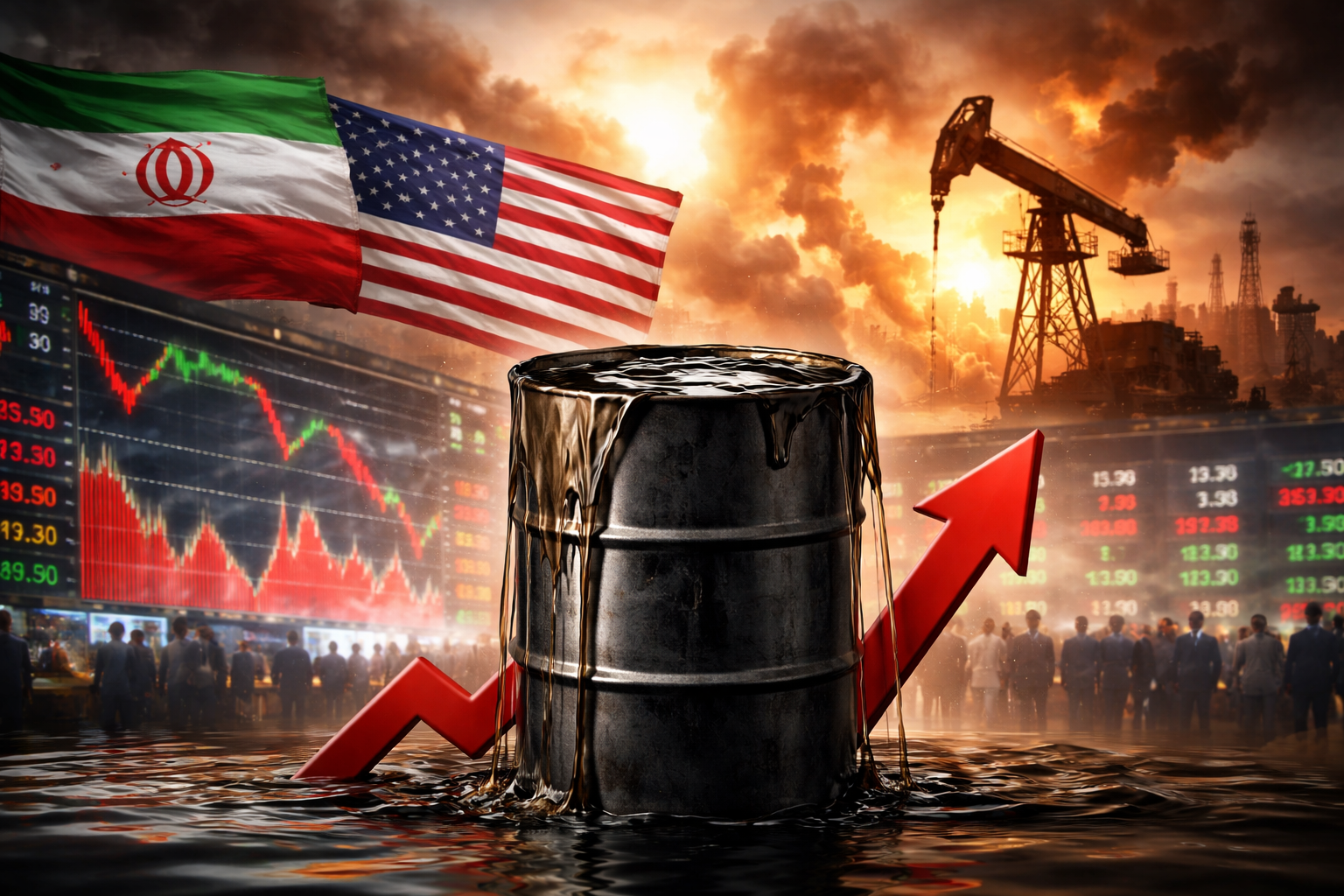
Global financial markets are once again being driven not by earnings reports or economic data—but by geopolitics. A sharp escalation in tensions between the United States and Iran has sent oil prices surging above $110 per barrel, triggering a cascade of reactions across equities, commodities, and currencies. For investors, the message is clear: volatility is back, and macro risks are firmly in the driver’s seat.
From Wall Street to global exchanges, markets have swung between steep losses and sudden rebounds, reflecting how quickly sentiment can shift on every headline. As reported by The Guardian’s live markets coverage, diplomatic signals have briefly eased fears, but underlying tensions remain unresolved—keeping markets on edge.
Oil Shock Reignites Inflation Concerns
At the heart of this market turbulence is energy. Crude oil’s surge above $110 is not just a commodity story—it’s a macroeconomic shock with far-reaching implications.
Historically, oil spikes of this magnitude have acted as a tax on global growth. Higher energy prices feed directly into transportation, manufacturing, and consumer goods, pushing inflation higher across the board. This comes at a particularly fragile moment, when central banks—especially the Federal Reserve—have been attempting to bring inflation under control.
According to recent market commentary and coverage from The Guardian, traders are increasingly pricing in a “higher-for-longer” interest rate environment as energy-driven inflation risks re-emerge. That shift is critical. Just weeks ago, markets were anticipating potential rate cuts in 2026. Now, those expectations are being pushed further out.
The implications are immediate:
- Bond yields are stabilizing at elevated levels
- Equity valuations—especially in growth sectors—are under pressure
- Risk assets, including cryptocurrencies, are showing renewed sensitivity
This is not just a short-term reaction. Energy-driven inflation has historically been one of the most persistent forms, making it particularly challenging for policymakers to counter without aggressive tightening.
Why Markets Are Whipsawing
The extreme volatility seen across global markets is a direct result of conflicting forces:
1. Geopolitical Risk vs. Diplomatic Signals
Markets initially sold off sharply on fears of escalation between the U.S. and Iran, with investors rushing toward safe-haven assets like the U.S. dollar. However, reports of delayed military action and ongoing diplomatic efforts triggered rapid rebounds.
This push-and-pull dynamic is creating intraday swings that are difficult to predict and even harder to navigate.
2. Oil Prices vs. Growth Expectations
While higher oil prices benefit energy producers, they simultaneously act as a drag on broader economic growth. This creates a divergence within equity markets:
- Energy stocks outperform
- Consumer discretionary and industrials lag
- Technology and growth stocks face valuation pressure
3. Interest Rate Uncertainty
Perhaps the most critical factor is the shifting outlook for interest rates. The Federal Reserve’s policy path is becoming increasingly uncertain as inflation risks resurface.
As highlighted in broader financial commentary across major outlets, including Reuters and Bloomberg, markets are now recalibrating expectations:
- Fewer rate cuts in 2026
- Potential for prolonged restrictive policy
- Increased sensitivity to inflation data
This uncertainty is amplifying volatility across asset classes.
Sector-Level Impact: Winners and Losers
Understanding how different sectors respond to this environment is key for investors looking to position effectively.
Energy: The Clear Winner
Energy companies are the most immediate beneficiaries of rising oil prices. Higher crude prices translate directly into improved margins and cash flow for producers.
This has led to renewed interest in:
- Oil & gas majors
- Exploration and production firms
- Energy infrastructure companies
If oil remains elevated, the sector could continue to outperform in the near term.
Technology & Growth Stocks: Under Pressure
Growth stocks, particularly in the technology sector, are highly sensitive to interest rates. As rate cut expectations are pushed further out, the present value of future earnings declines—putting pressure on valuations.
Companies with:
- High capital expenditure
- Long-term revenue projections
- Heavy reliance on cheap financing
are particularly vulnerable in this environment.
Consumer & Industrials: Caught in the Middle
Rising energy costs increase input expenses for manufacturers and reduce disposable income for consumers. This creates a challenging backdrop for sectors reliant on economic growth and consumer spending.
Retail, travel, and logistics companies may face margin compression if oil prices remain elevated.
Safe Havens: Mixed Signals
Interestingly, traditional safe havens like gold have not rallied as strongly as expected. According to recent Reuters coverage, a stronger U.S. dollar—driven by risk aversion—has limited gold’s upside.
This highlights a key shift in market dynamics:
- The U.S. dollar is currently the dominant safe haven
- Gold’s performance is being offset by currency strength
The Bigger Picture: A Market Driven by Macro
The current environment underscores a broader trend: markets are increasingly being driven by macroeconomic and geopolitical forces rather than company-specific fundamentals.
This shift has several implications:
- Earnings season may have less impact on short-term market direction
- Headline risk is elevated, requiring constant monitoring
- Correlations between asset classes are strengthening
For investors, this means traditional strategies based purely on fundamentals may need to be adjusted to account for macro risks.
Future Trends to Watch
1. Trajectory of U.S.–Iran Relations
The single most important variable is how tensions between the U.S. and Iran evolve. Any escalation could push oil prices even higher, while diplomatic breakthroughs could trigger rapid market relief rallies.
2. Federal Reserve Policy Signals
Investors should closely monitor Federal Reserve communications and inflation data. Any indication that rate cuts are being delayed further could weigh heavily on equities.
3. Oil Price Stability
Sustained oil prices above $100 could have long-term implications for inflation and economic growth. Conversely, a pullback could ease pressure on markets.
4. Market Volatility Trends
Expect volatility to remain elevated in the near term. The VIX and other volatility indicators are likely to reflect ongoing uncertainty.
Key Investment Insight
This is a market where macro awareness is just as important as stock selection.
Investors should consider:
- Increasing exposure to energy and commodity-linked assets as a hedge against inflation
- Reducing sensitivity to high-duration growth stocks that are vulnerable to rising rates
- Maintaining liquidity to take advantage of volatility-driven opportunities
- Diversifying across asset classes to manage geopolitical risk
Most importantly, investors should avoid overreacting to short-term market swings while staying prepared for continued volatility.
Staying Ahead in a Volatile Market
The resurgence of geopolitical risk as a primary market driver is a reminder that investing is as much about navigating uncertainty as it is about identifying opportunity. As oil prices surge and rate expectations shift, the path forward for markets will likely remain uneven.
For investors, the ability to interpret macro signals and adapt strategies accordingly will be critical in the weeks ahead.
Stay informed with MoneyNews.Today for daily, data-driven insights that help you cut through the noise and make smarter investment decisions in an increasingly complex market landscape.




