
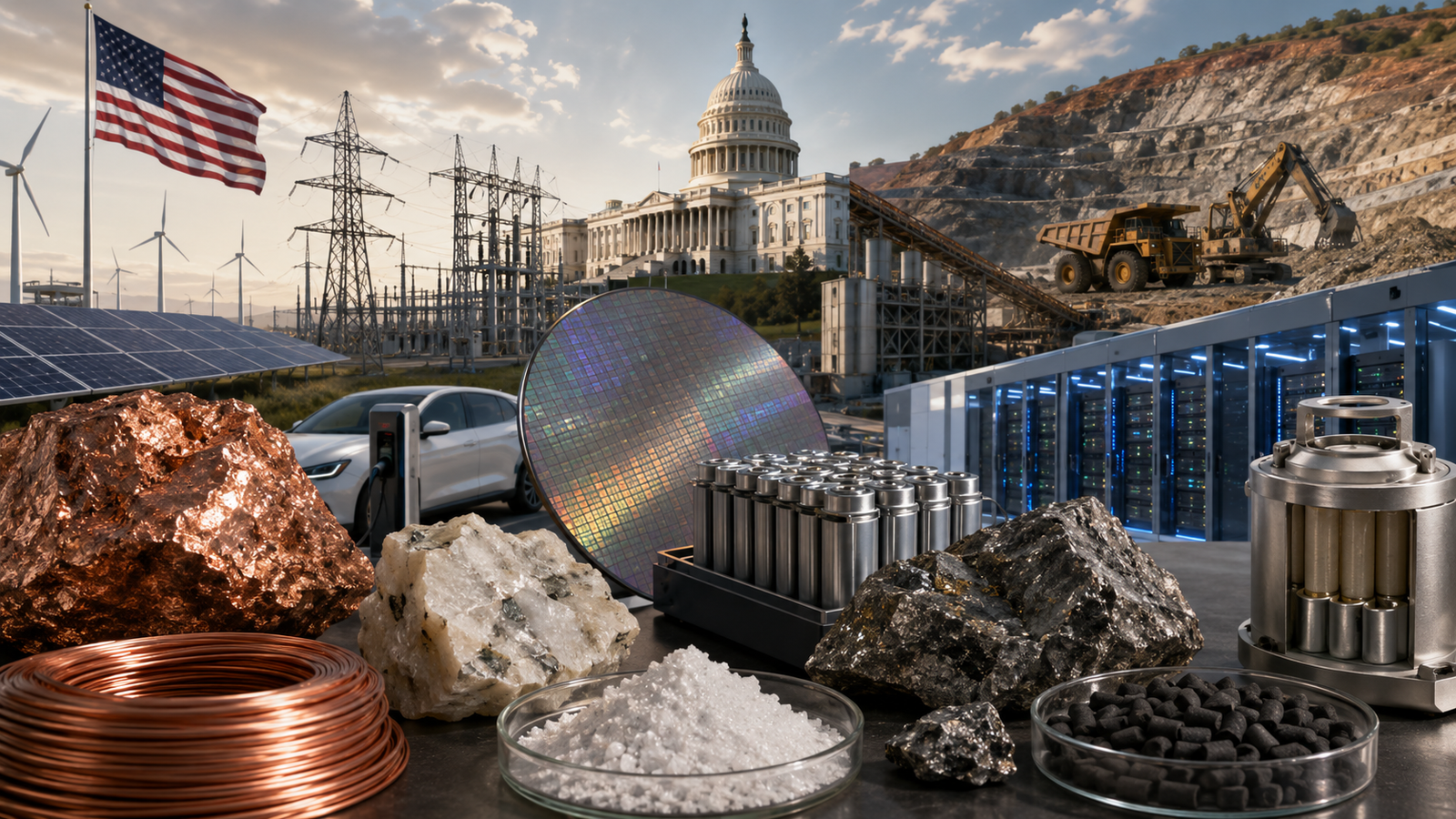
The global race for artificial intelligence dominance, clean energy leadership, and semiconductor independence is creating a powerful new investment battleground — and it starts deep beneath the ground.
From lithium and copper to uranium, graphite, and rare earth elements, critical minerals have rapidly become some of the world’s most strategically important commodities. Governments and corporations are now scrambling to secure long-term access to the raw materials required to power AI infrastructure, electric vehicles, renewable energy systems, semiconductor manufacturing, advanced defense technologies, and next-generation industrial supply chains.
The United States is at the center of that push.
Driven by growing geopolitical tensions and concerns over foreign supply chain dependence, Washington is accelerating industrial policies designed to strengthen domestic and allied critical mineral production across North America. According to the International Energy Agency’s Global Critical Minerals Outlook, White & Case policy analysis, and IndexBox industry reports, rising AI infrastructure spending and energy transition investments are creating structural demand growth across multiple strategic metals markets.
For investors, the implications may extend far beyond traditional mining stocks.
The critical minerals story is increasingly becoming a long-term geopolitical and technological transformation theme tied directly to artificial intelligence, electrification, national security, and industrial reshoring.
The AI Boom Is Creating a Massive New Commodities Cycle
Artificial intelligence may appear to be a software-driven revolution on the surface, but behind every AI model sits an enormous physical infrastructure network requiring massive quantities of industrial materials.
AI data centers consume vast amounts of copper for electrical systems, semiconductors rely on highly specialized mineral inputs, and advanced computing infrastructure requires stable energy supplies increasingly supported by uranium and grid modernization projects.
At the same time, the clean energy transition continues driving demand for lithium, nickel, graphite, and rare earth elements used in electric vehicle batteries, renewable power systems, and energy storage technologies.
This convergence of technological megatrends is creating what some analysts describe as a “multi-decade resource supercycle.”
Unlike previous commodity booms driven primarily by construction or industrial expansion, the current cycle is being fueled by multiple overlapping structural themes:
- Artificial intelligence infrastructure
- Semiconductor reshoring
- Electric vehicle adoption
- Renewable energy expansion
- Defense technology modernization
- Supply chain nationalism
- Energy security initiatives
The result is growing pressure on global mineral supply chains that were already struggling to keep pace with rising demand forecasts.
Washington Is Treating Critical Minerals as a National Security Priority
The U.S. government has increasingly reframed critical minerals policy as both an economic and national security issue.
For years, China maintained dominant control over large portions of the global rare earth processing market and significant influence across critical battery supply chains. That concentration created growing concerns within Washington as geopolitical tensions intensified and semiconductor competition accelerated.
Now, U.S. industrial policy is shifting aggressively toward domestic production and allied sourcing strategies.
Several major policy initiatives are driving this transformation:
- CHIPS Act semiconductor incentives
- Inflation Reduction Act clean energy provisions
- Strategic mineral stockpile expansion
- Domestic mining approvals
- Critical mineral processing investments
- North American supply chain partnerships
Government agencies are increasingly prioritizing partnerships with Canada and allied nations viewed as politically stable and resource-rich.
Canada, in particular, has become a major focal point due to its large reserves of uranium, lithium, nickel, copper, and rare earth elements.
This geopolitical alignment is reshaping global mining investment flows.
Copper Is Emerging as One of the Most Important AI Commodities
Among all critical minerals, copper may be one of the most strategically important for investors to monitor.
Copper plays a foundational role in:
- AI data centers
- Electrical transmission systems
- Renewable energy infrastructure
- Electric vehicles
- Semiconductor manufacturing
- Industrial automation
AI infrastructure expansion alone could significantly increase long-term copper demand as hyperscalers continue building massive global data center networks.
Several industry analysts have warned that future copper shortages may emerge due to years of underinvestment in large-scale mining projects combined with accelerating electrification demand globally.
Unlike software scaling, mining expansion takes years — and in some cases decades — to develop from exploration to production.
This creates the potential for prolonged supply constraints if demand continues accelerating faster than new production capacity.
For investors, that dynamic may support long-term bullish sentiment across select copper producers and development-stage mining projects.
Uranium Is Quietly Reentering the Investment Spotlight
Another major trend gaining momentum involves uranium.
As AI infrastructure expands, electricity demand is becoming one of the largest emerging constraints facing hyperscalers and industrial economies alike.
Large AI data centers require enormous and continuous power consumption, leading policymakers and corporations to increasingly reconsider nuclear energy as a stable long-term solution.
This shift has revived investor interest in uranium markets after years of underinvestment.
Several governments are now supporting nuclear energy expansion as part of broader energy security and decarbonization strategies. In North America, uranium producers are increasingly viewed as strategic assets tied to long-term electricity infrastructure needs.
AI-driven energy demand could further strengthen this narrative over the coming decade.
Rare Earths and Graphite Are Becoming Strategic Battlegrounds
Rare earth elements and graphite have also become central to supply chain security discussions.
Rare earths are essential for:
- Advanced electronics
- Defense systems
- Wind turbines
- Electric motors
- Semiconductor technologies
Meanwhile, graphite remains a critical battery material for electric vehicles and energy storage systems.
One of the biggest challenges facing Western economies is that processing capacity for many of these materials remains heavily concentrated in China.
As a result, governments are now encouraging domestic refining and processing infrastructure alongside raw material extraction projects.
For investors, this means opportunities may emerge not only in mining companies, but also in:
- Mineral processing firms
- Refining infrastructure companies
- Battery supply chain developers
- Recycling technologies
- Industrial logistics providers
The broader supply chain ecosystem may become just as important as raw mineral production itself.
Why This Matters for Investors
The critical minerals market is no longer simply a cyclical commodity story.
Instead, it is increasingly tied to some of the largest long-term global investment themes, including:
- Artificial intelligence
- Energy transition
- Semiconductor reshoring
- Defense modernization
- Geopolitical competition
- Infrastructure expansion
This creates a very different investment environment compared to previous commodity cycles.
Demand growth is being driven not only by economic expansion, but by strategic national policy priorities and technological transformation.
That combination could produce sustained long-term investment support across select metals and mining sectors.
At the same time, supply constraints remain significant.
Mining projects face challenges involving:
- Environmental permitting
- Regulatory approvals
- Capital intensity
- Infrastructure development
- Labor shortages
- Geopolitical risk
These barriers may limit how quickly global supply can respond to rising demand.
Future Trends Investors Should Watch
Several major developments could shape the critical minerals investment landscape moving forward:
1. AI Infrastructure Expansion
Growing hyperscaler data center construction may significantly increase demand for copper, uranium, and industrial power systems.
2. U.S. Industrial Policy
Additional government incentives for domestic mining and processing projects could accelerate sector investment.
3. Nuclear Energy Resurgence
AI-driven electricity demand may strengthen long-term uranium market fundamentals.
4. Supply Chain Localization
Western economies are likely to continue reducing dependence on foreign-controlled processing infrastructure.
5. Commodity Price Volatility
Geopolitical tensions and supply disruptions may continue creating sharp price swings across strategic metals markets.
Key Investment Insight
The global push for AI leadership, clean energy expansion, and semiconductor independence is transforming critical minerals into one of the most strategically important investment themes of the decade.
For investors, opportunities may increasingly emerge across North American miners, uranium producers, copper developers, rare earth processing firms, and infrastructure companies aligned with government-backed supply chain initiatives.
As industrial policy, geopolitics, and technological transformation continue converging, critical minerals are evolving from cyclical commodities into long-term strategic assets at the center of the modern global economy.
Stay informed on the latest commodity trends, mining developments, and market-moving investment opportunities with MoneyNews.Today, your trusted source for daily financial news and investor insights.




