Artificial intelligence is no longer just a software story. It is rapidly becoming one of the largest infrastructure buildouts in modern markets, and Meta’s latest move in Canada shows why investors are starting to look beyond chips and cloud platforms toward power, pipelines, cooling, land, construction, and grid capacity.
Meta Platforms is moving forward with its first artificial intelligence data center in Canada, a major Sturgeon County, Alberta project expected to represent more than CAD $13 billion, or roughly US$9.1 billion, in investment. The company says the facility will be its first data center in Canada and its 33rd globally, optimized for AI workloads as demand for computing power continues to accelerate.
For investors, the headline is bigger than Meta. The Alberta project highlights a structural shift in the AI economy: the next phase of growth may be determined not only by who builds the best models, but by who can secure enough electricity to run them.
AI’s Next Constraint Is Power
The AI trade has been dominated by semiconductors, hyperscale cloud providers, and software platforms. But as the industry scales from model training to mass deployment, physical infrastructure is becoming a decisive bottleneck.
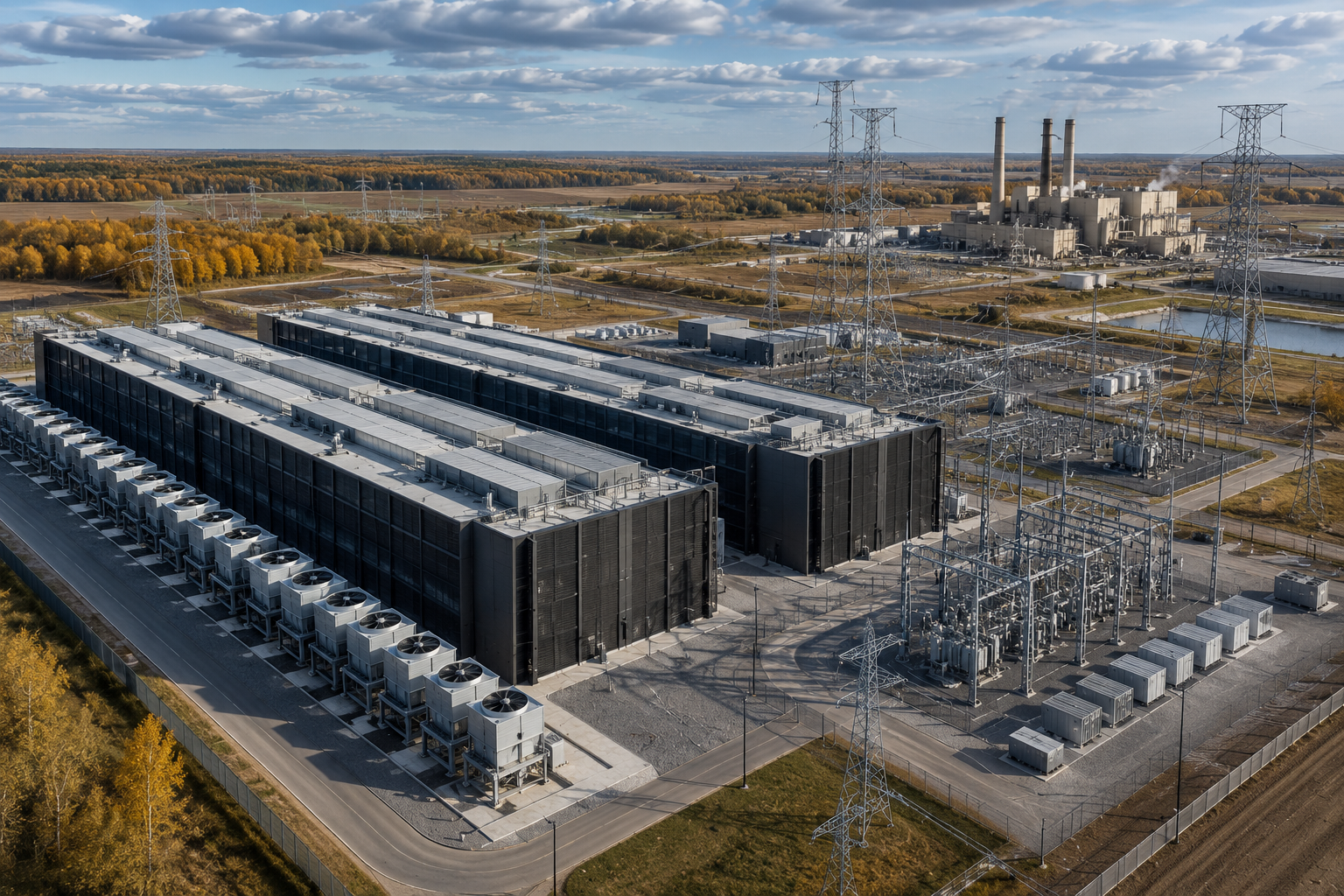
According to the Associated Press, Meta’s Alberta facility will be powered by a natural gas-fired plant developed by a consortium that includes Calgary-based Pembina Pipeline. The project is tied to the Greenlight Electricity Center, a planned 932-megawatt power plant expected to begin operating in the second half of 2030. AP also reported that Alberta is prioritizing data center projects that build or secure their own power generation because the province’s grid cannot support multiple large AI data centers at the same time.
That detail matters. In previous technology cycles, investors focused on users, margins, software adoption, and hardware performance. In the AI infrastructure cycle, investors also need to evaluate megawatts, interconnection queues, fuel supply, cooling systems, transmission constraints, and regulatory approvals.
The result is a broader investable theme: AI is turning energy availability into a competitive advantage.
Why Alberta Matters
Alberta is not Silicon Valley, Northern Virginia, or Texas. But that is exactly why the province is becoming relevant in the AI infrastructure race.
Large-scale data centers need land, energy, water planning, permitting support, and long-term operating certainty. Alberta has abundant energy resources, an established natural gas industry, and a government that has been openly courting hyperscale data center investment. The Meta project suggests that AI infrastructure development may increasingly move to regions where power can be secured more reliably than in crowded legacy data center markets.
Meta said the Sturgeon County data center will be a 1-gigawatt facility optimized for AI workloads. Business Insider reported that the project will occupy roughly 1,750 acres, span about 2.9 million square feet, and support more than 3,000 construction jobs at peak, along with more than 300 permanent operating jobs.
Those numbers underline the capital intensity of the AI buildout. The largest AI data centers are no longer just technology campuses. They are industrial-scale assets with energy, construction, real estate, and utility characteristics.
The “Power Certainty” Premium
Colliers’ 2026 Data Center Marketplace Report frames the industry’s current challenge clearly: AI-driven demand is pushing the data center market into a new phase defined by power scarcity, rising capital intensity, and infrastructure-scale execution.
That is the key investment message. Data center demand is not the only variable that matters. Supply is increasingly constrained by the ability to deliver power on time and at scale.
Colliers’ findings align closely with what the Meta-Alberta project demonstrates in practice. A hyperscaler is not simply leasing generic computing space. It is anchoring an energy-linked infrastructure project designed around long-term AI capacity needs. In this market, locations with secure electricity, favorable permitting, and scalable cooling solutions may command a premium.
Investors should therefore treat “power certainty” as a major screening factor when evaluating AI infrastructure exposure. A data center developer with signed power agreements, available land, and credible grid or self-generation plans may be better positioned than a competitor with attractive demand but uncertain energy access.
The Beneficiaries Beyond Big Tech
Meta remains the obvious headline company, but the investment implications stretch across multiple sectors.
Power generation companies may benefit as hyperscalers seek dedicated electricity supply. Natural gas infrastructure operators could see increased demand where gas-fired generation becomes part of the AI capacity solution. Grid equipment makers may benefit from transformer, switchgear, transmission, and substation upgrades. Cooling technology providers may gain relevance as AI workloads increase rack density and heat output.
Construction and engineering firms are also positioned to benefit. Projects measured in billions of dollars and millions of square feet require specialized design, permitting, materials, electrical systems, and long build cycles. Data-center REITs and private infrastructure funds may also find opportunities, although investors should be selective because capital requirements are rising and execution risk is significant.
The Alberta project also points to a possible shift in how investors evaluate pipeline and midstream energy companies. Traditionally, these businesses are assessed through throughput, commodity exposure, tariffs, and dividend stability. AI data center demand could add another layer to the thesis: long-term power-linked industrial demand near gas infrastructure.
That does not mean every energy infrastructure company becomes an AI winner. But it does mean investors should watch for companies that can connect fuel supply, generation, land access, and contracted demand from large technology customers.
The Environmental and Regulatory Risks
The opportunity is clear, but so are the risks.
AI data centers are energy-intensive, and public scrutiny is increasing around electricity use, water use, emissions, and local grid strain. AP reported that Meta’s Canadian facility will use a closed-loop cooling system designed not to draw water from surrounding sources, and that the company plans to invest about US$42 million in local infrastructure, including roads and water systems.
Those commitments may help address local concerns, but they do not eliminate broader regulatory risk. Communities are increasingly asking whether data centers create enough permanent jobs relative to their power demand. Policymakers are also weighing how to balance AI infrastructure growth with electricity affordability, emissions targets, and grid reliability.
For investors, this means the best-positioned projects may be those that can demonstrate not only power access, but political durability. Local support, environmental planning, water management, and transparent economic benefits could become just as important as compute capacity.
What Investors Should Watch Next
The Meta-Alberta announcement should be viewed as part of a larger AI infrastructure cycle. Investors should watch for three signals over the next several quarters.
First, follow hyperscaler capital spending. If Meta, Microsoft, Alphabet, Amazon, and other major platforms continue increasing AI infrastructure budgets, demand for power-secured data center capacity is likely to remain elevated.
Second, track energy partnerships. Deals involving utilities, natural gas operators, independent power producers, renewable developers, nuclear developers, and battery storage companies may become increasingly important indicators of AI infrastructure momentum.
Third, monitor permitting and grid constraints. Projects that appear attractive on paper can face delays if power interconnection, environmental approvals, or community opposition become obstacles. In this cycle, speed to power may matter as much as cost of capital.
Key Investment Insight
Meta’s US$9.1 billion Canada AI data center is a clear signal that the AI investment theme is moving from chips alone to full-stack infrastructure. The biggest opportunities may emerge in companies that help solve the physical constraints of AI: power generation, natural gas infrastructure, electrical equipment, cooling technology, construction, land development, and data center financing.
For investors, the practical takeaway is simple: do not analyze the AI boom only through software and semiconductor valuations. The next phase of winners may be found in the infrastructure layer that makes AI deployment possible. Power-secured assets, grid-ready development sites, and companies with credible exposure to hyperscale energy demand deserve closer attention.
At the same time, investors should remain disciplined. AI infrastructure is capital-intensive, politically sensitive, and exposed to execution delays. The strongest opportunities are likely to be in businesses with contracted demand, balance-sheet strength, regulatory alignment, and clear visibility into power availability.
Meta’s Alberta project may be remembered as more than a large data center announcement. It may be a marker of where the AI economy is heading: toward a future where compute power depends on electrical power, and where the companies that control reliable energy access may become essential players in the next technology cycle.
Stay with MoneyNews.Today for daily investor-focused coverage of the market trends, infrastructure shifts, and emerging industries shaping tomorrow’s opportunities.