
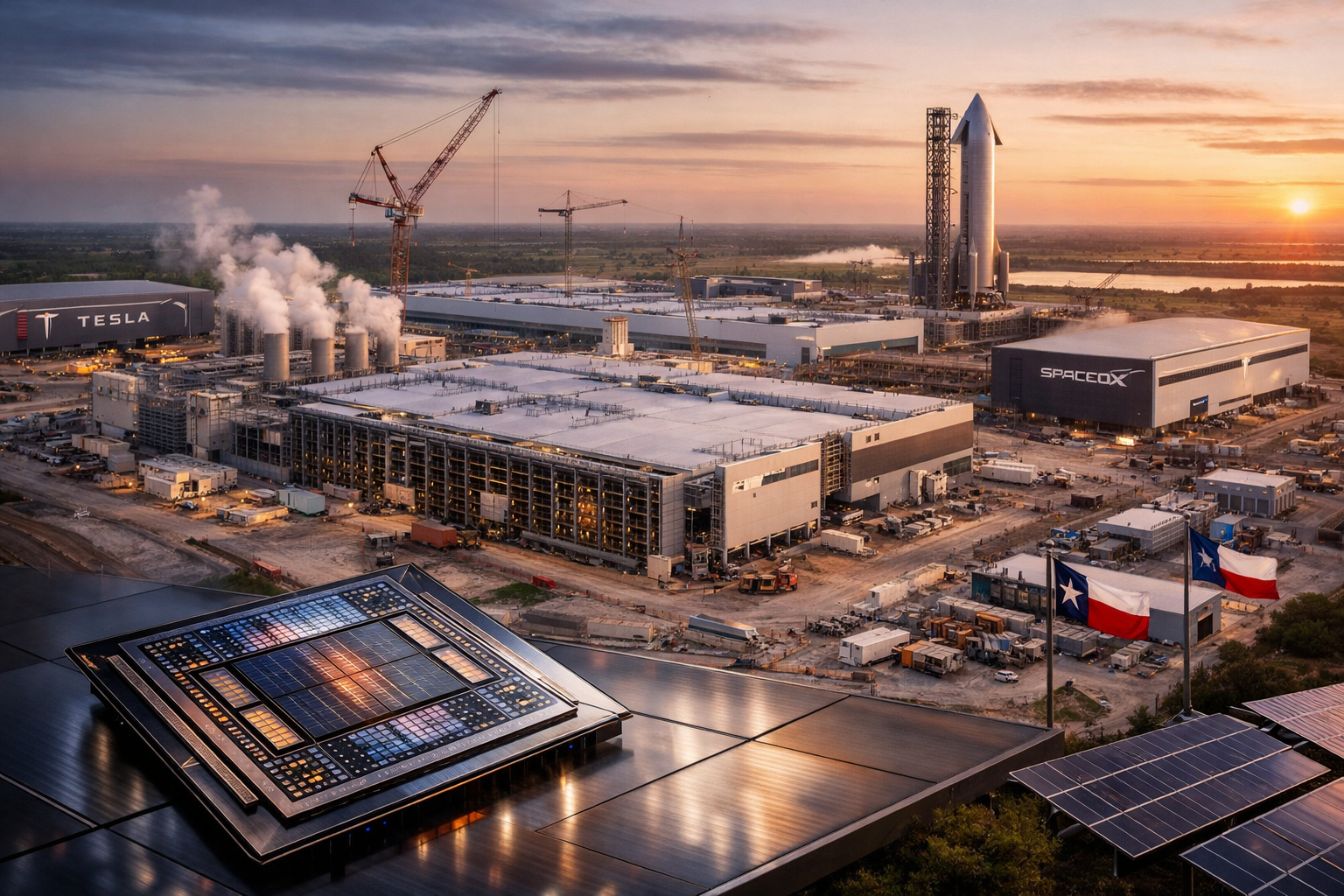
The race for AI dominance is no longer confined to software models or cloud platforms—it’s moving deeper into the physical infrastructure that powers intelligence itself. In a bold move that underscores this shift, Tesla and SpaceX are planning a massive AI-focused semiconductor manufacturing facility—reportedly dubbed “Terafab”—in Texas.
Confirmed through market briefings highlighted by Investopedia and supported by company announcements, the project represents a strategic leap toward vertical integration in AI hardware. For investors, this is more than just another factory announcement—it signals a fundamental restructuring of the technology value chain, where control over chips, compute, and supply chains could define the next generation of winners.
AI’s New Battleground: Semiconductor Sovereignty
Artificial intelligence has rapidly become the most competitive frontier in global technology. But as demand for AI accelerates, a critical bottleneck has emerged: access to advanced semiconductors.
The global chip shortage during the early 2020s exposed vulnerabilities in supply chains, heavily concentrated in regions like Taiwan and South Korea. Since then, governments and corporations alike have prioritized domestic chip production as a strategic imperative.
Tesla and SpaceX’s “Terafab” initiative fits squarely into this trend:
- It aims to localize semiconductor manufacturing in the U.S.
- It supports AI-driven applications across automotive, robotics, and space technologies
- It reduces reliance on third-party suppliers
According to industry analysis from Bloomberg and McKinsey, the global semiconductor market is expected to exceed $1 trillion annually by the early 2030s, with AI chips representing one of the fastest-growing segments.
Why Vertical Integration Is Back in Focus
For much of the past two decades, the tech industry embraced specialization. Companies focused on specific parts of the value chain—design, manufacturing, or software—while relying on partners for the rest.
That model is now being challenged.
1. Supply Chain Resilience
Recent disruptions—from geopolitical tensions to pandemic-related shutdowns—have highlighted the risks of relying on external suppliers. By building in-house manufacturing capabilities, companies can gain greater control over production timelines and costs.
2. Performance Optimization
Custom-designed chips tailored to specific AI workloads can deliver significant performance advantages. Tesla has already demonstrated this with its in-house AI chips for autonomous driving.
Extending this approach to large-scale manufacturing could:
- Improve efficiency
- Reduce latency
- Enhance competitive differentiation
3. Cost Control at Scale
While building semiconductor fabs requires massive upfront investment, it can lead to lower long-term costs for companies operating at scale.
For Tesla and SpaceX, which rely heavily on advanced computing for:
- Autonomous vehicles
- Robotics and AI training
- Satellite networks (Starlink)
the economics of vertical integration are becoming increasingly compelling.
Why This Matters for Investors
The “Terafab” project highlights several key trends that investors should be watching closely:
1. The AI Arms Race Is Expanding
Competition in AI is no longer limited to software developers. It now includes:
- Chip designers
- Manufacturers
- Infrastructure providers
This broadens the investment landscape, creating opportunities across multiple sectors.
2. Capital Expenditure Is Surging
Building semiconductor fabs is one of the most capital-intensive undertakings in the world.
According to data from the Semiconductor Industry Association and U.S. government reports, advanced fabs can cost $10 billion to $20 billion or more to construct.
This surge in capital expenditure has two implications:
- It creates opportunities for companies involved in construction, equipment, and materials
- It raises questions about return on investment and margin pressure
3. Government Policy Is a Key Catalyst
The push for domestic chip manufacturing is being supported by government initiatives such as the U.S. CHIPS Act, which provides incentives for companies to build fabs domestically.
Tesla and SpaceX’s Texas project could benefit from:
- Tax incentives
- Subsidies
- Regulatory support
This alignment between corporate strategy and government policy is a powerful driver of long-term growth.
Sector-Level Impact
Semiconductors: Intensifying Competition
The entry of Tesla and SpaceX into large-scale chip manufacturing could disrupt the competitive landscape.
Established players may face:
- Increased competition from vertically integrated tech companies
- Pressure to innovate and reduce costs
- Shifts in customer relationships
Automotive & Mobility: A Strategic Advantage
For Tesla, controlling chip production could enhance its leadership in:
- Autonomous driving
- AI-powered robotics
- Vehicle software integration
This could create a significant competitive edge over traditional automakers that rely on third-party suppliers.
Aerospace & Satellite Technology
For SpaceX, AI chips are critical for:
- Satellite communication networks
- Real-time data processing
- Autonomous space operations
Vertical integration could improve performance and reduce costs across its ecosystem.
Industrial & Construction Sectors
The development of “Terafab” will likely drive demand for:
- Construction and engineering firms
- Semiconductor equipment manufacturers
- Raw materials such as silicon and specialty chemicals
This creates ripple effects across the broader industrial economy.
Future Trends to Watch
1. Expansion of Domestic Chip Manufacturing
Expect more companies to invest in U.S.-based semiconductor production as geopolitical risks persist.
2. Custom AI Chip Development
The trend toward application-specific chips will continue, with companies designing hardware tailored to their unique needs.
3. Supply Chain Realignment
Global supply chains are likely to become more regionalized, with increased emphasis on resilience and security.
4. Cost vs. Efficiency Trade-Offs
Investors should monitor whether the benefits of vertical integration outweigh the significant costs associated with building and operating fabs.
Key Investment Insight
The “Terafab” initiative highlights a critical shift in the AI investment landscape: control over infrastructure is becoming just as important as innovation.
Investors should consider:
- Tracking companies investing in domestic semiconductor manufacturing
- Evaluating firms with strong vertical integration strategies
- Identifying suppliers and partners in the semiconductor ecosystem
- Monitoring capital expenditure trends and their impact on margins
In this environment, the companies that succeed will be those that can control their supply chains, optimize performance, and scale efficiently.
A New Era of Tech Competition
Tesla and SpaceX’s move into semiconductor manufacturing is more than a strategic expansion—it’s a reflection of how the technology landscape is evolving. The boundaries between industries are blurring, and companies are increasingly building end-to-end ecosystems to maintain a competitive edge.
For investors, this represents both an opportunity and a challenge. The opportunity lies in identifying the new leaders emerging from this transformation. The challenge lies in navigating a more complex and capital-intensive environment.
Stay informed with MoneyNews.Today for daily insights that help you understand the forces shaping global markets and uncover opportunities in the rapidly evolving world of technology and AI investing.




