
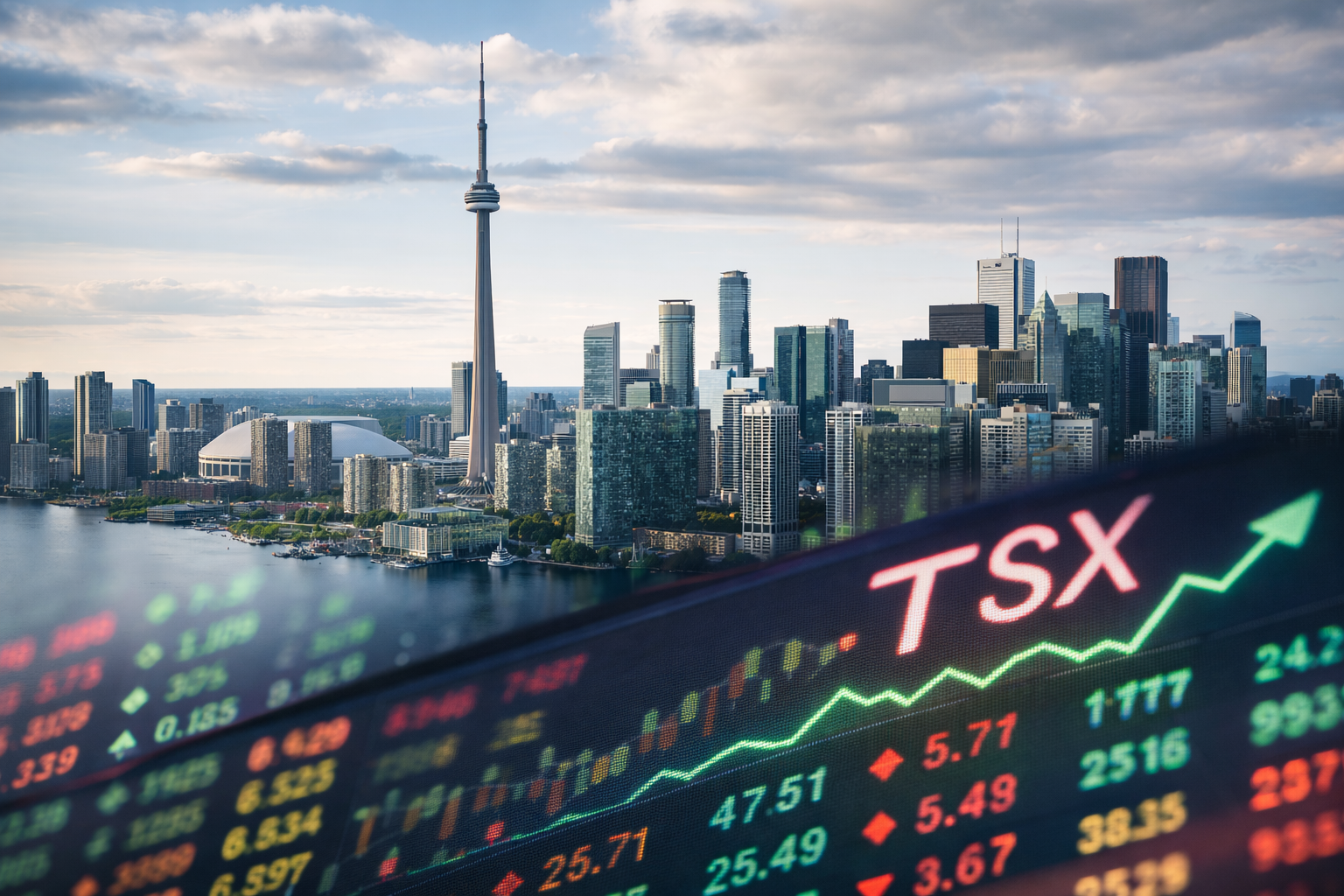
Global markets are once again being driven less by earnings and more by geopolitics—and right now, investors are betting on relief. Canada’s benchmark equity index, the S&P/TSX Composite Index, is on track for its fourth consecutive weekly gain as optimism builds around easing tensions in the Middle East. But beneath the surface of this rally lies a more complex dynamic—one that could quickly reshape the trajectory of Canadian equities.
For investors, this isn’t just a story about rising markets. It’s about how geopolitical narratives, commodity prices, and sector concentration intersect to drive returns in one of the world’s most resource-heavy indices.
A Market Rally Built on Relief
According to Reuters (April 17, 2026), the TSX has continued its upward momentum as investors increasingly price in the possibility of geopolitical de-escalation. After weeks of volatility driven by fears of supply disruptions and broader instability, markets are now shifting toward a more optimistic outlook.
This shift in sentiment has had a broad-based impact:
- Financials and industrials have benefited from improved risk appetite
- Defensive sectors have stabilized as volatility expectations decline
- Investor flows have returned to equities after a period of caution
The result is a steady climb in Canada’s equity benchmark, reflecting a market environment where uncertainty is fading—at least temporarily.
However, this optimism comes with an important caveat.
The Oil Factor: A Double-Edged Sword
Canada’s stock market is uniquely sensitive to energy prices. Oil and gas companies represent a significant portion of the TSX, meaning that movements in crude prices can have an outsized impact on overall index performance.
Recent developments have introduced a paradox.
As geopolitical tensions ease, oil prices have begun to decline—removing a key risk premium that had previously supported energy markets. While this is positive for global economic stability, it creates headwinds for energy-heavy indices like the TSX.
Companies such as Suncor Energy and Canadian Natural Resources are directly exposed to these price fluctuations. Lower crude prices can translate into reduced revenues, tighter margins, and potentially weaker stock performance.
This dynamic highlights a critical tension:
- Geopolitical calm supports equities broadly
- But it can simultaneously weaken the energy sector
For the TSX, which relies heavily on resource-based industries, this creates a balancing act that investors must carefully navigate.
Why This Matters for Investors
The current market setup offers both opportunity and risk.
On one hand, improving geopolitical conditions are encouraging investors to re-enter equities, driving momentum higher. On the other, declining commodity prices—particularly oil—pose a structural challenge for Canada’s market composition.
This divergence underscores an important point:
Not all rallies are created equal.
In the case of the TSX, gains may be uneven, with certain sectors outperforming while others lag. Financials, for example, may benefit from improved economic outlooks and stable interest rate expectations, while energy stocks could face pressure if oil continues to decline.
For investors, this means that sector allocation matters more than ever.
Sector Rotation in Action
One of the most notable trends emerging from this environment is the potential for sector rotation within the TSX.
As oil prices soften, capital may begin to shift toward:
- Financial institutions, which benefit from stable economic conditions
- Industrials and infrastructure, tied to growth and investment cycles
- Technology and innovation-driven firms, which are less sensitive to commodity swings
This rotation reflects a broader shift in investor priorities—from defensive positioning during periods of uncertainty to more growth-oriented strategies as risks subside.
However, it’s important to recognize that this transition is not guaranteed to be smooth.
Markets remain highly sensitive to geopolitical developments, and any reversal in sentiment—such as renewed tensions or supply disruptions—could quickly push oil prices higher again, reversing the current trend.
The Global Context: Why Geopolitics Still Matters
While the TSX is the focus, the forces driving it are global.
The recent improvement in sentiment is tied to developments in the Middle East, where easing tensions have reduced fears of supply chain disruptions and broader economic fallout. This has had a ripple effect across global markets, influencing everything from equities to commodities.
Institutions such as the International Monetary Fund (IMF) and major banks have repeatedly emphasized the importance of geopolitical stability in shaping economic outcomes. Energy prices, in particular, remain one of the most direct transmission channels between geopolitical events and financial markets.
For Canada, this connection is even stronger due to its reliance on natural resource exports.
This means that TSX performance cannot be viewed in isolation—it is deeply intertwined with global energy markets and geopolitical narratives.
Future Trends to Watch
As investors assess the sustainability of the current rally, several key trends will be critical:
1. Oil Price Trajectory
Will crude prices continue to decline, or will new geopolitical developments reintroduce volatility? This remains the single most important variable for the TSX.
2. Central Bank Policy
Interest rate expectations, particularly from the Bank of Canada, will influence financial stocks and broader market liquidity.
3. Earnings Season Signals
Corporate earnings will provide insight into how companies are managing current market conditions, including cost pressures and demand trends.
4. Global Risk Sentiment
Investor appetite for risk assets will depend on broader macro conditions, including inflation data and geopolitical stability.
5. Commodity Diversification
Beyond oil, metals such as gold and copper may play an increasing role in shaping TSX performance, particularly as global demand dynamics evolve.
Actionable Investment Insights
For investors looking to position effectively in this environment, several strategies stand out:
- Diversify within the TSX: Avoid overexposure to energy stocks, given current oil price uncertainty.
- Monitor oil as a leading indicator: Changes in crude prices will likely drive near-term market direction.
- Focus on sector rotation opportunities: Financials and industrials may outperform if geopolitical optimism holds.
- Stay flexible: Rapid changes in global conditions can quickly alter market dynamics—adaptability is key.
- Look beyond headlines: While geopolitical optimism is driving the rally, underlying fundamentals must still support long-term growth.
The key takeaway is clear: this is a sentiment-driven market, but fundamentals are beginning to reassert themselves.
The Bigger Picture: A Market at a Crossroads
The TSX’s recent performance reflects a broader theme playing out across global markets—a transition from fear-driven volatility to cautious optimism.
But this transition is far from complete.
Energy prices, geopolitical developments, and macroeconomic conditions remain deeply interconnected, creating a market environment that is both dynamic and unpredictable.
For Canada, the challenge is particularly acute. As a resource-heavy economy, its equity market is uniquely exposed to shifts in commodity prices and global demand.
This means that while the current rally is encouraging, it should be viewed through a lens of measured optimism rather than unchecked enthusiasm.
Stay Ahead of the Market
As Canada’s TSX extends its gains amid shifting geopolitical dynamics, the real opportunity lies in understanding what’s driving the move—and what could come next.
Stay informed with MoneyNews.Today for daily, high-impact insights that help you navigate global markets, identify emerging trends, and make smarter investment decisions in an ever-changing financial landscape.




