
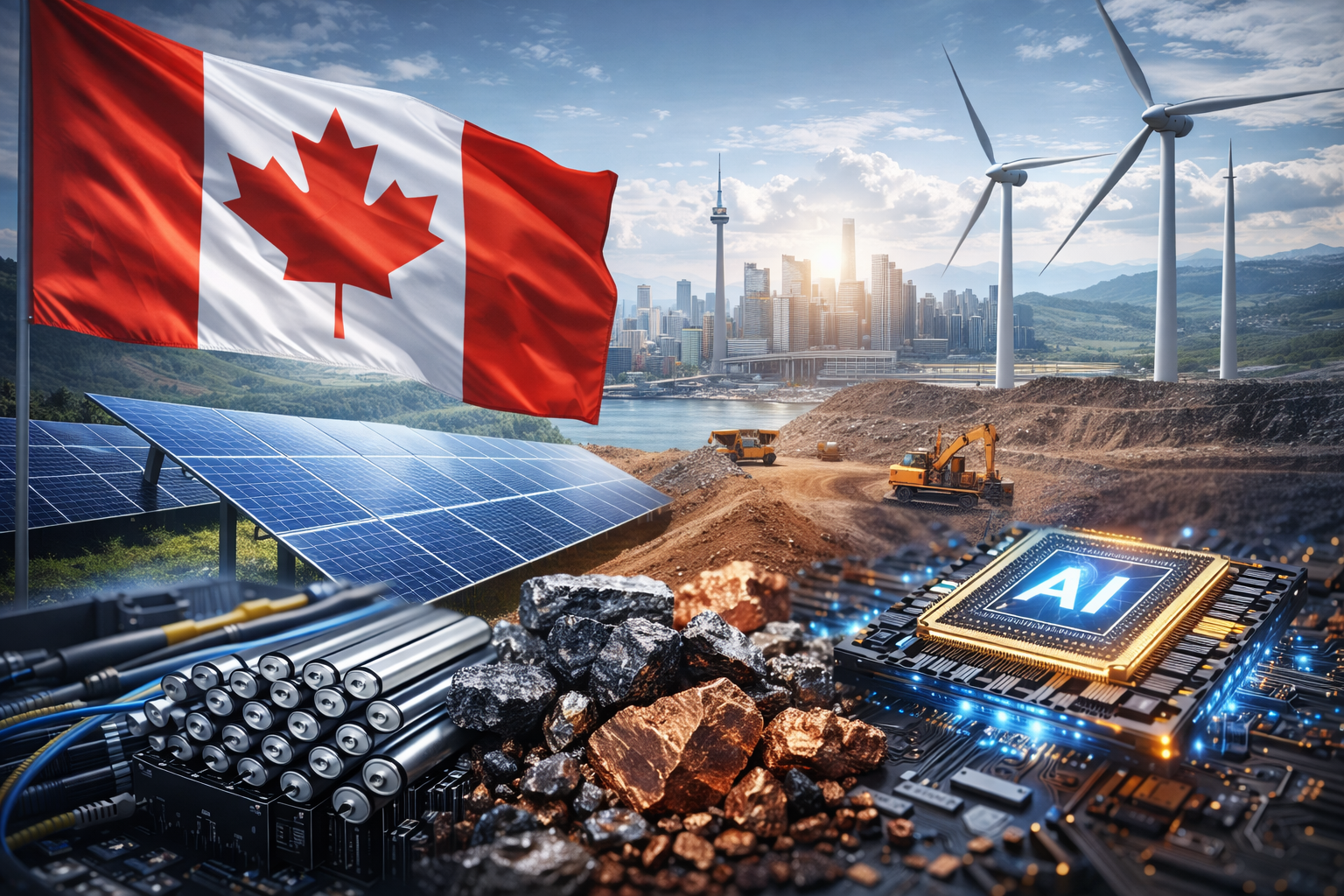
Global capital is rapidly reorganizing around a new economic reality—one defined by artificial intelligence, energy transition infrastructure, and strategic resource security. In that context, Canada is making a decisive move to position itself at the center of the next industrial cycle.
A new government-led investment initiative, announced by the Government of Canada, signals an aggressive push into clean technology, artificial intelligence, critical minerals, and advanced manufacturing. The strategy is not incremental—it represents a structural attempt to reshape Canada’s economic identity from a resource exporter to a next-generation industrial hub.
For investors, this shift is significant. It directly links public policy, capital allocation, and global supply chain positioning at a time when demand for AI infrastructure and energy transition materials is accelerating worldwide.
A Strategic Shift Toward High-Growth Industries
According to the Prime Minister’s Office (April 17, 2026), Canada’s latest investment drive is designed to accelerate growth in four key areas:
- Clean energy and decarbonization technologies
- Critical minerals essential for advanced manufacturing
- Artificial intelligence and digital infrastructure
- Next-generation industrial innovation
This marks a clear departure from traditional economic reliance on oil, gas, and legacy manufacturing sectors. Instead, policymakers are targeting industries expected to define the global economy over the next several decades.
The initiative reflects a broader global trend highlighted in reports from organizations such as the International Energy Agency (IEA) and McKinsey & Company, both of which emphasize that the energy transition and digital transformation are becoming deeply interconnected megatrends.
In Canada’s case, these two forces are now being explicitly combined into a unified national strategy.
Why This Matters for Investors
This announcement is not just policy—it is capital direction.
When governments prioritize specific sectors, they influence:
- Where infrastructure is built
- How subsidies and incentives are allocated
- Which industries attract foreign direct investment
- How supply chains are structured over time
For investors, this creates a framework for identifying structural growth opportunities supported by policy tailwinds.
Canada’s strategy is particularly important because it aligns with two of the most powerful global investment themes:
- The rise of AI-driven infrastructure
- The acceleration of the global energy transition
Together, these forces are reshaping demand for everything from semiconductors to battery materials to grid infrastructure.
Critical Minerals: The Backbone of the New Economy
At the center of Canada’s strategy is a focus on critical minerals—materials such as lithium, nickel, copper, and rare earth elements.
These resources are essential inputs for:
- Electric vehicle batteries
- Renewable energy systems
- Semiconductor manufacturing
- AI data center infrastructure
Canada’s push to expand this sector positions it as a key player in global supply chain diversification efforts.
Companies such as Teck Resources and Lundin Mining are among those closely tied to this thematic shift, benefiting from long-term demand trends driven by electrification and industrial decarbonization.
Industry research from the IEA suggests that demand for key energy transition minerals could multiply significantly over the next two decades, driven by electrification and grid modernization. This makes Canada’s resource base strategically important—not just economically, but geopolitically.
AI and Digital Infrastructure Expansion
Another pillar of the initiative is artificial intelligence and digital infrastructure.
AI is no longer just a software story—it is a physical infrastructure story requiring:
- High-performance data centers
- Advanced semiconductor supply chains
- Massive energy consumption capacity
- High-speed connectivity networks
This places Canada in a competitive position if it can successfully integrate energy capacity, regulatory clarity, and capital investment.
Global tech leaders such as Microsoft and Amazon continue to expand AI infrastructure globally, and countries that can provide stable energy and resource access are becoming increasingly attractive investment destinations.
Canada’s advantage lies in its combination of:
- Abundant natural resources
- Stable regulatory environment
- Access to renewable and nuclear energy potential
- Proximity to U.S. technology ecosystems
If executed effectively, this could position Canada as a strategic AI infrastructure partner within North America.
Clean Energy as a Competitive Advantage
Clean technology and energy transition infrastructure form the third pillar of the strategy.
Canada’s approach aligns with global decarbonization efforts led by institutions such as the International Monetary Fund (IMF) and World Bank, which emphasize that climate-related investment will be a major driver of global capital flows in the coming decades.
Key areas of focus include:
- Renewable energy generation
- Grid modernization and transmission infrastructure
- Hydrogen and alternative fuels
- Nuclear energy development
For investors, this creates potential opportunities across utilities, engineering firms, and energy infrastructure providers.
It also strengthens Canada’s role as a low-carbon industrial base, which could attract multinational corporations seeking to decarbonize supply chains.
The Global Competition for Emerging Industries
Canada’s announcement should also be viewed in a global context.
Countries around the world are competing to dominate emerging industries, particularly:
- Artificial intelligence
- Clean energy systems
- Critical mineral supply chains
- Advanced manufacturing
The United States, European Union, and China are all deploying large-scale industrial strategies to secure leadership in these sectors.
Canada’s approach is distinct in that it combines:
- Resource abundance (critical minerals and energy)
- Geographic proximity to the U.S. technology ecosystem
- Stable governance and investment environment
This positions Canada as a potential bridge economy between resource supply and advanced technology demand.
Future Trends to Watch
Several key developments will determine how successful this strategy becomes:
1. Capital Inflows Into Mining and Energy Transition
Expect increased domestic and foreign investment into Canadian resource projects.
2. AI Infrastructure Expansion
Data center construction and energy capacity development will accelerate.
3. Public-Private Partnerships
Government-backed initiatives will likely play a larger role in funding strategic industries.
4. Supply Chain Reconfiguration
Global firms may increasingly source critical inputs from Canadian operations.
5. Regulatory and Environmental Policy Alignment
Policy consistency will be essential to attracting long-term institutional capital.
Actionable Investment Insights
For investors tracking emerging industries, Canada’s strategic shift creates several clear implications:
- Critical minerals exposure is becoming a core theme: Mining companies linked to battery metals and industrial inputs may benefit from long-term demand growth.
- AI infrastructure is expanding beyond tech companies: Energy, utilities, and industrial firms are becoming indirect AI beneficiaries.
- Clean energy remains structurally supported: Policy alignment reduces long-term investment risk in the sector.
- Canada-focused diversification opportunities are increasing: ETFs and index exposure may capture broad thematic growth.
- Long-term positioning matters more than short-term volatility: These are multi-decade structural trends, not cyclical trades.
The central takeaway is that Canada is actively building a policy-driven investment ecosystem around the next industrial revolution.
The Bigger Picture: A New Industrial Identity
Canada’s latest investment push reflects a broader transformation in global economic strategy.
We are moving into an era where economic leadership is defined by control over:
- Energy systems
- Digital infrastructure
- Critical resource supply chains
- Artificial intelligence ecosystems
Canada is attempting to position itself at the intersection of all four.
If successful, this strategy could reshape its role in global markets—from a commodity exporter to a strategic hub for emerging industries.
For investors, that transition creates both opportunity and complexity. But one thing is clear: emerging industries are no longer emerging—they are becoming foundational.
Stay Ahead of Emerging Industry Trends
As Canada accelerates investment into clean technology, AI, and critical minerals, the global competition for emerging industries is entering a decisive phase.
Stay informed with MoneyNews.Today for daily, high-impact investor insights that track where capital, policy, and innovation are converging across global markets.




