
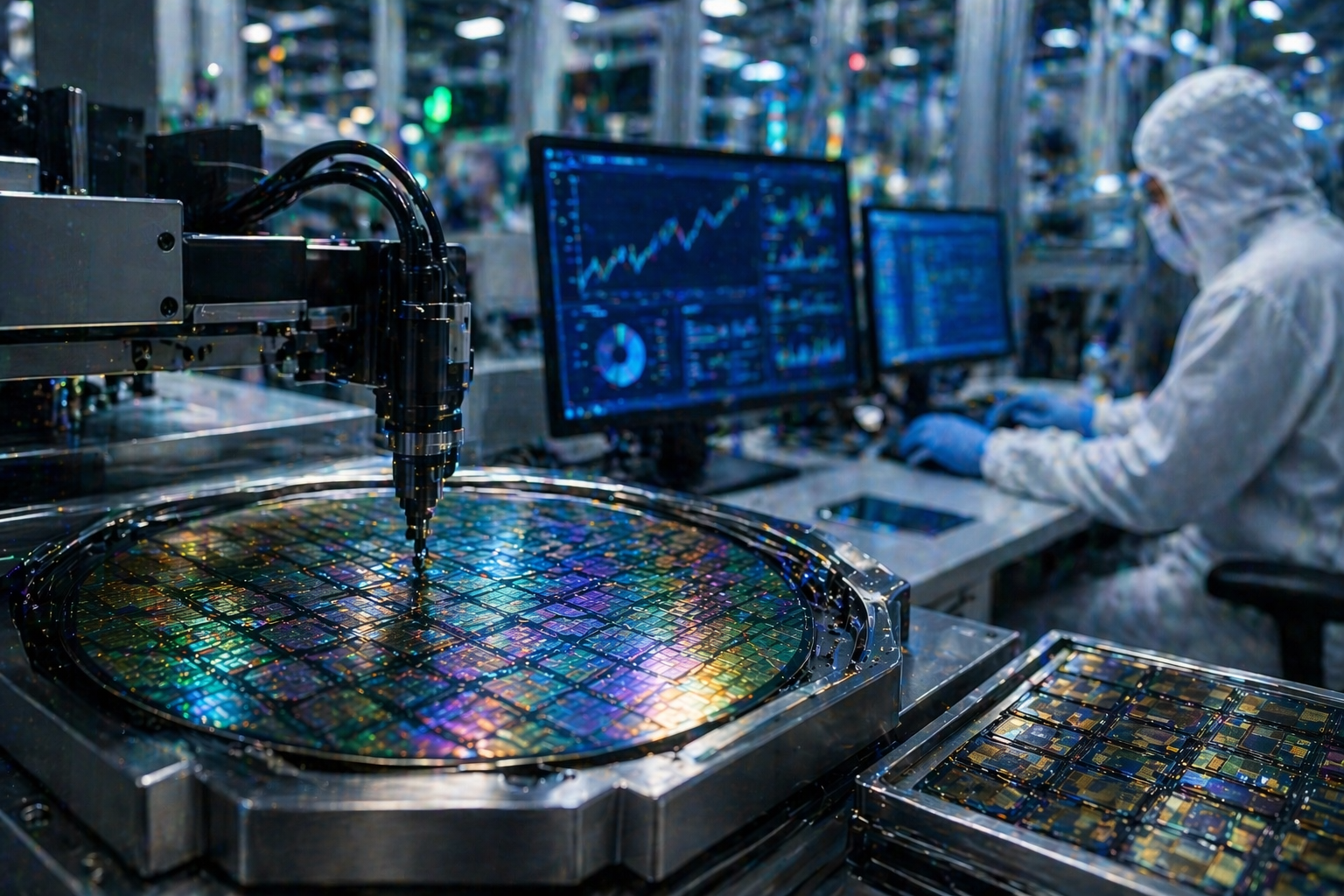
The backbone of the AI revolution isn’t software—it’s silicon. And right now, semiconductor stocks are at the center of one of the most powerful structural rallies in global markets.
As artificial intelligence adoption accelerates across industries, demand for high-performance chips—particularly AI accelerators and next-generation processors—is surging. According to recent reporting from Reuters and Financial Times (April 24, 2026), this demand is not only driving strong revenue growth for chipmakers but also tightening supply, reinforcing pricing power across the sector.
For investors, this is more than just another tech cycle. It’s a multi-year infrastructure buildout, with semiconductors acting as the foundation.
AI Is Redefining the Semiconductor Cycle
The semiconductor industry has historically been cyclical—driven by fluctuations in consumer electronics, PCs, and smartphones. But the current cycle is different.
AI is introducing a structural demand layer that is less dependent on consumer spending and more tied to enterprise and infrastructure investment.
From Cyclical to Structural Growth
Traditionally, semiconductor demand followed predictable patterns:
- Expansion during tech upgrades
- Contraction during demand slowdowns
- Recovery tied to new product cycles
Now, AI is changing that equation.
Demand is increasingly driven by:
- Data center expansion
- Cloud computing infrastructure
- AI model training and inference workloads
These are long-term investments—not short-term consumer trends.
According to the Financial Times, hyperscalers and enterprise clients are committing billions to AI infrastructure, creating sustained demand for advanced chips.
Supply Constraints Are Reinforcing Pricing Power
One of the defining characteristics of the current rally is not just strong demand—but limited supply.
Why Supply Remains Tight
Several factors are contributing to ongoing constraints:
Advanced Node Complexity
Producing cutting-edge chips (e.g., 3nm, 5nm) requires highly specialized manufacturing processes that only a few companies can execute at scale.
Capital-Intensive Expansion
Building new fabrication plants (fabs) requires massive capital investment and long lead times—often several years.
Geopolitical Factors
Export controls, trade restrictions, and regional supply chain shifts are adding friction to global semiconductor production.
Equipment Bottlenecks
Limited availability of advanced manufacturing equipment is slowing capacity expansion.
Reuters reports that these constraints are allowing chipmakers to maintain strong pricing power, even as production ramps up.
The Winners: Advanced Manufacturing and AI Partnerships
Not all semiconductor companies are benefiting equally from the AI boom. The biggest gains are being concentrated among firms with specific competitive advantages.
Key Characteristics of Market Leaders
1. Advanced-Node Manufacturing Capabilities
Companies capable of producing cutting-edge chips are capturing the highest-value segments of the market.
2. Strong AI Ecosystem Integration
Partnerships with cloud providers, AI developers, and enterprise clients are critical for sustained growth.
3. Proprietary Architectures
Firms designing specialized AI chips are differentiating themselves from traditional chipmakers.
4. Scale and Capital Access
The ability to invest heavily in R&D and infrastructure is becoming a key barrier to entry.
This is leading to a concentration of market power among a relatively small group of companies—those positioned at the intersection of technology leadership and ecosystem relevance.
Why This Matters for Investors
The semiconductor rally is not just about short-term momentum—it reflects a deeper shift in how value is created in the technology sector.
Key Implications:
1. Semiconductors Are Now Core AI Infrastructure
Chips are no longer just components—they are essential enablers of AI innovation.
2. Earnings Visibility Is Improving
Long-term contracts and sustained demand from hyperscalers are providing greater revenue predictability.
3. Valuations Reflect Structural Growth
While valuations are elevated, they are increasingly supported by long-term growth expectations.
4. Risk Is Becoming More Concentrated
With leadership concentrated among a few companies, investors face higher exposure to sector-specific risks.
Data Centers: The New Demand Engine
At the heart of the semiconductor surge is the rapid expansion of data centers.
AI workloads require:
- Massive computational power
- High-speed memory and storage
- Advanced networking capabilities
This is driving demand for a wide range of semiconductor components, including:
- GPUs and AI accelerators
- Memory chips (DRAM, HBM)
- Networking and connectivity solutions
According to Reuters, data center-related semiconductor demand is growing at a pace that outstrips traditional segments, reinforcing the sector’s long-term growth trajectory.
Future Trends to Watch
As the AI-driven semiconductor cycle evolves, several trends will shape the next phase:
Continued AI Investment
Ongoing spending by hyperscalers and enterprises will remain the primary demand driver.
Diversification of Chip Architectures
The rise of custom AI chips and alternative architectures could reshape competitive dynamics.
Regionalization of Supply Chains
Governments are increasingly prioritizing domestic semiconductor production, influencing global supply chains.
Energy and Efficiency Focus
As AI workloads grow, energy efficiency will become a critical factor in chip design and deployment.
The Risk Factor: Can the Rally Sustain?
Despite strong fundamentals, investors should remain aware of potential risks.
Key Risks:
Valuation Pressure
High expectations are already priced into many semiconductor stocks, leaving limited room for disappointment.
Execution Challenges
Delays in capacity expansion or technological setbacks could impact growth trajectories.
Macro Sensitivity
While AI demand is strong, broader economic slowdowns could still affect overall semiconductor demand.
Geopolitical Uncertainty
Trade tensions and regulatory actions remain key variables.
The current rally is supported by strong fundamentals—but it is not without vulnerabilities.
Key Investment Insight
The semiconductor sector is no longer just a cyclical play—it’s a strategic cornerstone of the AI economy.
For investors, the opportunity lies in identifying companies that are:
- Leading in advanced-node manufacturing
- Deeply integrated into AI ecosystems
- Positioned to benefit from sustained data center growth
- Capable of maintaining pricing power in constrained markets
At the same time, managing risk is critical. Diversification within the tech sector—and across other sectors—can help mitigate concentration risk.
In this environment, the winners will not just be those riding the AI wave, but those building the infrastructure that powers it.
The Bigger Picture
The semiconductor rally is a reflection of a broader transformation taking place across the global economy. AI is not just a technological trend—it’s a foundational shift that is redefining industries, business models, and investment strategies.
As demand for computational power continues to grow, semiconductors will remain at the center of this transformation.
For investors, this presents a compelling opportunity—but also a challenge. Understanding the nuances of the semiconductor ecosystem will be key to capturing long-term value.
Stay informed on the trends shaping the future of technology and uncover actionable insights with MoneyNews.Today, your trusted source for daily investor intelligence.




