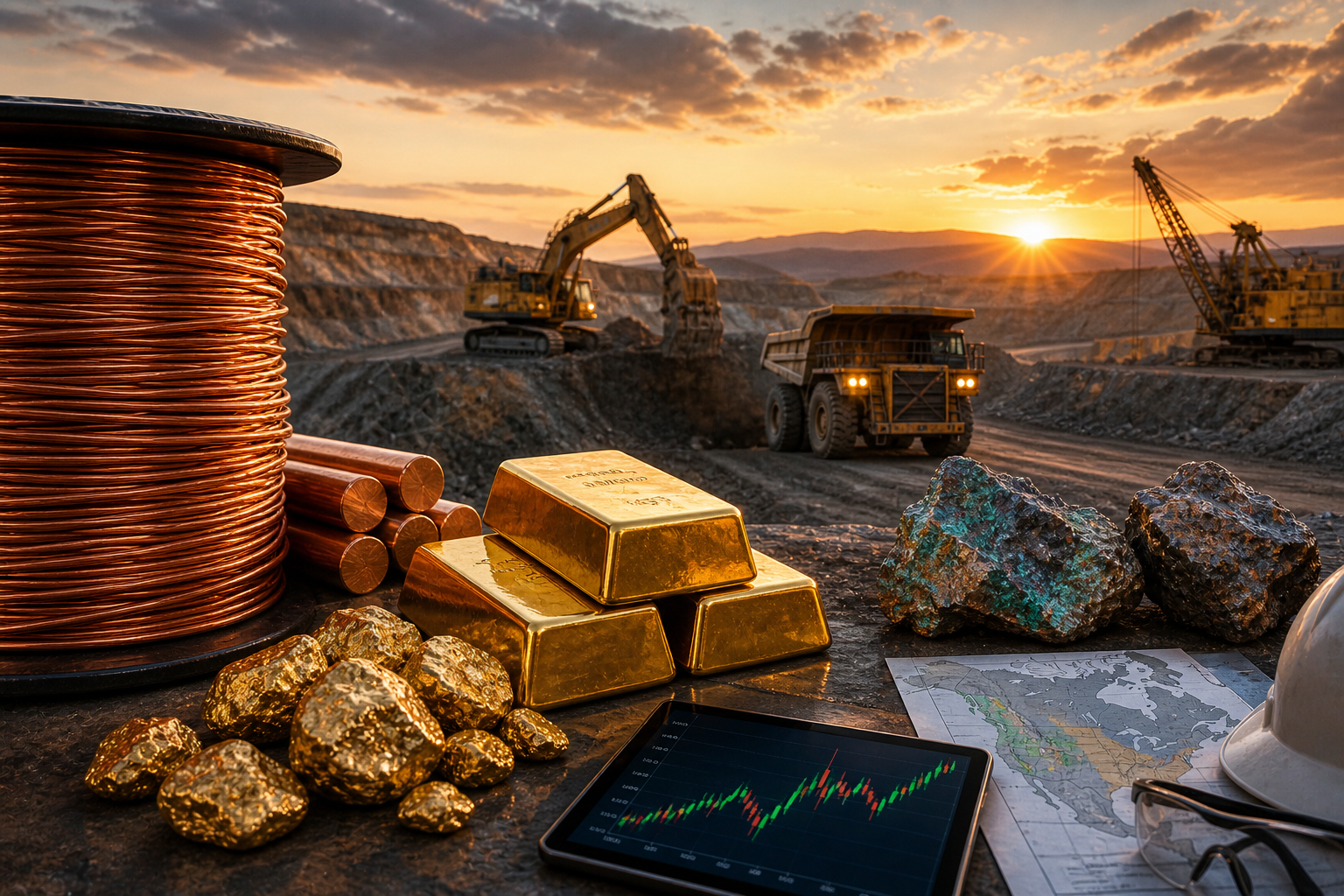
Copper and gold are sending the same message to investors from two different corners of the market: hard assets are back at the center of the global investment debate. Copper is being pulled higher by electrification, AI infrastructure, defense needs, and strategic supply concerns, while gold remains supported by safe-haven demand, central-bank buying themes, and geopolitical volatility. At the same time, mining policy and dealmaking are moving just as fast as commodity prices.
For investors, the metals and mining sector is no longer just a cyclical bet on global growth. It has become a strategic arena where energy transition, artificial intelligence, national security, inflation risk, and permitting politics all collide. On May 5, copper prices moved higher again, gold-sector consolidation accelerated, and North American mining policy remained a market-moving story after the U.S. lifted restrictions near Minnesota’s Boundary Waters region.
Copper’s Rally Reflects More Than Short-Term Speculation
Copper rose on May 5, with Trading Economics showing the metal around $5.84 to $5.93 per pound, up on the day and roughly 23% to 25% higher year over year, depending on the benchmark snapshot. Copper had also touched an all-time high earlier in 2026, underscoring how quickly the market has repriced the metal’s long-term importance.
The bullish case is not hard to understand. Copper is essential for power grids, electric vehicles, data centers, industrial automation, transmission lines, defense systems, and renewable-energy infrastructure. In a world racing to electrify, digitize, and secure critical supply chains, copper is becoming less of a traditional base metal and more of a strategic industrial input.
S&P Global’s “Copper in the Age of AI” report framed copper as central to electrification, digitalization, AI data centers, electric vehicles, and defense needs through 2040. That matters because investors are increasingly linking copper demand not only to China’s construction cycle, but also to U.S. AI infrastructure, grid upgrades, cloud computing, and national-security spending.
AI Infrastructure Adds a New Demand Layer
The AI boom is changing how investors think about commodities. Data centers require enormous amounts of power infrastructure, cooling systems, backup generation, wiring, switchgear, transformers, and grid connectivity. Copper is embedded throughout that system.
BHP has highlighted the role of copper in data centers and AI-related power infrastructure, citing the broader increase in data-center investment and electricity needs. The International Energy Agency has also noted that global data-center electricity consumption could rise significantly this decade, increasing pressure on power systems and related materials demand.
This is why copper producers and developers are gaining investor attention even when macro data is mixed. The metal is tied to several investment themes at once: AI, electrification, grid modernization, defense, and supply-chain security. That multi-theme exposure can support valuations, especially for producers with low-cost assets, long mine lives, and operations in stable jurisdictions.
Still, investors should be careful. Copper rallies can become crowded, and warehouse inventories, Chinese demand, smelter economics, and speculative positioning can create volatility. The long-term setup may be constructive, but entry price matters.
Gold Consolidation Shows Miners Are Chasing Scale
Gold is delivering a different but equally important message. Elevated bullion prices are encouraging mining companies to pursue consolidation, improve operating scale, and strengthen balance sheets. The latest example is the proposed merger between Regis Resources and Vault Minerals, which would create one of Australia’s largest listed gold producers.
The Wall Street Journal reported that Regis agreed to acquire Vault in a deal creating a gold miner with an estimated market value of about US$7.67 billion, or A$10.7 billion. Under the transaction, Vault shareholders would receive 0.6947 Regis shares for each Vault share, and the combined company is expected to produce more than 700,000 troy ounces of gold annually from five Western Australian assets, with additional projects in New South Wales and Canada.
The deal is significant because it reflects a broader trend: miners are using high gold prices to build scale. Larger producers can often access capital more efficiently, diversify asset risk, reduce overhead, improve reserve replacement options, and compete for acquisitions. In a sector where mine lives, development costs, and permitting delays can pressure long-term growth, scale matters.
The Australian Financial Review reported that the Regis-Vault merger creates a A$10.7 billion gold-mining group and may signal more deals ahead in Western Australia’s Leonora and Laverton regions.
Gold’s Safe-Haven Role Remains Intact
Gold’s investment case remains tied to uncertainty. Investors are using bullion and gold equities as hedges against geopolitical risk, currency weakness, inflation volatility, and central-bank policy uncertainty. The Wall Street Journal’s basic materials roundup noted spot gold was up 0.5% at $4,541.83 an ounce, while State Street Investment Management suggested gold could benefit if Federal Reserve guidance continues pointing toward future rate cuts, though higher oil prices or a hawkish Fed could limit gains.
That is an important nuance. Gold often benefits from lower real rates, weaker currencies, geopolitical stress, and safe-haven demand. But if oil-driven inflation forces central banks to stay restrictive for longer, gold’s path can become more volatile.
For mining investors, the distinction between gold bullion and gold equities is critical. Bullion offers direct exposure to the metal. Gold miners offer leveraged exposure, but also carry operational risk, cost inflation, reserve depletion, jurisdictional risk, and management execution risk. The Regis-Vault merger shows that even in a strong gold market, companies still need to solve long-term reserve and mine-life challenges.
Mining Policy Is Becoming a Market Catalyst
North America’s mining-policy debate is becoming increasingly important to investors. President Donald Trump recently lifted a federal ban on mining near Minnesota’s Boundary Waters Canoe Area Wilderness, reversing a 20-year moratorium put in place under the Biden administration. The move allows Chilean-owned Twin Metals Minnesota, a subsidiary of Antofagasta, to restart efforts to pursue copper, nickel, and other metals in the Superior National Forest, though the project still faces permitting, legal, environmental, and state-level hurdles.
MPR News reported that the decision ends a moratorium on about 350 square miles of federal land south of the Boundary Waters, while other local reporting noted the area contains deposits of copper, nickel, and cobalt.
For investors, the policy change is a reminder that critical-minerals supply is not determined by geology alone. It is determined by permitting, litigation, community acceptance, environmental rules, Indigenous and cross-border concerns, and political control. A project can look valuable on paper and still remain years away from production.
That makes jurisdictional risk one of the most important variables in mining valuation. Projects in the U.S. and Canada may benefit from strategic-minerals policy, but they are also subject to intense environmental scrutiny. Investors should not assume that a political green light automatically translates into a producing mine.
Uranium and Critical Minerals Stay Strategic
Copper and gold are grabbing headlines, but the broader critical-minerals theme also includes uranium, nickel, cobalt, lithium, graphite, rare earths, and other materials tied to energy security and industrial resilience. The International Energy Agency’s Critical Minerals Data Explorer tracks demand projections for 37 critical minerals needed for clean-energy transitions, highlighting how broad the investment theme has become.
Uranium remains especially relevant because nuclear power is increasingly viewed as a solution for reliable, low-carbon baseload electricity. As AI data centers and grid demand grow, investors are watching whether utilities, governments, and large technology companies expand nuclear commitments. That could support uranium miners, developers, and nuclear-fuel-cycle companies, though the sector remains exposed to policy risk, long project timelines, and regulatory complexity.
The key point is that critical minerals are becoming strategic assets. Governments want secure supply. Companies want resilient sourcing. Investors want exposure to the materials behind electrification, AI infrastructure, defense, and energy independence.
Key Investment Insight
The strongest investment takeaway is that metals and mining exposure should be evaluated through both commodity prices and strategic positioning. Copper offers leverage to electrification, AI infrastructure, grid expansion, and defense spending. Gold offers safe-haven exposure and potential upside through consolidation. Uranium and other critical minerals provide long-duration optionality tied to energy security and industrial policy.
However, investors should separate high-quality exposure from speculative exposure. Strong producers with operating cash flow, low debt, long-life assets, and disciplined capital allocation may be better positioned than early-stage explorers relying on promotional commodity narratives. For developers, permitting progress, environmental approvals, financing plans, and jurisdictional stability are just as important as resource size.
A balanced mining strategy may include copper producers for structural demand, gold exposure for macro hedging, and selective critical-minerals names for strategic upside. But investors should be prepared for volatility, especially when policy headlines, commodity price swings, and geopolitical shocks move faster than mine development timelines.
What Investors Should Watch Next
Copper investors should monitor whether prices hold recent gains, whether AI and grid infrastructure spending continues accelerating, and whether supply disruptions tighten the market further. Gold investors should watch M&A activity, central-bank demand, real-rate expectations, and miner cost inflation. Mining-policy investors should track U.S. and Canadian permitting decisions, especially around copper, nickel, uranium, and other strategic minerals.
The metals and mining sector is entering a new phase. It is not just about digging commodities out of the ground; it is about controlling the inputs required for the next industrial cycle. Copper powers the grid. Gold protects portfolios. Uranium supports energy security. And policy determines which projects actually get built.
Stay with MoneyNews.Today for daily investor-focused coverage of metals, mining, commodities, energy security, and the market trends shaping capital flows.