
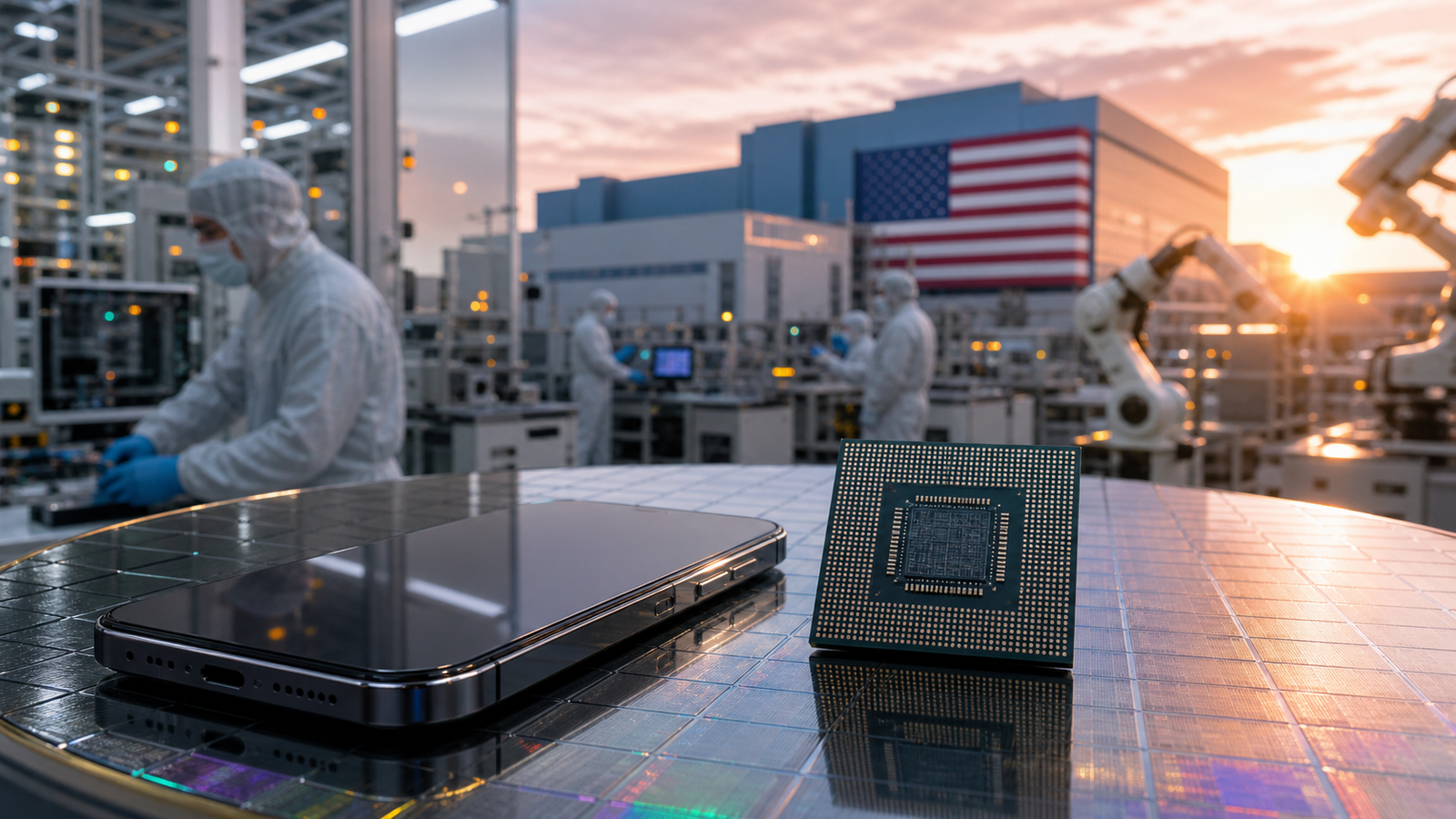
Apple’s reported talks with Intel and Samsung are more than a supply-chain footnote. They may signal one of the most important technology-investment themes of 2026: the push to bring advanced semiconductor production closer to the United States and reduce dependence on Taiwan-based manufacturing.
According to Bloomberg reporting republished by Yahoo Finance, Apple has held exploratory discussions with Intel and Samsung Electronics about producing the main processors for its devices in the U.S., potentially creating a secondary manufacturing option beyond longtime chipmaking partner Taiwan Semiconductor Manufacturing Co. The discussions are still preliminary, and no production orders have been placed, but the strategic message is clear: the world’s most valuable consumer technology company is examining ways to diversify where its most important chips are made.
For investors, this is not just an Apple story. It is a semiconductor reshoring story, a geopolitical-risk story, and a potential catalyst for foundries, chip-equipment suppliers, advanced packaging firms, and U.S.-based manufacturing infrastructure.
Why Apple’s Chip Strategy Matters
Apple designs the processors that power its most important devices, including iPhones, iPads, Macs, and other hardware categories. For more than a decade, the company has relied heavily on TSMC to manufacture those chips using advanced process technology, much of it based in Taiwan. Bloomberg described that relationship as central to Apple’s device strategy, noting that Apple has designed its own main processors while depending on TSMC’s leading-edge production capabilities.
That model has worked extremely well. Apple’s custom chips have helped improve performance, battery life, hardware-software integration, and product differentiation. But the model also creates concentration risk. If geopolitical tensions around Taiwan intensify, or if advanced-node capacity remains constrained, Apple could face supply-chain vulnerabilities that affect product launches, margins, and long-term planning.
The reported Intel and Samsung discussions suggest Apple is at least evaluating alternatives. MacRumors, citing Bloomberg, reported that Apple held early-stage talks with Intel about using its chipmaking services and that Apple executives visited a Samsung plant under construction in Texas that is expected to make advanced chips.
The key phrase is “exploratory.” Investors should not assume an imminent shift away from TSMC. Advanced chip production is complex, expensive, and technically demanding. Apple will not move major processor production unless yield, performance, cost, reliability, and scale meet its standards. Still, even early talks matter because Apple’s supply-chain decisions can reshape entire segments of the semiconductor industry.
The Reshoring Trade Gains Momentum
The U.S. has made semiconductor manufacturing a national economic and security priority. The logic is straightforward: chips power smartphones, cars, cloud servers, AI systems, defense platforms, industrial automation, and data centers. A supply disruption in advanced semiconductors can ripple across the global economy.
Apple’s reported interest in U.S.-based chip production fits into this broader reshoring trend. TSMC is expanding aggressively in Arizona, Intel is trying to rebuild itself as a major foundry competitor, and Samsung is investing in Texas fabrication capacity. Together, these investments reflect a structural effort to reduce overreliance on Asia-based manufacturing while building more resilient supply chains in North America.
Samsung’s Texas project is particularly relevant to the Apple story. Local reporting from MySA said Samsung is progressing toward the launch of its $17 billion semiconductor plant in Taylor, Texas, with tooling installation underway and chip production targeted by the end of 2026, followed by further expansion plans.
If Samsung can prove advanced manufacturing capability in Texas, it could become more strategically relevant to large U.S. customers. Apple would likely require extensive testing before assigning major processor volume, but Samsung’s U.S. fab footprint gives it a seat at the table.
Intel’s Foundry Ambition Gets a Potential Validation Moment
Intel may have the most to gain from the perception shift. The company has spent years trying to transform from an integrated chipmaker into a serious contract-manufacturing alternative to TSMC and Samsung. Winning meaningful Apple business would be a major credibility boost.
That does not mean Apple is close to awarding Intel production of iPhone or Mac processors. Intel still has to prove it can deliver advanced-node foundry services at scale with competitive yields. But the fact that Apple is reportedly willing to hold talks is important for investor sentiment.
Intel’s bull case depends partly on whether major external customers believe its foundry roadmap is real. Apple is among the most demanding semiconductor customers in the world. Even preliminary engagement may encourage investors to re-examine Intel’s optionality, especially if U.S. policy continues favoring domestic semiconductor capacity.
The risk is execution. Intel’s turnaround remains complex, capital-intensive, and highly competitive. Investors should separate “strategic possibility” from “confirmed revenue.” The Apple discussions may support the narrative, but actual foundry wins, production timelines, margin contribution, and yield performance will determine the financial impact.
TSMC Still Remains the Benchmark
A potential Apple diversification strategy should not be read as a negative verdict on TSMC. TSMC remains the global leader in advanced foundry manufacturing and continues to dominate leading-edge chip production. SemiWiki described TSMC as the “undisputed leader” in pure-play foundry manufacturing, with Samsung Foundry and Intel Foundry competing for strategic relevance in the same advanced-chip landscape.
For Apple, the goal may be less about replacing TSMC and more about building redundancy. A second or third manufacturing option could reduce geopolitical risk, improve supply-chain flexibility, and strengthen Apple’s negotiating position over time.
That said, TSMC’s dominance creates a high hurdle for competitors. Apple’s chips depend on tight integration between design and manufacturing process. Any alternative foundry must match performance requirements without compromising device efficiency or production scale. That is difficult, especially for flagship processors.
The more realistic near-term scenario may involve Apple testing lower-volume or less performance-sensitive chips before considering broader processor diversification. Over time, however, successful U.S.-based production by Intel or Samsung could alter the competitive structure of the foundry market.
Who Could Benefit Beyond Apple
Investors should look beyond the headline names. If Apple and other major technology companies diversify chip production into the U.S., the beneficiaries may include several layers of the semiconductor supply chain.
First are foundries: Intel and Samsung could benefit from customer wins, higher utilization, and strategic relevance. TSMC may also benefit from U.S. reshoring through its Arizona expansion, even if Apple explores additional partners.
Second are semiconductor equipment suppliers. Advanced fabs require lithography, deposition, etching, inspection, metrology, and process-control tools. Companies exposed to fab construction and leading-edge process equipment could benefit from sustained capital spending.
Third are materials and specialty suppliers, including gases, wafers, chemicals, photoresists, and cleanroom infrastructure providers. Reshoring is not just about building fabs; it requires a localized supplier ecosystem.
Fourth are advanced packaging and testing companies. As chips become more complex, packaging is increasingly important for performance, power efficiency, and AI workloads. Domestic capacity in packaging could become a strategic priority alongside wafer fabrication.
Finally, infrastructure providers may benefit. Semiconductor plants require reliable power, water, construction services, industrial automation, and logistics. Large fab projects can create demand across regional industrial ecosystems.
Why Investors Should Be Cautious
The reshoring theme is powerful, but it is not risk-free. Semiconductor fabrication is one of the most capital-intensive industries in the world. Projects often face delays, cost overruns, skilled-labor shortages, permitting challenges, and technology-transition risk.
Investors should also be careful about overpricing headlines. Apple’s talks with Intel and Samsung are preliminary. Business Standard, citing Bloomberg, reported that neither effort has resulted in orders and that the work remains early-stage.
That means the near-term earnings impact may be limited. Intel shares, Samsung sentiment, and chip-equipment stocks may react to the story, but durable investment upside will require signed production agreements, confirmed timelines, and evidence that U.S.-based advanced fabs can operate competitively.
There is also a margin question for Apple. Diversifying production may improve supply-chain resilience, but U.S.-based production may carry higher costs than Taiwan-based manufacturing. If Apple absorbs those costs, margins could face pressure. If it passes costs through, device pricing could become more sensitive.
Key Investment Insight
The key investment takeaway is that semiconductor reshoring is becoming a long-duration theme, not a short-term trade. Apple’s reported discussions with Intel and Samsung reinforce the idea that major technology companies are actively evaluating supply-chain resilience, geopolitical risk, and domestic manufacturing capacity.
For investors, the most attractive opportunities may sit in companies that benefit regardless of which foundry wins Apple volume: chip-equipment suppliers, advanced packaging providers, fab infrastructure companies, and critical materials suppliers. Intel and Samsung offer more direct upside if they win Apple-related production, but they also carry higher execution risk.
Apple itself could benefit strategically if it reduces dependence on a single foundry geography, but investors should not expect an immediate transformation. The company’s supply chain is too complex, and TSMC’s technical leadership remains too important, for a rapid shift.
What to Watch Next
Investors should watch for three developments. First, whether Apple moves beyond exploratory talks into test production or formal agreements. Second, whether Intel’s foundry roadmap shows measurable progress with external customers. Third, whether Samsung’s Texas fab meets production milestones and attracts advanced-chip customers.
The broader semiconductor market should also be monitored for signs of capacity tightness. AI demand continues to absorb advanced-node production, and companies from Apple to Nvidia, AMD, Amazon, and Google are competing for leading-edge chip supply. If capacity remains constrained, Apple’s incentive to diversify will only increase.
The Apple-Intel-Samsung story is not just about where future iPhone or Mac chips may be manufactured. It is about the next phase of semiconductor competition, where national policy, supply-chain security, AI demand, and advanced manufacturing all intersect.
For daily investor-focused coverage of technology, semiconductors, AI, and market-moving corporate strategy, stay with MoneyNews.Today as your trusted source for actionable financial news and analysis.




