
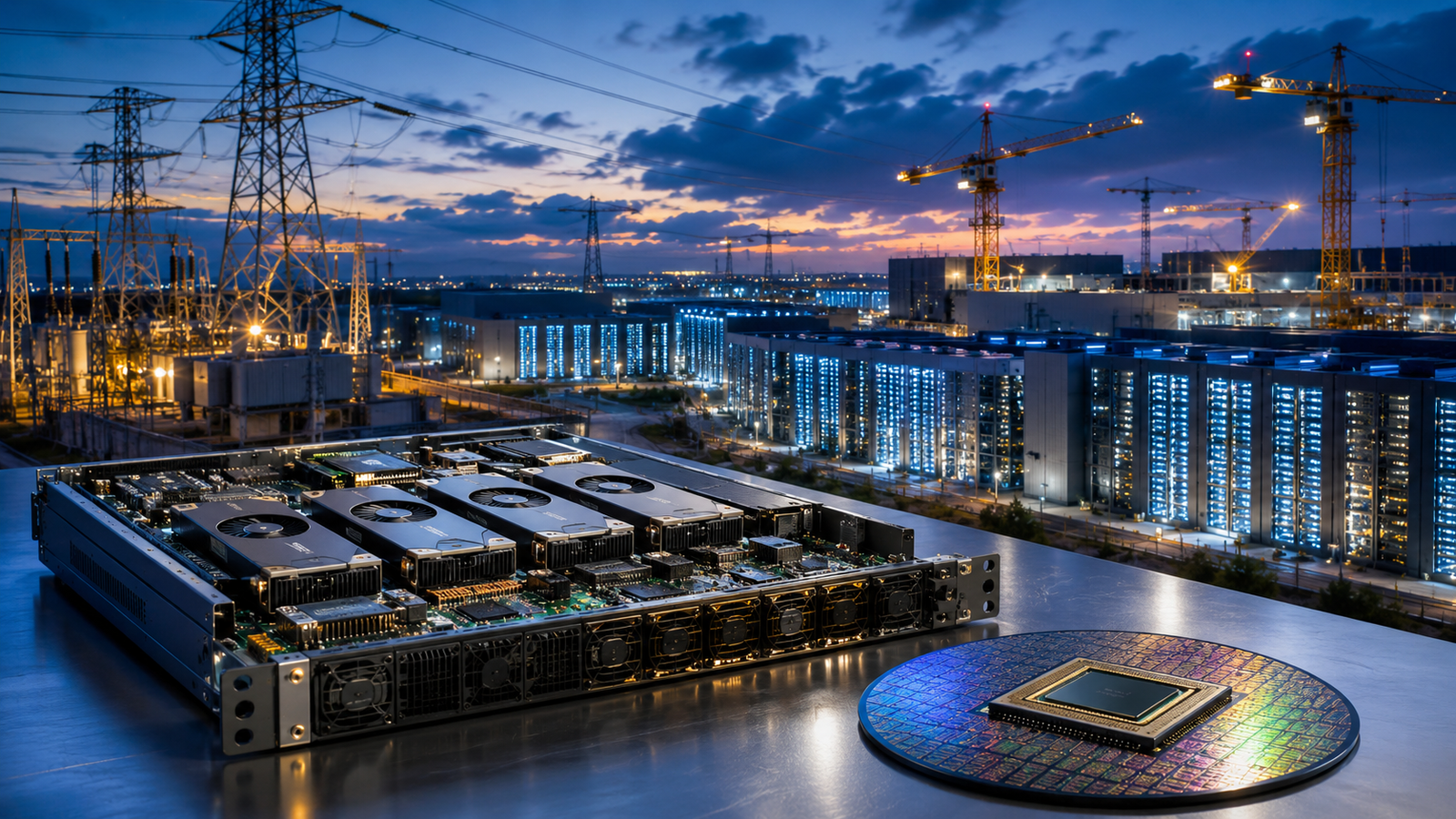
The artificial intelligence boom is no longer confined to software, chatbots, or semiconductor headlines. A new phase of the AI revolution is unfolding across North America, and it is rapidly transforming into one of the largest infrastructure investment cycles in modern technology history.
From billion-dollar data center projects to surging electricity demand and hyperscale cloud expansion, investors are increasingly focusing on the physical backbone powering artificial intelligence. On May 8, markets reacted strongly to reports that Nvidia plans to invest up to $2.1 billion in AI-focused data center operator IREN, while Hut 8’s massive $9.8 billion AI data center lease agreement in Texas reinforced the scale of capital now flowing into AI infrastructure.
According to Reuters and broader market infrastructure reports, engineering firms, utilities, and construction companies tied to AI facilities are also raising guidance as hyperscalers race to secure computing power for generative AI models. What began as a semiconductor-driven rally is now evolving into a full industrial expansion cycle touching energy, real estate, networking, cooling systems, and large-scale infrastructure development.
For investors, this shift could create opportunities far beyond traditional technology stocks.
The AI Boom Is Becoming an Infrastructure Story
Over the last two years, artificial intelligence has primarily been associated with companies like Nvidia, Microsoft, OpenAI, and other software and semiconductor leaders. But as AI adoption accelerates globally, the market is beginning to recognize a deeper reality: AI requires enormous amounts of physical infrastructure.
Training and deploying advanced AI models consumes vast computing resources. Those systems require high-performance chips, sophisticated networking hardware, advanced cooling systems, massive data centers, and reliable electricity supply at unprecedented scale.
That demand is now driving one of the fastest expansions in digital infrastructure seen in decades.
Nvidia’s reported investment plans involving IREN highlight how critical data center capacity has become in the AI race. Companies are no longer competing only on software capabilities—they are competing for access to computing power itself.
At the same time, Hut 8’s nearly $10 billion Texas AI data center lease demonstrates the extraordinary scale of investment flowing into hyperscale AI infrastructure.
According to Reuters, the deal underscores growing investor confidence that demand for AI compute capacity will continue accelerating through the second half of the decade.
This is becoming increasingly important for Wall Street because the AI infrastructure wave is broadening the number of sectors benefiting from the AI revolution.
Why Data Centers Are Suddenly One of the Hottest Markets
Data centers have emerged as one of the most important assets in the global AI economy.
Historically, data centers were viewed primarily as backend infrastructure supporting cloud computing and internet services. Today, they are becoming strategic assets directly tied to national competitiveness, AI innovation, and enterprise productivity.
Generative AI systems require exponentially more computing power than traditional software applications. Large language models, AI training systems, inference engines, and enterprise AI platforms all consume enormous amounts of GPU capacity and electricity.
This has created an unprecedented race among hyperscalers—including Microsoft, Amazon, Google, and Meta—to secure AI-ready infrastructure.
According to market analysts and infrastructure reports, AI data center demand is rising so rapidly that some regions are already experiencing power constraints and increased competition for land, energy access, and cooling capacity.
Investors are responding by aggressively targeting companies tied to:
- AI data center development
- GPU infrastructure
- Electrical grid expansion
- Cooling technology
- Fiber and networking systems
- Industrial engineering services
- Power generation infrastructure
This shift is turning AI into a much broader economic story than many investors initially anticipated.
Nvidia’s Influence Extends Beyond Chips
Nvidia remains the central force behind the AI infrastructure buildout.
While the company is best known for its dominance in AI accelerators and GPUs, its influence now extends across the entire AI ecosystem. Demand for Nvidia hardware continues to outpace supply as enterprises and cloud providers compete to expand AI capacity.
The company’s involvement in infrastructure partnerships and investments reflects a growing strategic reality: securing AI compute infrastructure may become just as important as designing advanced chips.
Analysts increasingly view Nvidia not only as a semiconductor company, but as a foundational infrastructure provider for the AI economy.
This broader positioning is one reason Nvidia has become one of the most influential stocks in global markets.
However, the AI infrastructure boom is also creating opportunities for companies beyond the semiconductor sector.
Utilities, industrial technology firms, construction companies, and energy providers are all beginning to benefit from rising AI-related capital expenditures.
The Energy Sector Is Becoming an Unexpected AI Winner
One of the most overlooked aspects of the AI expansion is electricity demand.
AI data centers consume enormous amounts of power, particularly facilities housing advanced GPU clusters used for large-scale model training. Some estimates suggest next-generation AI facilities may require energy consumption comparable to small cities.
As a result, utilities and energy infrastructure providers are becoming critical participants in the AI economy.
This trend is attracting growing investor attention toward:
- Natural gas infrastructure
- Nuclear energy projects
- Renewable power generation
- Grid modernization companies
- Energy storage systems
Several utility providers across the United States and Canada have already reported increased discussions surrounding AI-related energy demand.
According to infrastructure analysts cited in Reuters and broader market reports, power availability is becoming one of the biggest bottlenecks in AI data center expansion.
This creates a potentially powerful long-term investment theme extending far beyond technology companies alone.
Engineering and Construction Firms Are Seeing Demand Surge
Another major beneficiary of the AI infrastructure cycle is the industrial and engineering sector.
Building AI-ready data centers requires specialized construction capabilities, advanced cooling systems, electrical engineering expertise, and high-capacity networking infrastructure.
As hyperscaler spending accelerates, engineering and construction firms tied to AI infrastructure are reporting stronger order books and improved revenue visibility.
Several infrastructure-related companies have already raised guidance due to rising AI-related demand, according to Reuters reporting.
This dynamic is significant because it demonstrates how AI is beginning to influence the broader industrial economy.
Investors are increasingly recognizing that the AI revolution is not simply a software trend—it is also an industrial construction cycle involving billions of dollars in physical infrastructure investment.
Risks Investors Should Watch
Despite the optimism, investors should remain aware of several important risks.
Valuations across AI-related sectors have risen sharply, increasing the potential for volatility if spending growth slows or earnings expectations fail to materialize.
There are also growing concerns surrounding power availability, regulatory approvals, and infrastructure bottlenecks. AI facilities require enormous amounts of electricity, water, land, and cooling capacity, which could create operational challenges as expansion accelerates.
Another major risk is overcapacity.
If too many companies aggressively build AI infrastructure based on optimistic long-term demand assumptions, parts of the sector could eventually face pricing pressure or utilization challenges.
Geopolitical tensions also remain important. Semiconductor supply chains, energy security, and trade restrictions involving advanced AI hardware continue influencing investor sentiment across the industry.
Key Investment Insight
For investors, the most important takeaway is that artificial intelligence is evolving into a full-scale industrial infrastructure cycle rather than simply a software boom.
Companies tied to AI data centers, utilities, power generation, cooling systems, industrial engineering, networking infrastructure, and hyperscale cloud expansion are increasingly becoming secondary beneficiaries of the AI revolution.
Nvidia remains at the center of this ecosystem, but the opportunity is broadening rapidly across multiple sectors of the economy.
Investors should closely monitor AI infrastructure spending trends, energy demand growth, data center expansion activity, and hyperscaler capital expenditures throughout 2026. Firms positioned to support the physical infrastructure powering AI may benefit from one of the largest technology-driven investment cycles in decades.
As AI continues reshaping industries worldwide, understanding the infrastructure behind the technology may become just as important as understanding the software itself.
Stay with MoneyNews.Today for more daily investor insights covering AI, emerging industries, stock markets, crypto, commodities, and the global trends shaping the future of investing.




