
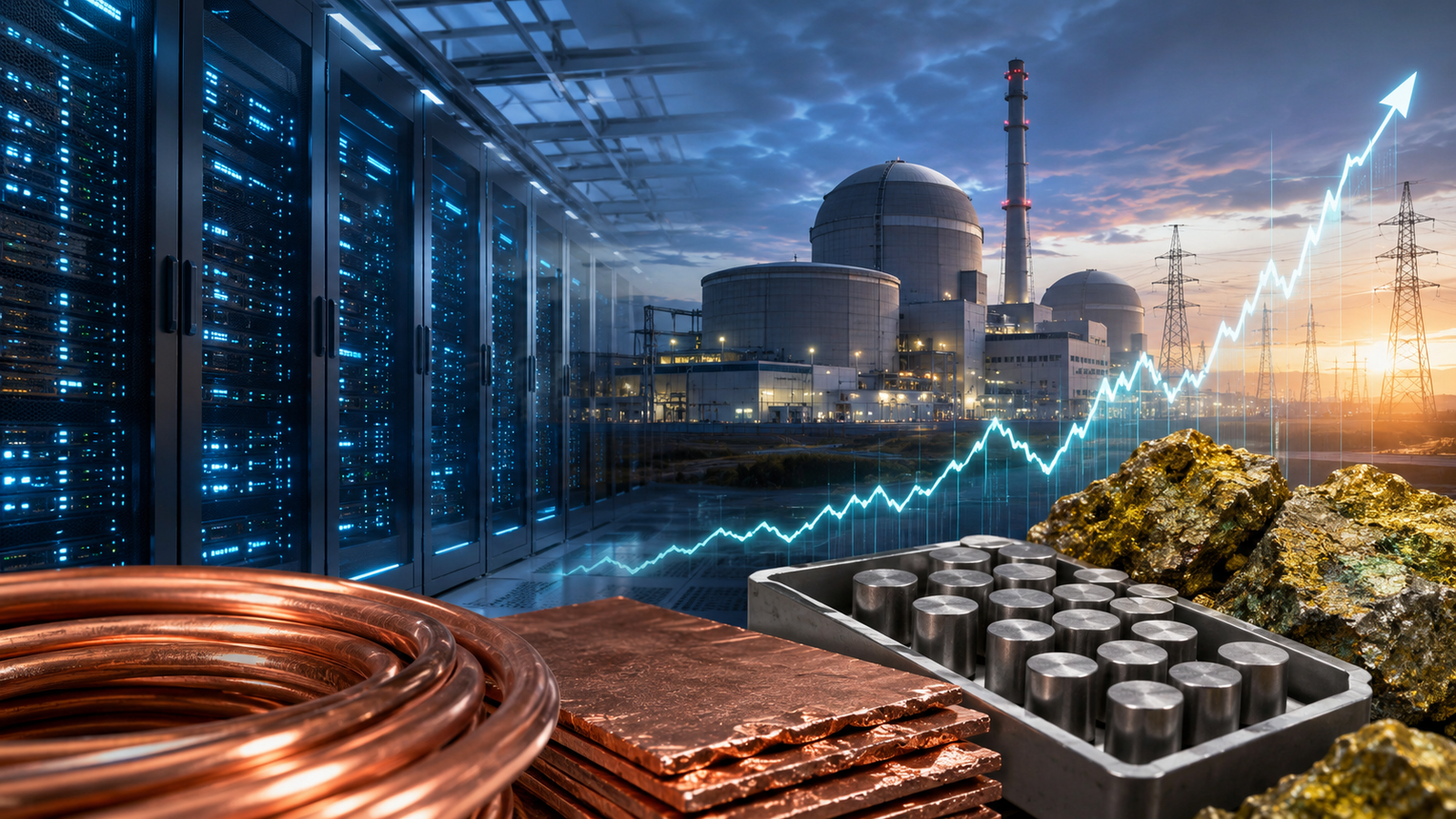
The global race for artificial intelligence dominance is creating an unexpected group of market winners: uranium producers, copper explorers, and critical mineral developers.
As AI data centers expand, electrification accelerates, and governments intensify efforts to secure strategic supply chains, investors are pouring capital into nuclear fuel companies and mining firms tied to critical minerals essential for the next generation of energy and technology infrastructure.
The momentum accelerated this week following renewed market attention on HALEU nuclear fuel development, uranium supply security, and copper exploration projects tied to AI-driven electricity demand. Industry coverage from World Nuclear News alongside broader market discussions surrounding companies such as Asp Isotopes and emerging copper developers has fueled growing investor enthusiasm across the metals and mining sector.
For investors, the story is no longer simply about commodity prices.
It is about the intersection of artificial intelligence, geopolitics, energy security, industrial policy, and infrastructure scarcity — themes increasingly shaping long-term capital flows across global markets.
And Wall Street is beginning to recognize that the AI revolution may ultimately require a massive expansion in energy production and raw material supply.
AI Is Creating a Massive Energy Demand Shock
The rapid rise of artificial intelligence is dramatically increasing electricity demand forecasts across the global economy.
AI data centers require enormous computational power, particularly for training and operating large language models, hyperscale cloud systems, and advanced AI infrastructure. The energy requirements tied to these systems are becoming so significant that investors are increasingly viewing electricity generation as one of the defining investment themes of the decade.
According to estimates from the International Energy Agency (IEA), global electricity demand from data centers could surge sharply over the coming years as AI adoption accelerates. Major technology firms including Microsoft, Amazon, Google, and Meta continue investing billions into hyperscale AI infrastructure, fueling concerns that existing power grids may struggle to meet future demand.
That dynamic is revitalizing investor interest in nuclear energy.
Unlike intermittent renewable sources such as solar and wind, nuclear power provides stable baseload electricity generation capable of supporting large-scale industrial and AI infrastructure operations.
Governments increasingly see nuclear energy as strategically important not only for decarbonization goals, but also for maintaining technological competitiveness in an AI-driven economy.
That shift is creating powerful tailwinds for uranium markets and nuclear fuel suppliers.
HALEU Fuel Is Becoming a Strategic Battleground
One of the fastest-growing themes within the nuclear sector is HALEU — High-Assay Low-Enriched Uranium.
HALEU fuel is expected to play a critical role in the next generation of advanced nuclear reactors, including small modular reactors (SMRs), which many governments and energy companies view as essential to future energy security strategies.
The problem is supply.
At present, global HALEU production capacity remains extremely limited, and much of the existing enrichment infrastructure has historically been concentrated in Russia. That dependency has become increasingly problematic amid rising geopolitical tensions and efforts by Western governments to secure independent nuclear fuel supply chains.
This is where companies tied to uranium enrichment, nuclear fuel processing, and isotope technologies are attracting heightened investor attention.
Asp Isotopes and other firms operating in the nuclear fuel ecosystem are increasingly being viewed as potential strategic beneficiaries of Western efforts to reduce reliance on foreign-controlled uranium infrastructure.
Governments are now actively supporting domestic nuclear fuel initiatives through subsidies, research partnerships, and long-term energy policy planning.
For investors, the implications are substantial.
The nuclear fuel cycle — once viewed as a niche commodity segment — is rapidly evolving into a strategic geopolitical industry tied directly to energy independence and national security.
Copper Is Emerging as One of the Most Important AI Commodities
While uranium is attracting headlines, copper may be the most critical long-term commodity tied to AI infrastructure expansion.
Every major electrification trend requires copper.
AI data centers, electrical grids, renewable energy systems, electric vehicles, battery infrastructure, and semiconductor manufacturing all depend heavily on copper-intensive infrastructure. As global electrification accelerates, analysts increasingly warn that future copper supply may struggle to keep pace with demand growth.
According to projections from S&P Global and the International Energy Agency, global copper demand could rise dramatically over the next decade due to energy transition and digital infrastructure expansion.
That forecast is fueling investor interest in copper developers and strategic mining assets worldwide.
Major mining firms are aggressively pursuing new copper reserves, particularly in politically stable jurisdictions across North America, South America, and Australia. Investors are also increasingly focusing on junior mining companies with promising exploration assets that could become acquisition targets as supply competition intensifies.
The AI boom is amplifying this trend.
As hyperscale computing infrastructure expands globally, the demand for electricity transmission, cooling systems, industrial wiring, and semiconductor production capacity all contribute to rising copper consumption forecasts.
That creates a long-duration bullish narrative for the metal.
Geopolitics Is Reshaping Commodity Markets
The growing rally across uranium and critical minerals is also deeply connected to geopolitics.
Governments increasingly view strategic resources as essential national security assets rather than ordinary commodities.
The United States, Canada, the European Union, and allied nations are aggressively attempting to reduce dependence on China and Russia for critical minerals, rare earth elements, uranium enrichment, and advanced industrial materials.
This push toward “resource nationalism” is reshaping capital allocation across mining and energy markets.
Western governments are increasingly offering incentives for domestic mining projects, refining infrastructure, and supply-chain development tied to strategic minerals. Defense concerns, AI infrastructure expansion, and energy transition goals are all reinforcing this trend simultaneously.
For investors, this creates an environment where strategic resource projects may receive stronger political support, financing opportunities, and long-term demand visibility.
The mining sector is increasingly becoming part of broader industrial policy strategy.
Why Institutional Investors Are Returning to Commodities
Another major factor supporting the rally is the return of institutional capital to commodity markets.
For years, many institutional investors underweighted mining and resource sectors in favor of technology and growth equities. However, the combination of inflation concerns, geopolitical instability, AI infrastructure demand, and supply-chain constraints is changing that positioning.
Commodities are once again being viewed as strategic assets.
Large institutional investors are increasingly looking for exposure to uranium, copper, lithium, rare earths, and critical minerals tied to electrification and industrial transformation.
The market is also beginning to recognize that supply expansion in mining takes years — sometimes decades — to develop. Permitting challenges, environmental regulations, geopolitical risk, and capital intensity all constrain the speed at which new production can come online.
That supply scarcity may create long-term pricing support for strategic commodities.
Risks Investors Should Monitor
Despite growing optimism, commodity investing remains highly cyclical and volatile.
Uranium and copper prices can fluctuate significantly based on macroeconomic conditions, interest rates, industrial demand, and geopolitical developments. Mining companies also face operational risks, permitting challenges, financing constraints, and commodity price sensitivity.
Investors should also recognize that many junior mining companies remain speculative and dependent on future development success.
Additionally, shifts in government policy, energy regulation, or technological breakthroughs could influence long-term demand projections for specific commodities.
Still, the broader structural trends supporting strategic minerals appear increasingly powerful.
Future Trends Investors Should Watch
Several major themes are likely to shape the next phase of the metals and mining rally.
First, AI-related electricity demand could continue driving renewed investment into nuclear power infrastructure and uranium supply chains.
Second, copper demand is likely to remain a critical long-term theme as electrification, AI infrastructure, and grid modernization accelerate globally.
Third, governments are expected to continue supporting domestic critical mineral development through subsidies, strategic partnerships, and industrial policy initiatives.
Finally, strategic resource competition may intensify globally as nations race to secure control over energy and technology supply chains.
Key Investment Insight
The rally in uranium, copper, and strategic minerals reflects a major shift in how investors are viewing the future global economy.
Artificial intelligence, electrification, and energy security are converging to create what many analysts believe could become a multi-decade infrastructure supercycle. Companies tied to nuclear fuel production, copper exploration, critical mineral processing, and strategic resource development are increasingly positioned at the center of that transformation.
For investors, the strongest opportunities may emerge not only from major commodity producers, but also from junior miners, nuclear fuel suppliers, and infrastructure firms benefiting from Western efforts to diversify strategic supply chains.
The AI boom may dominate headlines, but the industries supplying the energy and raw materials powering that boom could become some of the market’s most important long-term winners.
Stay with MoneyNews.Today for more daily investor insights covering metals, mining, AI, energy, stock markets, crypto, and the trends shaping the future of global investing.




