
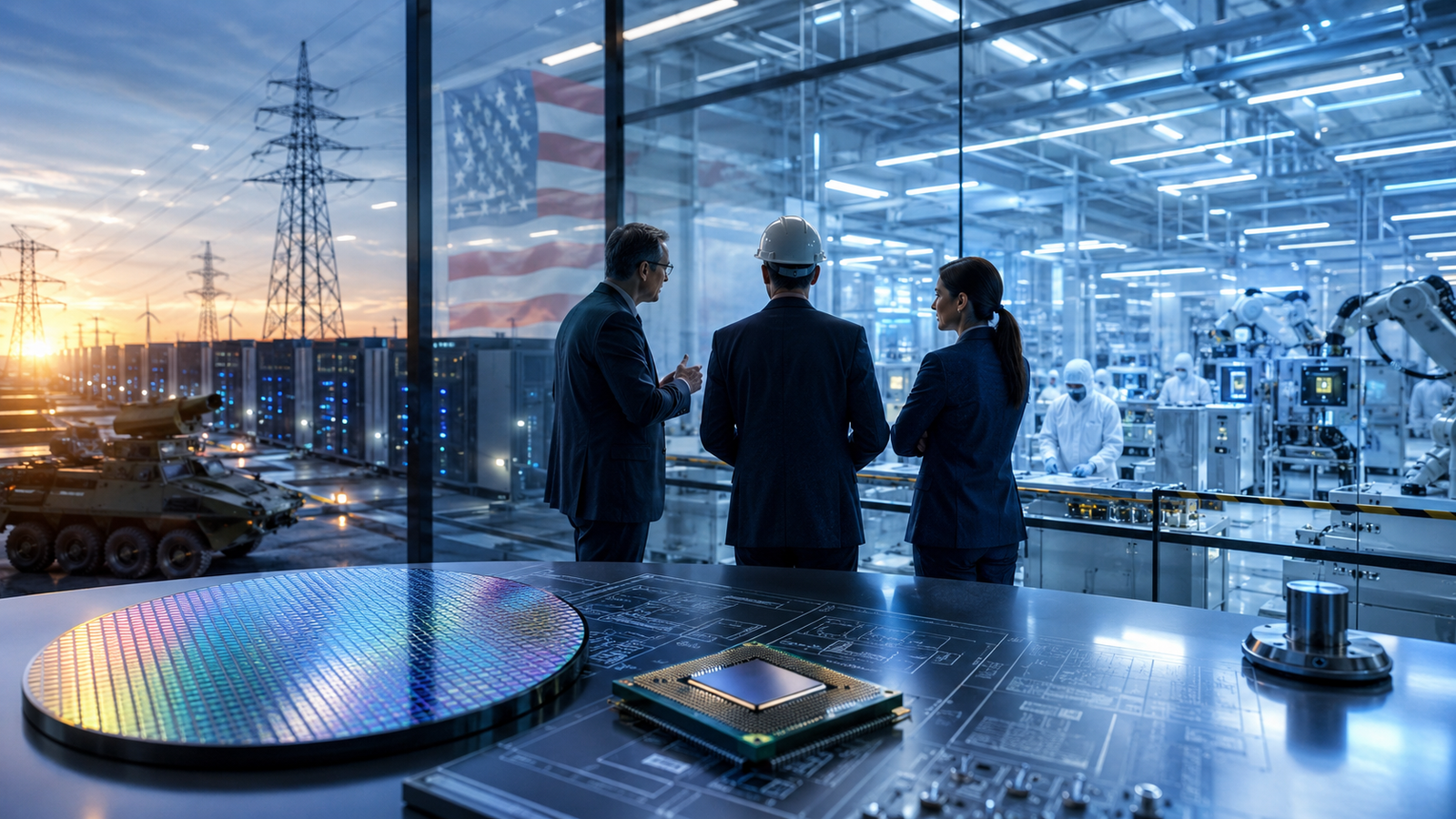
For decades, globalization encouraged corporations to prioritize efficiency, low-cost production, and overseas manufacturing dominance. Now, Washington is attempting to reverse that model — and investors are rapidly repositioning around the consequences.
The United States’ accelerating industrial policy push is transforming semiconductor manufacturing, strategic resource development, energy infrastructure, and defense-related supply chains into some of the most important investment themes in global markets.
Investor attention intensified this week following reports surrounding a potential manufacturing partnership between Apple and Intel, a development increasingly viewed as part of a much broader national effort to rebuild domestic semiconductor production and reduce reliance on foreign supply chains.
The reports, discussed across Wall Street Journal-linked coverage, Reuters commentary, and highly active investor discussions online, reinforced a growing market narrative: industrial policy is no longer a background political issue. It is becoming one of the dominant forces shaping capital allocation across the U.S. economy.
For investors, the implications stretch far beyond semiconductors.
The reshoring movement now touches artificial intelligence infrastructure, strategic minerals, energy systems, advanced manufacturing, defense technologies, and national security priorities. Government-backed investment incentives are increasingly driving private-sector capital spending decisions across multiple industries simultaneously.
The result is the emergence of a new economic framework where geopolitics, technology leadership, and industrial capacity are becoming deeply interconnected.
And Wall Street is positioning for it aggressively.
Why Industrial Policy Has Returned to the Center of Markets
For much of the last thirty years, markets largely rewarded globalization and outsourced manufacturing efficiency.
That model is now facing structural pressure from multiple directions:
- U.S.-China geopolitical tensions
- Semiconductor shortages
- AI infrastructure competition
- Supply-chain disruptions
- National security concerns
- Energy security priorities
- Strategic resource competition
The COVID-era supply-chain crisis exposed how dependent the global economy had become on concentrated overseas manufacturing hubs, particularly in semiconductors and critical industrial materials.
At the same time, the rise of artificial intelligence dramatically increased the strategic importance of advanced computing infrastructure.
Semiconductors are no longer viewed simply as commercial products. They are now considered foundational national assets critical to economic competitiveness, military systems, cybersecurity, cloud computing, and AI leadership.
That shift fundamentally changed Washington’s approach to industrial policy.
The U.S. government responded with major legislation including the CHIPS and Science Act, which allocated tens of billions of dollars toward domestic semiconductor manufacturing, research, and supply-chain development.
The goal is clear: rebuild strategic industrial capacity inside the United States.
For investors, that policy direction is becoming one of the most important long-term structural themes in markets.
The Apple-Intel Narrative Reflects a Bigger Strategic Shift
The reported Apple-Intel manufacturing discussions have attracted enormous investor attention because they symbolize a broader transformation occurring within the semiconductor industry.
For years, Taiwan Semiconductor Manufacturing Company, or TSMC, emerged as the dominant advanced chip manufacturer globally. Many of the world’s largest technology firms — including Apple, Nvidia, AMD, and Qualcomm — became heavily dependent on overseas semiconductor fabrication.
Now, geopolitical tensions surrounding Taiwan and rising concerns over supply-chain concentration are forcing companies to rethink those dependencies.
A potential Apple manufacturing relationship with Intel would represent more than a commercial agreement.
It would reinforce the growing political and economic push toward domestic semiconductor resilience.
Investors increasingly believe governments will continue supporting U.S.-based semiconductor manufacturing through subsidies, tax incentives, infrastructure support, and procurement policies tied to national security goals.
That expectation is helping fuel massive capital investment across the semiconductor sector.
Intel, TSMC, Samsung, and other major chipmakers are collectively spending hundreds of billions of dollars expanding manufacturing facilities globally, particularly in the United States.
The AI boom is accelerating this process even further.
AI Infrastructure Is Fueling the Manufacturing Renaissance
Artificial intelligence is transforming industrial policy from a defensive strategy into an economic growth engine.
AI systems require extraordinary computing power, which in turn depends on semiconductors, advanced networking hardware, data centers, energy infrastructure, and sophisticated manufacturing ecosystems.
This infrastructure expansion is creating one of the largest industrial investment cycles in decades.
According to McKinsey & Company, generative AI could contribute between $2.6 trillion and $4.4 trillion annually to the global economy. Supporting that growth will require enormous investments in physical infrastructure.
That includes:
- Semiconductor fabrication plants
- Electrical grid modernization
- Data center construction
- Advanced cooling systems
- Strategic mineral supply chains
- Energy generation capacity
- Industrial automation
As a result, industrial policy is increasingly overlapping with AI strategy.
Governments are no longer simply supporting manufacturing jobs. They are attempting to secure control over the infrastructure powering the next generation of technological competition.
Investors are beginning to recognize that this transformation extends far beyond traditional technology stocks.
Strategic Commodities Are Becoming National Security Assets
One of the most important side effects of the reshoring movement is the growing strategic importance of critical minerals and industrial commodities.
Semiconductors, batteries, defense systems, renewable energy infrastructure, and AI data centers all depend heavily on materials such as copper, uranium, lithium, rare earth elements, and advanced industrial metals.
Western governments are increasingly concerned about dependence on foreign-controlled supply chains for these materials, particularly those linked to China and Russia.
That concern is reshaping investment flows across the mining and energy sectors.
The United States and allied nations are now actively supporting domestic mining projects, critical mineral processing facilities, uranium enrichment infrastructure, and advanced industrial manufacturing systems.
This policy environment is creating significant opportunities for companies involved in:
- Strategic mineral exploration
- Domestic refining capacity
- Nuclear fuel production
- Semiconductor materials
- Energy infrastructure
- Defense manufacturing
For investors, industrial policy is becoming deeply connected to commodity markets.
The AI revolution may dominate headlines, but the physical resources powering that revolution are increasingly viewed as strategically essential assets.
Defense Technology and Energy Infrastructure Are Benefiting
Another important shift investors are watching is the convergence between industrial policy, defense spending, and energy security.
Advanced semiconductor manufacturing plays a central role in modern defense systems, cybersecurity infrastructure, aerospace technologies, and intelligence operations.
As geopolitical competition intensifies, governments are prioritizing domestic technological independence across sensitive sectors.
That trend is supporting increased investment into defense-tech manufacturing and industrial infrastructure.
Meanwhile, AI-related electricity demand is driving renewed attention toward energy systems.
AI data centers consume enormous amounts of power, creating long-term demand for utilities, grid modernization, nuclear energy, and transmission infrastructure.
This dynamic is broadening the list of potential beneficiaries tied to industrial policy expansion.
Investors are increasingly positioning around an ecosystem that includes semiconductors, industrial automation, utilities, advanced manufacturing, commodities, and defense-related infrastructure.
Why Investors Are Paying Attention to Capital Spending
One of the defining features of the current industrial policy cycle is the sheer scale of capital expenditures involved.
Building semiconductor fabs, nuclear infrastructure, strategic mineral processing facilities, and AI data centers requires enormous investment.
The market is now entering a period where government incentives and private-sector capital spending are reinforcing each other simultaneously.
This creates several important implications for investors.
First, infrastructure-related industries may experience multi-year demand visibility supported by policy tailwinds.
Second, companies tied to domestic manufacturing ecosystems could benefit from stronger political support and strategic funding opportunities.
Third, long-term supply constraints across semiconductors and critical minerals may continue supporting elevated pricing and investment activity.
However, investors should also monitor risks tied to overcapacity, execution challenges, geopolitical tensions, and rising financing costs.
Industrial policy can create enormous investment opportunities — but it can also produce periods of volatility and capital misallocation.
Future Trends Investors Should Watch
Several major themes are likely to define the next phase of the industrial policy investment cycle.
First, semiconductor reshoring efforts will remain central to U.S. technology strategy, particularly as AI infrastructure demand accelerates.
Second, critical mineral supply chains are likely to become increasingly politicized, driving additional investment into domestic mining and refining capacity.
Third, energy infrastructure may emerge as one of the biggest secondary beneficiaries of AI expansion due to rising electricity consumption from hyperscale data centers.
Finally, defense-tech manufacturing and industrial automation could experience sustained growth as governments prioritize strategic independence and advanced production capabilities.
Key Investment Insight
The U.S. industrial policy push is rapidly reshaping global investment markets by transforming semiconductors, strategic minerals, energy infrastructure, and advanced manufacturing into national strategic priorities.
For investors, this is no longer simply a political story. It is an economic and market transformation tied directly to artificial intelligence, supply-chain resilience, geopolitical competition, and long-term infrastructure expansion.
The companies best positioned for this environment may include semiconductor manufacturers, defense-tech firms, industrial automation providers, utilities, strategic commodity developers, and infrastructure companies benefiting from reshoring and domestic manufacturing investment.
The AI era is accelerating the need for physical industrial capacity — and governments are increasingly willing to support the industries building it.
Stay with MoneyNews.Today for more daily investor insights covering politics, technology, AI, commodities, stock markets, and the trends shaping the future of global investing.




