
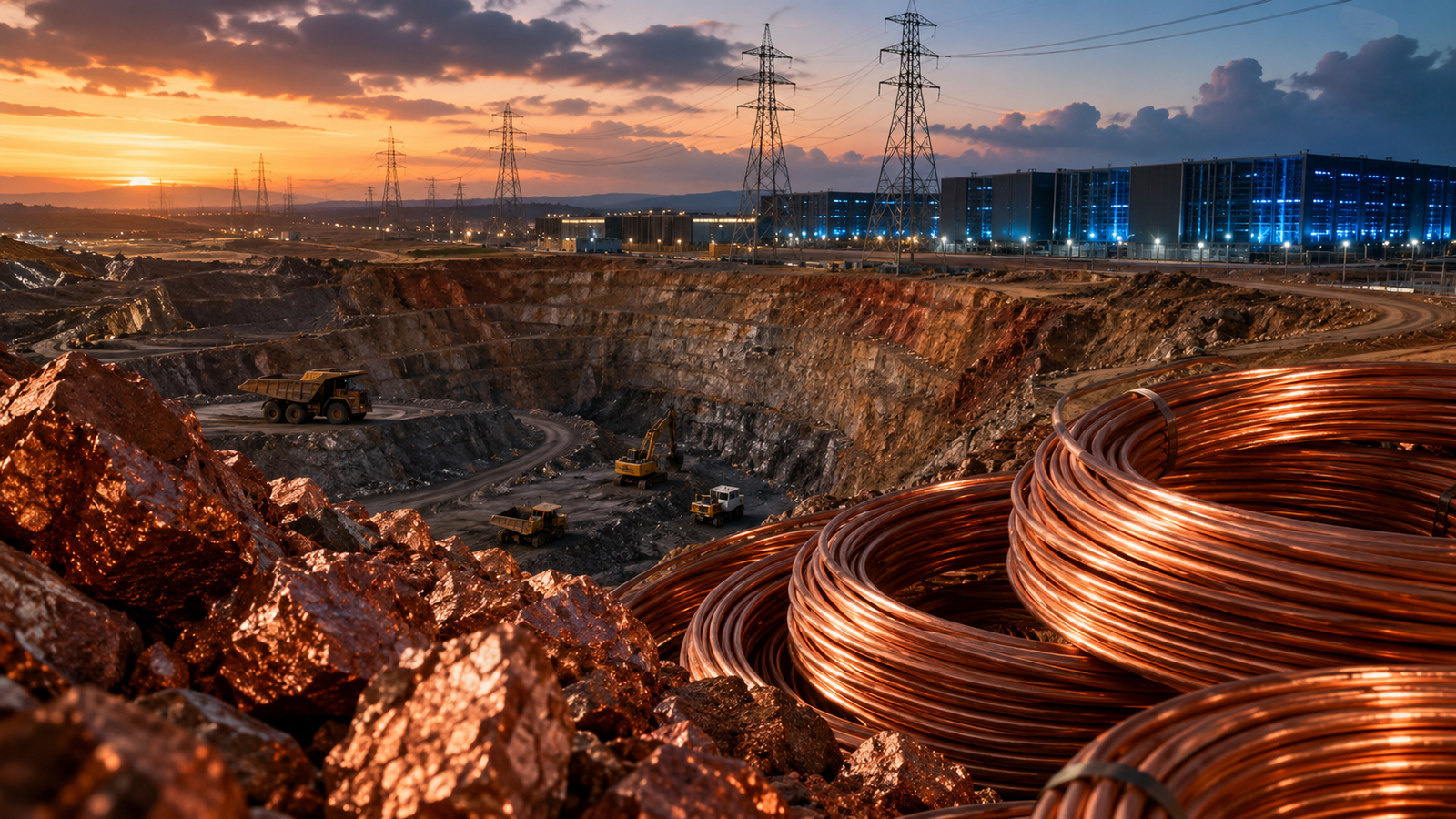
Copper is no longer trading like a quiet industrial metal. It is trading like the backbone of the artificial intelligence economy.
On May 13, 2026, copper prices pushed further into record territory as investors connected two powerful forces: surging electricity demand from AI data centers and mounting supply-chain stress across the global mining and refining system. Trading Economics reported copper near $6.58 per pound, up more than 8% over the past month and more than 43% year over year, with the metal reaching an all-time high in May 2026.
For investors, this is not just a commodities story. It is an AI infrastructure story, a power-grid story, and a supply-security story. The same artificial intelligence boom that has lifted Nvidia, AMD, power-equipment companies, and data-center operators is also pushing attention toward the metals needed to build and electrify the physical infrastructure behind digital growth.
Copper is essential for electrical wiring, power transmission, transformers, cooling systems, renewable-energy infrastructure, electric vehicles, grid upgrades, and data centers. That makes it one of the clearest “picks-and-shovels” trades tied to AI expansion.
Why Copper Is Breaking Out Now
Copper’s rally reflects a rare combination of strong demand and fragile supply. MarketWatch reported that July copper futures traded around $6.53 per pound, with record prices driven by AI-related infrastructure demand, supply disruptions, and tightening conditions in critical inputs such as sulfuric acid.
The AI angle is increasingly difficult for investors to ignore. Data centers require enormous amounts of electricity, and copper is central to delivering that power efficiently. High-density AI computing facilities need copper for internal wiring, power distribution, cooling systems, grounding, backup power systems, and grid connections. As hyperscale cloud providers expand AI capacity, the demand for reliable electrical infrastructure rises with them.
That demand is not limited to the United States. Global cloud companies, utilities, governments, and industrial operators are investing heavily in grid expansion and data-center capacity. The result is a market where copper demand is no longer driven only by traditional construction cycles or Chinese property activity. It is increasingly tied to secular themes: AI, electrification, renewable energy, electric vehicles, transmission infrastructure, and energy security.
The Wall Street Journal reported that copper futures reached fresh records for a third consecutive session, with most-traded contracts surpassing $6.50 per pound for the first time. The report cited data-center construction, supply disruptions, and a global sulfuric-acid shortage as major forces behind the move.
The Supply Chain Problem Investors Cannot Ignore
Copper demand is rising at the same time supply is becoming harder to expand. That is the core reason the market has turned so bullish.
New copper mines are expensive, politically sensitive, and slow to permit. Existing mines are dealing with declining ore grades, higher operating costs, environmental constraints, water stress, and local opposition. Even when prices rise, new supply cannot respond quickly.
The International Energy Agency warned earlier this year that copper markets had entered “uncharted territory” as structural and short-term pressures converged. The IEA noted that copper prices briefly exceeded $14,500 per metric ton intraday in January 2026, after crossing $12,000 per metric ton for the first time in December 2025.
That long-term constraint is now being made worse by short-term disruptions. The Wall Street Journal reported that slower restoration of operations at Freeport-McMoRan’s Grasberg mine in Indonesia, following a deadly mudslide, added to market anxiety. The same report also cited rising sulfuric-acid costs as a factor affecting copper processing.
This matters because Grasberg is one of the world’s most important copper operations. Any delay, disruption, or uncertainty at a mine of that scale can tighten market psychology, especially when inventories are already low and demand expectations are strong.
Sulfuric Acid Has Become a Hidden Copper Catalyst
One of the most important details behind copper’s record move is also one of the least understood by general investors: sulfuric acid.
Sulfuric acid is critical for extracting and processing copper and other industrial metals. When sulfuric acid becomes scarce or expensive, refining and mine operations can face cost pressure or production constraints. That is exactly what markets are now watching.
The Wall Street Journal reported that the war in the Persian Gulf and Chinese export restrictions have contributed to a global sulfuric-acid shortage and price surge. The report noted that Chile and Indonesia, both important mining jurisdictions, are especially exposed because they depend on sulfuric acid for metals production.
MarketWatch also reported that sulfuric acid supply pressures have been intensified by restricted tanker traffic through the Strait of Hormuz and China’s move to restrict sulfuric-acid exports. These developments are affecting a key input at the same time copper demand is strengthening from AI infrastructure and grid investment.
For investors, the sulfuric-acid issue is important because it shows that copper supply risk is not only about ore in the ground. It is also about refining chemistry, logistics, shipping routes, energy markets, geopolitics, and national export policies.
Why This Matters for AI Investors
Most investors think of the AI trade through semiconductors, cloud software, and data centers. But copper may be one of the most underappreciated ways to participate in the AI infrastructure cycle.
AI chips need electricity. Data centers need grid connections. Utilities need transmission lines. Cooling systems need conductive materials. Renewable power, battery storage, substations, and backup generation all require significant copper input. As AI workloads grow, the physical infrastructure behind the digital economy becomes more valuable.
That is why copper is increasingly being described as a “picks-and-shovels” AI trade. It does not depend on which model wins, which cloud provider signs the next major contract, or which chip architecture dominates. If AI infrastructure expands, copper demand tends to benefit across the value chain.
This theme also connects to power-equipment companies, utilities, engineering firms, miners, royalty companies, and exchange-traded funds tied to copper producers. Investors who missed the first wave of AI semiconductor gains may be looking at copper as a second-order beneficiary of the same structural trend.
Stocks and Companies to Watch
The most obvious equity names include Freeport-McMoRan, Teck Resources, Southern Copper, Rio Tinto, and BHP. Each provides exposure to copper production, though with different geographic, operational, and commodity mixes.
Freeport-McMoRan remains one of the most direct large-cap copper plays, but investors should monitor Grasberg-related updates closely because Indonesian operations are strategically important to the company’s production profile.
Teck Resources gives investors Canadian-listed copper exposure with meaningful relevance to North American resource portfolios. It may attract attention from investors seeking copper exposure outside pure U.S. miners.
Southern Copper offers high-margin copper exposure, though valuation and country-specific risk should be considered carefully.
Rio Tinto and BHP provide diversified mining exposure, with copper becoming increasingly important to their long-term growth strategies. The Wall Street Journal reported that Rio Tinto CEO Simon Trott said the company’s copper output rose 11% year over year and could rise another 13% by 2030, supported by assets including Oyu Tolgoi in Mongolia and Kennecott in Utah.
Investors should also watch Canadian copper developers, junior miners, and royalty companies. These names can offer higher upside in a rising copper market, but they also carry greater financing, permitting, execution, and liquidity risk.
Key Investment Insight
Copper’s record rally is supported by a real structural story, but investors should avoid treating the trade as risk-free.
The bullish case is clear: AI data centers, grid modernization, electrification, electric vehicles, and renewable energy all require more copper. Meanwhile, mine supply is slow to respond, input costs are rising, sulfuric-acid shortages are creating bottlenecks, and geopolitical disruptions are adding risk premiums.
The bearish risk is also real. Copper is economically sensitive. If global growth slows, China demand weakens, AI infrastructure spending pauses, or high prices trigger demand destruction, the metal could correct sharply. Commodity rallies often become volatile once speculative positioning builds.
A practical investor approach is to separate core exposure from high-beta exposure. Core exposure may include large producers such as FCX, TECK, SCCO, RIO, and BHP. High-beta exposure may include junior developers, explorers, royalty companies, and copper-focused ETFs. Investors should also track sulfuric-acid prices, Chinese inventories, mine disruptions, U.S. grid investment, AI data-center spending, and Federal Reserve policy because all can influence copper demand and valuation multiples.
Future Trends to Watch
The most important trend is whether copper demand remains resilient even at record prices. If AI and grid investment continue accelerating, copper may trade less like a cyclical metal and more like a strategic infrastructure asset.
The second trend is permitting. The Wall Street Journal reported that Rio Tinto’s CEO highlighted permitting delays as a major barrier to new supply and urged governments to streamline approvals. The same report noted that the Resolution Copper project in Arizona, backed by Rio Tinto and BHP, recently cleared its final federal permitting challenge after more than a decade.
The third trend is supply-chain nationalism. As copper becomes more central to AI, energy security, and industrial policy, governments may increasingly treat copper supply as a strategic priority. That could benefit domestic projects, politically stable jurisdictions, and companies with secure long-life assets.
Copper’s breakout is a message to investors: the AI boom is not only about chips and software. It is also about the metals, power systems, and infrastructure required to make the AI economy run.
For daily investor-focused analysis across commodities, AI, technology, markets, crypto, and policy, stay with MoneyNews.Today as your trusted source for market-moving financial news and actionable investment insight.




