
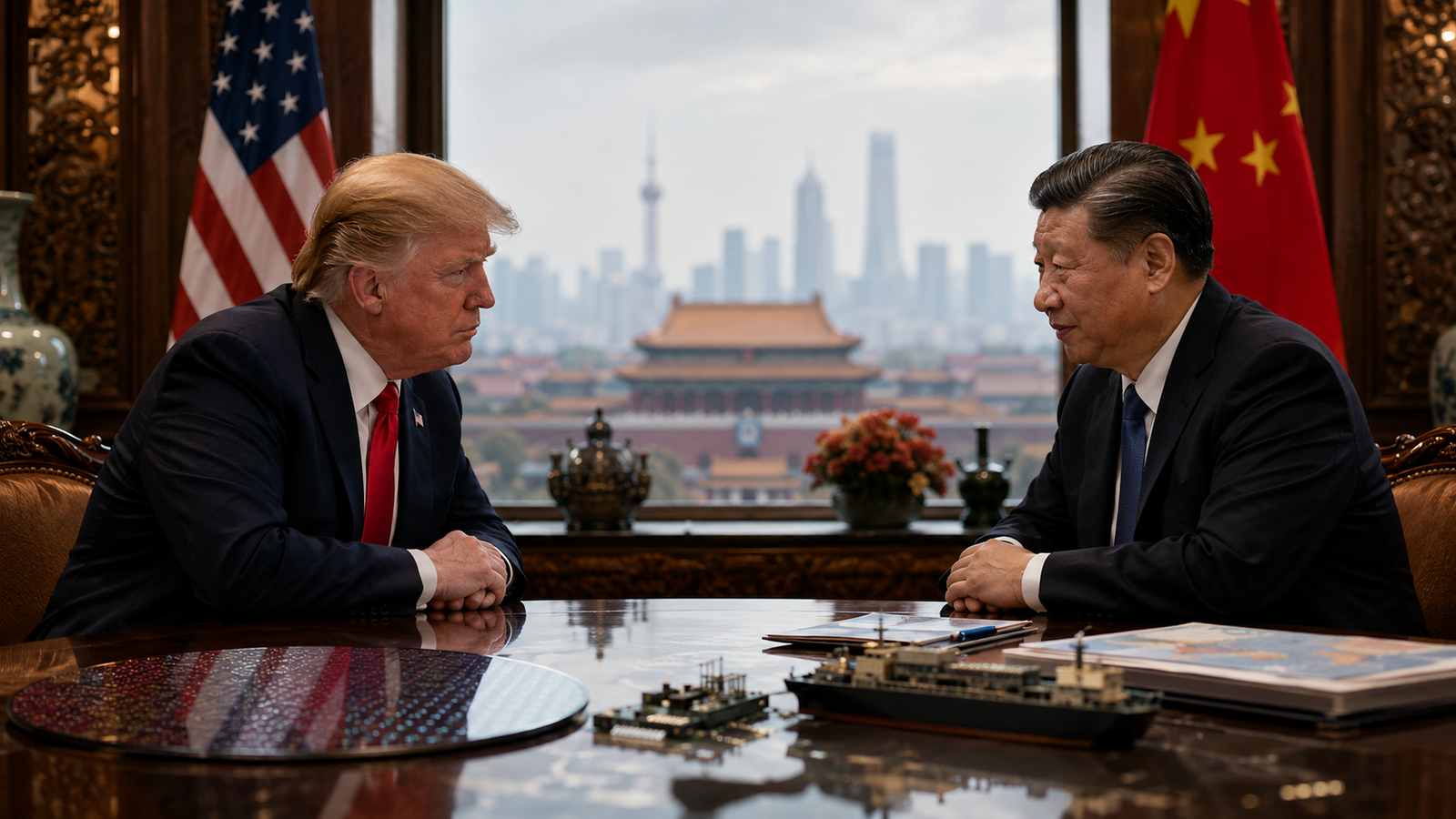
President Donald Trump’s arrival in Beijing has turned geopolitics into the day’s most important market catalyst. For investors, the meeting with Chinese President Xi Jinping is not just a diplomatic event. It is a live test of whether the world’s two largest economies can reduce pressure on tariffs, technology restrictions, Taiwan tensions, Middle East energy risk and global supply chains at a moment when markets are already balancing AI enthusiasm against inflation anxiety.
AP reported that Trump arrived in Beijing on Wednesday, May 13, 2026, for high-level talks with Xi focused on the Iran war, trade tensions and U.S. arms sales to Taiwan. The core summit discussions are expected to begin Thursday, with trade relations, Chinese purchases of American goods and a proposed bilateral Board of Trade among the economic items on the agenda.
That makes the summit immediately relevant to equities, commodities, currencies and inflation expectations. A constructive tone could support semiconductor stocks, China-exposed technology companies, industrial exporters and commodity markets. A breakdown could lift volatility, pressure growth stocks, strengthen demand for gold and defense names, and keep oil risk premiums elevated.
Why This Summit Matters for Investors
The market is watching the Beijing talks because the agenda cuts across nearly every major asset class.
Trade policy affects U.S. manufacturers, retailers, agriculture exporters, industrial companies and consumer prices. Taiwan policy affects semiconductor supply chains because Taiwan remains central to advanced chip production. AI policy affects Nvidia, AMD, Micron, Qualcomm, Intel and the broader technology ecosystem. Iran policy affects oil, shipping costs, inflation and central-bank expectations. Commodity supply chains affect copper, rare earths, energy and mining equities.
AP’s market coverage on May 13 showed how quickly investors connected the diplomatic visit to asset prices. U.S. markets were mixed, with S&P 500 futures up 0.2%, Dow futures down 0.3% and Nasdaq futures up 0.7%, supported by a rebound in semiconductor stocks. AP also reported that Intel rose 3.1%, while Micron and Qualcomm rebounded as investors focused on AI and trade-related developments tied to the China visit.
The message is clear: investors are not waiting for a formal treaty. They are trading the probability of reduced geopolitical friction.
Trade: Tariffs, Market Access and Business Confidence
Trade remains the most direct market issue in the Trump-Xi talks. Investors are looking for signs that Washington and Beijing can stabilize commercial relations, reduce tariff uncertainty and create a mechanism to prevent new trade disputes from escalating into market shocks.
The Financial Times reported that Trump arrived in Beijing pressing Xi to “open up” China’s economy to American businesses, with a business delegation including leaders from BlackRock, Blackstone, Tesla, SpaceX, Apple and Nvidia. That matters because corporate access to China remains a major revenue variable for U.S. technology, consumer, industrial and financial companies.
The potential upside for markets is a framework that improves confidence around U.S.-China business flows. Even modest progress could help companies with China exposure, including semiconductor firms, aerospace manufacturers, luxury brands, electric-vehicle suppliers and industrial exporters.
The risk is that the summit produces symbolism but little substance. Bloomberg noted ahead of the meeting that expectations were low because U.S.-China relations remain dominated by trade, tariffs, chips, rare earths and Taiwan, none of which are easy to resolve quickly.
For investors, that means the market reaction may depend less on sweeping policy announcements and more on tone, sequencing and whether both sides signal a willingness to avoid near-term escalation.
AI and Semiconductors Take Center Stage
Artificial intelligence is one of the most market-sensitive topics surrounding the summit. Nvidia CEO Jensen Huang’s presence in the U.S. delegation has put AI chips directly in the spotlight.
Bloomberg reported that Huang’s last-minute appearance thrust technology into focus ahead of the Beijing summit, with Trump confirming Huang’s attendance along with other business leaders. The Guardian also reported that Huang joined the delegation, alongside high-profile executives such as Elon Musk and Tim Cook, as technology became a central part of the trip.
For investors, the key issue is whether U.S. chipmakers can gain more clarity on China access without triggering national-security backlash in Washington. Nvidia, AMD and other chipmakers have been caught between massive Chinese demand for AI computing and U.S. export-control restrictions designed to limit China’s access to advanced chips.
A positive signal on licensing, allowed product categories or commercial engagement could support AI hardware names. That includes Nvidia, AMD, Micron, Qualcomm, Intel and semiconductor equipment suppliers. But a tougher stance on export controls or Chinese retaliation could pressure the same stocks quickly.
The AI trade is still powerful, but it is increasingly policy-sensitive. Investors should treat AI-chip exposure as both a growth trade and a geopolitical trade.
Taiwan: The Semiconductor Risk Investors Cannot Ignore
Taiwan remains one of the most sensitive topics on the agenda because it sits at the center of global semiconductor supply chains. AP reported that U.S. arms sales to Taiwan are expected to be a key topic, including a proposed $11 billion arms deal strongly opposed by China.
This is a major risk factor for investors. Any escalation around Taiwan can raise concerns about advanced chip supply, shipping routes, defense spending, insurance costs and broader Asia-Pacific stability. Semiconductor companies, consumer electronics firms, automotive manufacturers and cloud infrastructure companies all rely on complex supply chains that would be vulnerable to a Taiwan crisis.
A constructive summit could reduce immediate risk premiums. Even if no formal Taiwan breakthrough occurs, language emphasizing stability and continued dialogue would likely be welcomed by markets. Conversely, sharp rhetoric or disagreement over arms sales could increase volatility in chip stocks and global risk assets.
Investors should watch defense names, semiconductor ETFs, Taiwan-exposed supply-chain companies and safe-haven assets such as gold if Taiwan headlines worsen.
Iran, Oil and Inflation Risk
The Iran war adds another layer of urgency to the summit. AP reported that Trump’s visit comes during a difficult period marked by foreign-policy strain related to Iran and domestic pressure from rising inflation. The Guardian reported that Iran is expected to loom over the talks, especially because China is a major buyer of Iranian oil and the Strait of Hormuz remains a critical global energy route.
This matters because energy prices feed directly into inflation expectations. AP’s market coverage noted that Brent crude hovered around $101.72 per barrel amid tension in the Persian Gulf and disruption risk around the Strait of Hormuz. Higher oil prices can pressure consumers, raise transportation costs and complicate Federal Reserve policy.
If China helps reduce Iranian oil tensions or supports diplomatic stabilization, oil risk premiums could ease. That would be positive for airlines, transportation companies, consumer discretionary stocks and inflation-sensitive growth equities.
If talks fail and Middle East risk increases, energy stocks, defense names, gold and volatility hedges could benefit, while broader equities may face pressure.
What CSIS Is Watching
The Center for Strategic and International Studies has framed the Trump-Xi summit as a major U.S.-China event covering strategic, economic and technology issues. CSIS noted that the summit is Trump’s first trip to China since 2017 and the first meeting between Trump and Xi since October, with experts tracking the summit as it unfolds.
That context is important because this is not a single-issue meeting. It is a strategic reset attempt across trade, technology, security and global crisis management. Investors should not evaluate the summit only through one stock or one sector. The impact could ripple through semiconductors, industrials, commodities, energy, defense, currencies and Treasury yields.
Key Investment Insight
The most important investor takeaway is that the Trump-Xi summit is a binary macro catalyst with sector-specific winners and losers.
A constructive outcome could support semiconductor stocks, China-exposed technology, industrial exporters, aerospace, consumer brands, copper and broader risk assets. It could also reduce oil-risk premiums if the Iran discussion produces even limited diplomatic progress.
A negative outcome could benefit gold, oil producers, defense contractors and volatility hedges, while pressuring technology, emerging markets, China-exposed multinationals and rate-sensitive growth stocks.
Investors should monitor four signals closely: official statements on trade and tariffs, any language around AI-chip exports, comments on Taiwan arms sales, and whether China signals cooperation on Iran or energy-market stability.
The smartest strategy is not to chase every headline. It is to identify which sectors are most exposed to each outcome. Semiconductors and industrials benefit from de-escalation. Energy, gold and defense benefit from geopolitical stress. Commodity producers may benefit either way if supply-chain concerns remain elevated.
Future Trends to Watch
The summit could mark the beginning of a managed-stability phase in U.S.-China relations, but investors should keep expectations realistic. Bloomberg’s pre-summit analysis emphasized that major breakthroughs may be difficult because the relationship remains shaped by structural disputes over chips, tariffs, rare earths and Taiwan.
That means markets may reward process, not perfection. A bilateral trade mechanism, continued executive engagement, limited export-control clarity or cooperation on Iran could all be enough to support risk sentiment.
The bigger investment theme is that geopolitics is now embedded in valuation. AI stocks trade on export policy. Energy trades on Middle East diplomacy. Copper trades on infrastructure and supply security. Defense stocks trade on geopolitical risk. U.S.-China relations are no longer a background issue for investors; they are a front-page market driver.
For daily investor-focused coverage of politics, markets, AI, commodities, crypto and global macro catalysts, stay with MoneyNews.Today as your trusted source for actionable financial news and market insight.




