
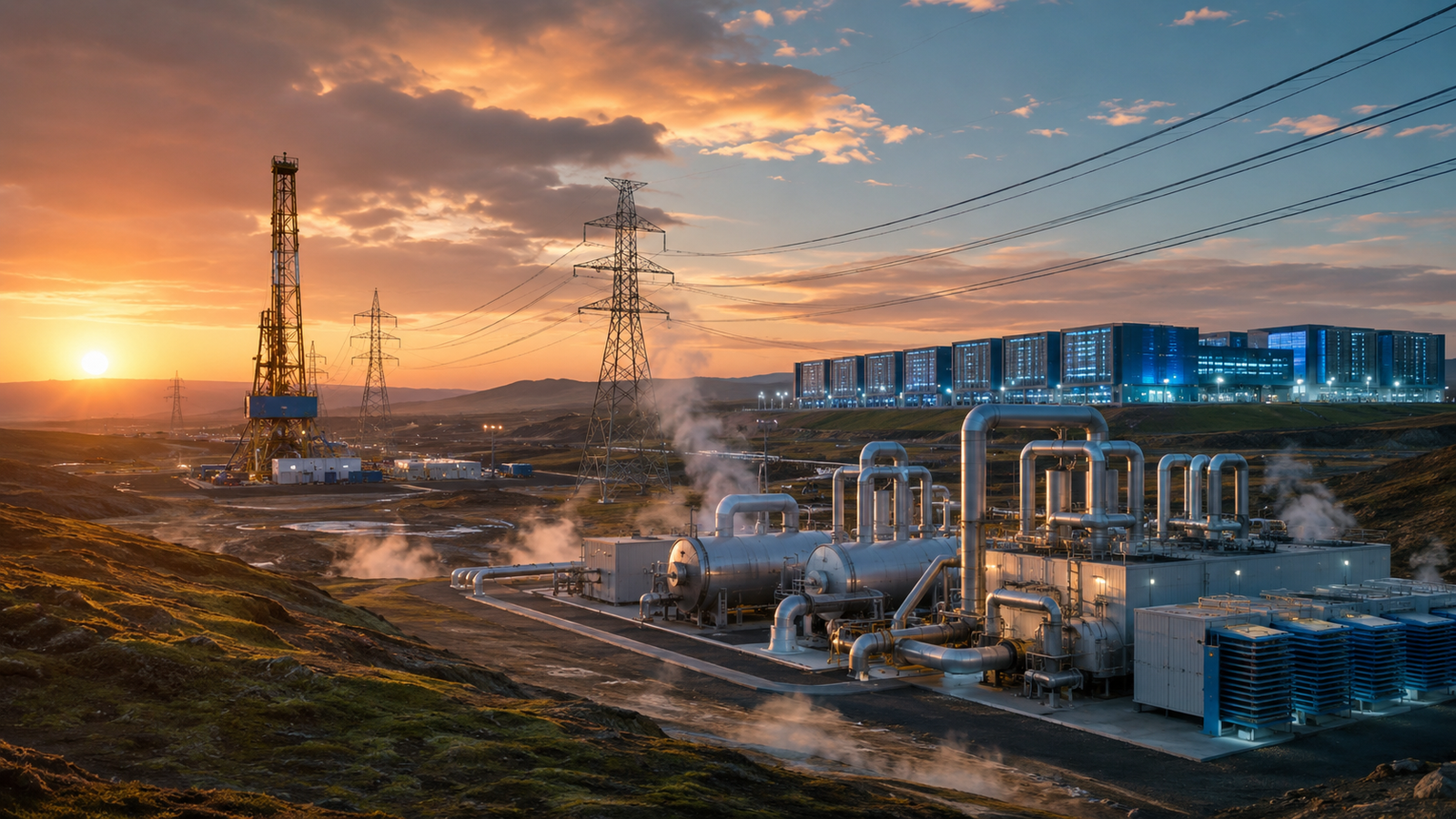
The next major AI trade may not be a chipmaker, a cloud provider, or a data-center landlord. It may be buried thousands of feet underground.
Fervo Energy’s move toward the public markets has put enhanced geothermal power at the center of a fast-growing investor theme: firm clean power for the artificial intelligence economy. As AI data centers consume more electricity and utilities race to upgrade the grid, investors are looking beyond solar and wind toward power sources that can run around the clock. Fervo’s IPO momentum suggests Wall Street is increasingly willing to fund the infrastructure layer behind AI growth — energy, drilling technology, grid reliability, and industrial decarbonization.
Fervo announced on May 12, 2026, that it priced an upsized initial public offering of 70 million Class A shares at $27 per share, after previously increasing the proposed deal size from 55.6 million shares. The company said the shares are expected to trade on Nasdaq under the ticker FRVO. The offering follows a sharp increase in investor demand after Fervo earlier launched its roadshow at 55.6 million shares with an expected range of $21 to $24 per share.
For investors, the message is clear: climate-tech IPOs are no longer just about environmental narratives. They are increasingly tied to the hard economics of power demand.
Why Fervo’s IPO Matters Now
Fervo’s listing arrives at a moment when electricity has become one of the biggest bottlenecks in the AI boom. Hyperscale data centers need reliable, large-scale power, and traditional renewable sources alone may not solve the problem because solar and wind are intermittent. Geothermal, by contrast, can provide clean power continuously, making it attractive for companies seeking low-carbon electricity without sacrificing reliability.
TNW described Fervo’s IPO launch as a Nasdaq listing positioned as a climate-tech vehicle for the AI infrastructure trade, originally targeting up to $1.33 billion before the deal was later upsized. TechCrunch also reported that Fervo and nuclear company X-energy have both benefited from surging electricity demand from technology companies racing to secure power for AI data centers.
That is why the Fervo story belongs in the emerging industries category. It sits at the intersection of clean energy, drilling technology, AI infrastructure, grid reliability, and capital markets. It is not only a geothermal company going public. It is a public-market test of whether investors will pay premium valuations for companies that can help solve the power constraints created by AI.
Houston’s Industrial Transition Becomes an Investment Theme
The Houston Chronicle framed Fervo’s IPO as more than a company milestone, arguing that the listing signals a broader transition for Houston’s industrial economy. The publication noted that Fervo was founded by a former oilfield engineer and uses knowledge, talent, and infrastructure from the oil-and-gas industry to pioneer advanced geothermal energy.
That point matters for investors because it highlights one of geothermal’s biggest advantages: it can reuse capabilities from the fossil-fuel economy. Drilling, subsurface mapping, reservoir engineering, completions technology, pressure management, and project execution are all core oil-and-gas disciplines. Fervo’s business model effectively applies those skills to zero-carbon power.
The Houston Chronicle also noted that the IPO could encourage more startup activity and job creation in Houston, a city seeking to offset energy-sector job losses while building a cleantech ecosystem around groups such as Greentown Labs, Activate, and TEX-E. For investors, that suggests the opportunity is not limited to one IPO. It could expand into a regional industrial transition involving drilling services, engineering firms, energy developers, grid companies, and project-finance partners.
The Firm Clean Power Premium
The phrase investors should focus on is firm clean power. In energy markets, “firm” power means electricity that can be delivered when needed, not only when the sun shines or the wind blows. That reliability is becoming increasingly valuable as data-center operators, utilities, and industrial customers compete for power.
Fervo’s Cape Station project has already attracted attention because it is designed to deliver large-scale geothermal power. TechMarketBriefs reported that Fervo’s IPO is anchored by a 3-gigawatt framework agreement with Google and 658 megawatts of binding power purchase agreements with hyperscalers and utilities. A prior Houston Chronicle report also said Fervo expanded Cape Station from 400 megawatts to 500 megawatts because of strong demand for clean, firm energy, with purchasers including Shell Energy, Southern California Edison, and Clean Power Alliance.
Those agreements are important because power purchase agreements, or PPAs, can provide revenue visibility and help support project financing. Investors evaluating Fervo and similar companies should pay close attention to contracted capacity, counterparty quality, project timelines, financing costs, and whether projects can move from development to commercial operation on schedule.
Why AI Makes Geothermal More Investable
AI has changed the investor conversation around clean power. For years, climate-tech companies often depended on policy support, decarbonization mandates, or long-term energy-transition assumptions. Now, the demand signal is more immediate: AI data centers need electricity, and they need it soon.
This changes the risk-reward profile for emerging energy technologies. A geothermal developer with credible drilling results, contracted demand, and hyperscaler customers may attract more capital than it would have in a slower power-demand environment. Investors are not only buying a clean-energy story; they are buying exposure to the infrastructure needs of AI growth.
Barron’s recently grouped Fervo with other AI-adjacent IPOs, including Cerebras Systems and Blackstone Digital Infrastructure Trust, arguing that these listings could test investor demand for AI-related public-market offerings. That grouping is telling. Fervo is not an AI company in the conventional sense, but it is part of the AI supply chain because AI cannot scale without electricity.
The Oil-and-Gas Skill Transfer
Fervo’s technology story is closely tied to the oil-and-gas industry’s technical base. Enhanced geothermal systems use advanced drilling methods to access hot rock formations and circulate fluid to produce heat and power. Time previously reported that Fervo’s technology uses horizontal drilling into hot rock, fiber-optic monitoring, and improved drilling processes, helping reduce drilling time and lower well costs.
That matters because execution risk is one of the biggest concerns for geothermal. Investors should not treat geothermal like a software business. It is capital-intensive, project-based, and operationally complex. The upside is that if the technology scales, enhanced geothermal could become a major source of reliable, low-carbon power. The risk is that project delays, drilling costs, permitting issues, or financing constraints could weigh heavily on returns.
Stocks and Sectors to Watch
Fervo’s IPO could sharpen investor attention across several public-market categories.
The first is geothermal and next-generation clean power. If FRVO trades well, it could create momentum for other private geothermal developers and adjacent energy-transition companies.
The second is grid equipment and electrification. Companies tied to transformers, transmission hardware, switchgear, substations, power management, and industrial electrical systems may benefit as data centers and utilities spend to expand capacity.
The third is data-center power supply. Investors should watch utilities, independent power producers, energy infrastructure companies, and developers able to sign long-term PPAs with hyperscalers.
The fourth is oilfield services and drilling technology. If geothermal scales using oil-and-gas expertise, service providers with drilling, casing, completions, subsurface analytics, and reservoir capabilities may find new revenue opportunities.
The fifth is industrial decarbonization. Geothermal may eventually support not only data centers but also manufacturing, hydrogen, mining, district heating, and other energy-intensive sectors that require reliable low-carbon power.
Key Investment Insight
The key investment insight is that Fervo’s IPO momentum shows investors are willing to pay attention to energy infrastructure that directly supports AI growth. The strongest opportunity is not simply “clean energy.” It is clean energy that is reliable, contracted, scalable, and connected to customers with urgent power needs.
Investors should track three metrics closely. First, watch Fervo’s trading performance after listing under FRVO, because it may set the valuation benchmark for public geothermal companies. Second, monitor PPA announcements from hyperscalers, utilities, and industrial customers, because contracted demand validates the business model. Third, follow project execution at Cape Station and future developments, because geothermal companies ultimately must prove they can deliver power at scale.
The risk is that the IPO excitement may outrun execution. Enhanced geothermal remains capital-intensive, and investors should evaluate development timelines, cost inflation, permitting, drilling performance, debt requirements, and dilution risk. A strong IPO does not eliminate those challenges.
Future Trends to Watch
The next phase of the AI power trade will likely reward companies that can solve reliability, speed, and scale. Solar and wind remain critical, but the market is increasingly searching for firm resources such as geothermal, nuclear, natural gas with carbon capture, battery storage, and advanced grid systems.
Fervo’s IPO may become a marker for a broader capital-market shift. Climate-tech companies that can tie themselves directly to AI power demand may receive stronger investor interest than companies relying only on long-term decarbonization narratives. Houston’s role is also important: the city’s oilfield talent and industrial base could become a competitive advantage in building next-generation geothermal power.
For investors, the lesson is straightforward. The AI boom is not only about chips, models, and cloud platforms. It is also about electricity. Fervo’s IPO shows that the market is starting to price that reality.
For daily investor-focused coverage of emerging industries, AI infrastructure, clean energy, markets, crypto, and policy, stay with MoneyNews.Today as your trusted source for market-moving financial news and actionable investment insight.




