A major shift is underway in one of the market’s most speculative technology frontiers: Washington is no longer treating quantum computing as a distant research project. It is treating it as strategic infrastructure. For investors, that distinction matters.
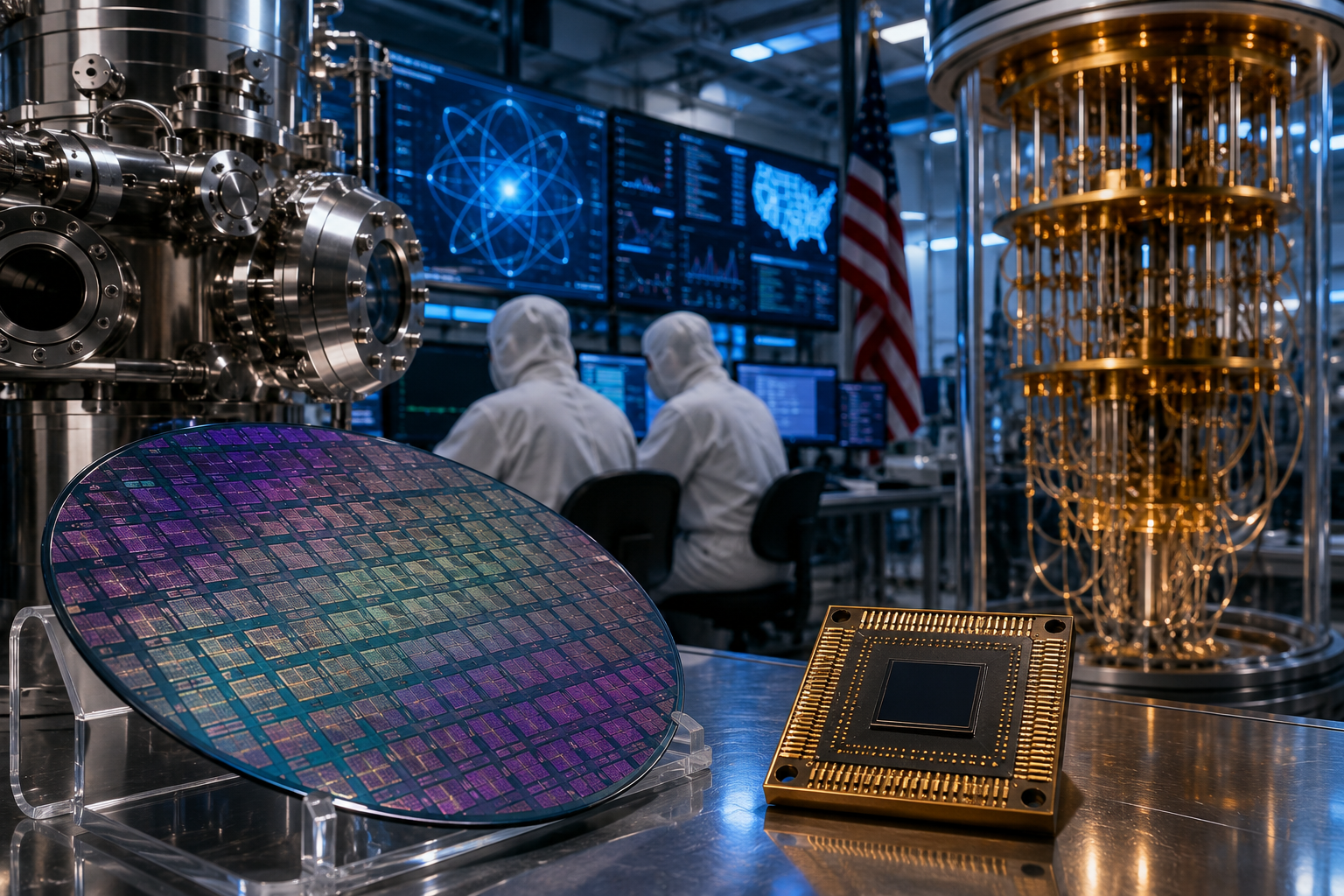
On May 21, IBM and the U.S. Department of Commerce announced a letter of intent for a proposed $1 billion CHIPS incentive to support Anderon, a new IBM-backed company described as America’s first purpose-built, pure-play quantum chip foundry. IBM said the project is designed to support quantum wafer production and strengthen U.S. leadership in quantum technology manufacturing.
The announcement landed alongside broader reports that the Commerce Department is backing a roughly $2 billion quantum-computing funding push across nine companies, including IBM, GlobalFoundries, D-Wave Quantum, Rigetti Computing, Infleqtion, PsiQuantum, Quantinuum, Atom Computing and Diraq. The Wall Street Journal reported that the government is also expected to take minority equity stakes in participating companies, turning federal support into something closer to a strategic investment model than a traditional grant program.
For Wall Street, the message was immediate: quantum computing may still be early-stage, but it is becoming too important for governments, national-security planners and institutional investors to ignore.
Why Quantum Suddenly Matters to Investors
Quantum computing has long been viewed as a high-potential but highly uncertain technology. The promise is enormous: machines capable of solving certain optimization, simulation, cryptography, materials-science and drug-discovery problems far beyond the practical reach of today’s classical computers. The problem, from an investor’s perspective, is that commercial timelines have been hard to quantify and many pure-play quantum companies remain unprofitable.
That is why this funding package is notable. Federal dollars do not eliminate execution risk, but they can change the risk profile of an emerging industry. By directing capital toward manufacturing, foundry capacity and domestic quantum infrastructure, the U.S. government is signaling that quantum is not merely a speculative software theme. It is increasingly tied to semiconductor supply chains, defense readiness, cybersecurity, advanced research and next-generation computing capacity.
IBM’s role is especially important. The company has decades of experience in enterprise technology, research and chip-related infrastructure. Its planned Anderon venture, supported by the proposed Commerce Department award, gives investors a more concrete framework for evaluating the quantum buildout: not only who can design quantum systems, but who can manufacture the components needed to scale them.
That foundry angle is critical. In artificial intelligence, investors learned that compute infrastructure can become the profit pool long before the full application layer matures. Quantum may follow a different technical path, but the market is beginning to ask a similar question: which companies will control the hardware, fabrication, software stack and government-aligned infrastructure if quantum systems move from labs into commercial deployment?
The Market Reaction: Quantum Stocks Surge
Investor enthusiasm was visible across public quantum-related names. Investor’s Business Daily reported that IBM rose 12.4%, D-Wave jumped 33.4%, Rigetti gained 30.6%, Infleqtion climbed 31.5%, and GlobalFoundries advanced 14.9% after the funding news.
Barron’s also reported that IBM continued higher in premarket trading on Friday, following the prior day’s sharp rally, while D-Wave, Infleqtion and Rigetti also posted additional gains.
Those moves show how quickly capital can rotate into frontier-technology themes when a credible policy catalyst appears. However, investors should separate two ideas: the strategic importance of quantum and the valuation discipline required to invest in quantum stocks. The first has strengthened. The second has not disappeared.
Pure-play quantum companies can move dramatically on headlines because many have limited revenue bases, high research costs and long commercialization horizons. Government awards may extend funding runways and validate technology roadmaps, but they do not automatically produce near-term earnings power. That is the key distinction investors should keep in mind after a sharp rally.
The IBM Advantage: Scale, Credibility and Optionality
IBM may be the most investable near-term beneficiary because it combines quantum exposure with a diversified enterprise technology business. Unlike smaller pure plays, IBM does not depend solely on quantum commercialization to support its valuation. The company has recurring enterprise relationships, hybrid-cloud exposure, AI-related services and a large installed customer base.
That makes IBM a different kind of quantum trade. It offers exposure to the theme without the same binary risk profile carried by smaller quantum specialists. If Anderon becomes a meaningful foundry platform, IBM could strengthen its position in an emerging strategic supply chain. If commercialization takes longer than expected, IBM still has other operating segments to support the stock.
IBM had already announced in 2025 that it planned to invest $150 billion in the U.S. over five years, including more than $30 billion in research and development to advance mainframe and quantum computer manufacturing. The proposed quantum foundry award adds policy validation to that broader domestic technology investment strategy.
For investors, IBM now looks less like a legacy technology company dabbling in quantum and more like a potential anchor institution in the U.S. quantum ecosystem.
What It Means for D-Wave, Rigetti and Other Pure Plays
For smaller quantum companies, the opportunity is potentially larger in percentage terms, but so is the risk. D-Wave and Rigetti have become popular trading vehicles for investors seeking direct exposure to quantum computing. A federal funding endorsement can improve market confidence, attract strategic partners and reduce financing pressure.
According to Wall Street Journal coverage, companies including D-Wave, Rigetti, Infleqtion, Atom Computing, PsiQuantum and Quantinuum are expected to receive funding as part of the broader program, with Diraq receiving a smaller award. Investor’s Business Daily reported that several awards range from $100 million to $375 million, with GlobalFoundries among the larger recipients.
The equity-stake structure is worth watching. If the government becomes a minority shareholder in frontier-technology companies, investors may interpret that as a form of strategic validation. But it also introduces questions about dilution, governance, political priorities and future funding terms. The market may reward companies for receiving government backing, but investors still need to examine balance sheets, revenue quality, cash burn and commercialization milestones.
Why GlobalFoundries Is Part of the Story
GlobalFoundries’ inclusion highlights the manufacturing dimension of the quantum race. Quantum computing is not only about algorithms and qubits; it also depends on precision fabrication, materials, packaging and specialized semiconductor processes. If quantum systems scale, foundry partners could become essential infrastructure providers.
Barron’s reported that GlobalFoundries introduced a quantum-related venture tied to a prospective $375 million award and would provide the government with an equity stake. That positions the company as a possible manufacturing enabler rather than a pure quantum-computing bet.
For investors who prefer infrastructure exposure over speculative application-layer exposure, foundries, advanced packaging, cryogenics, test equipment, photonics and specialized materials may become important watchlist categories.
Key Investment Insight
The most actionable takeaway is not simply “buy quantum stocks.” It is that quantum computing is moving from a speculative theme toward a government-backed industrial strategy.
Investors should watch three signals over the next several quarters. First, whether the proposed awards convert into finalized funding agreements. Second, whether companies receiving funds translate policy support into measurable technical milestones, customer contracts or revenue visibility. Third, whether institutional investors begin treating quantum infrastructure as a long-duration strategic allocation, similar to how AI infrastructure evolved from a niche theme into a dominant market driver.
The opportunity is real, but the sector remains volatile. IBM offers diversified exposure with quantum upside. GlobalFoundries may provide infrastructure-linked exposure. D-Wave, Rigetti and other pure plays offer higher upside potential but carry higher execution and valuation risk.
For investors, the quantum rally should be viewed as an early-stage policy catalyst, not a guarantee of immediate commercial success. The winners will likely be the companies that can pair scientific credibility with manufacturing scale, government alignment and a clear path to monetization.
As frontier technologies reshape the investment landscape, stay with MoneyNews.Today for daily market intelligence, emerging-industry analysis and actionable insights investors can use before the next major trend becomes consensus.