
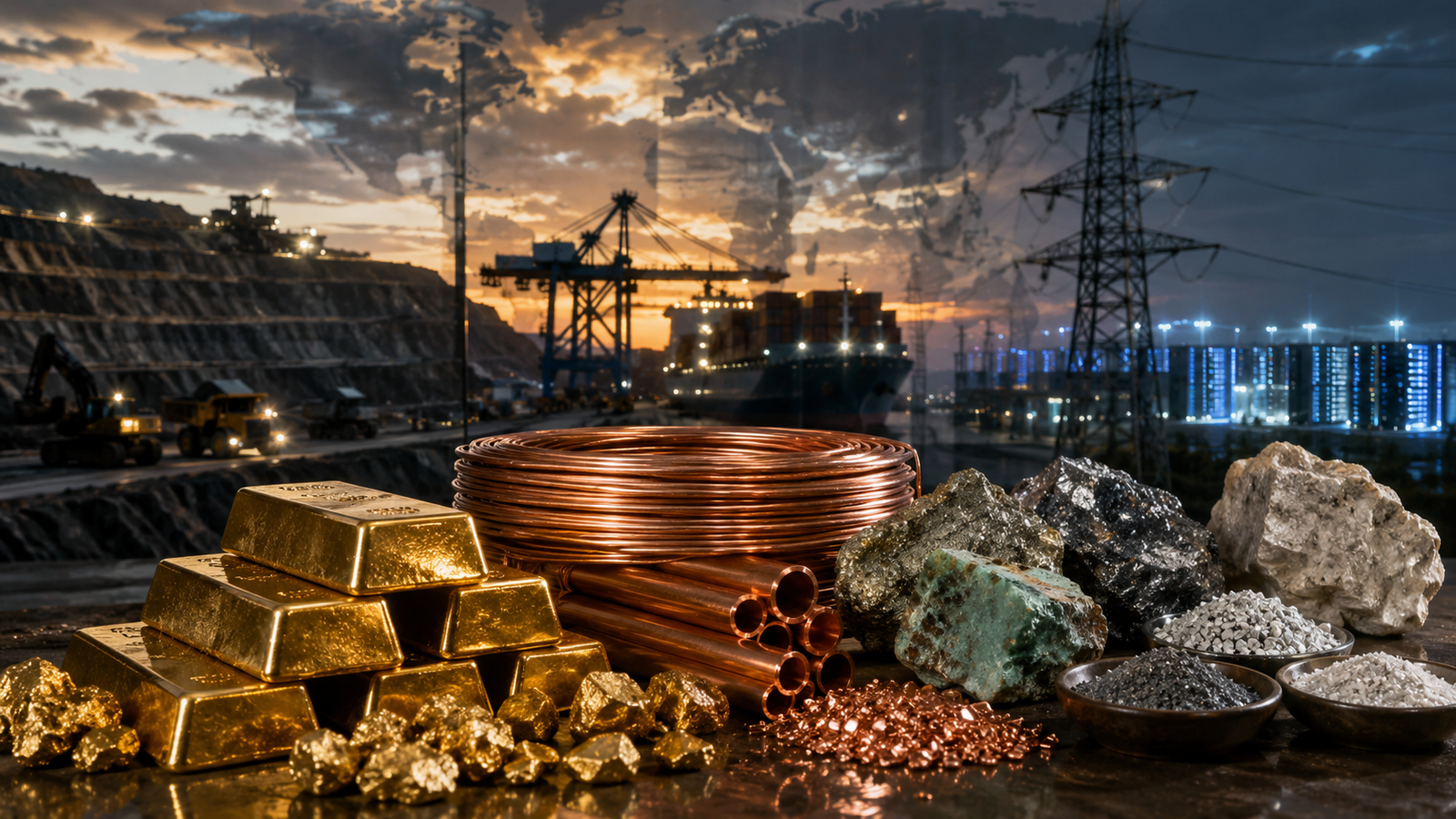
Global commodity markets are entering a new phase of investor attention as geopolitical tensions, energy security concerns, and the accelerating artificial intelligence revolution reshape demand for precious metals and strategic minerals. From gold’s resurgence as a safe-haven asset to surging long-term forecasts for copper and rare earth elements, investors are increasingly turning toward metals and mining equities as both defensive plays and structural growth opportunities.
The renewed momentum comes amid rising uncertainty surrounding global trade routes, Middle East tensions, oil supply risks, and intensifying competition between the United States and China over critical mineral supply chains. At the same time, the rapid expansion of AI infrastructure, electrification technologies, data centers, electric vehicles, and renewable energy systems is creating unprecedented demand for industrial commodities essential to the modern digital economy.
According to analysts cited by Reuters, CPM Group, and speakers at the OTC Markets Mining Conference, the current environment is creating one of the strongest long-term backdrops for strategic commodities in more than a decade.
For investors, the story extends far beyond traditional mining cycles. Metals are increasingly becoming tied to national security, technological leadership, energy transition strategies, and global infrastructure development — all themes that could drive sustained capital flows into the sector throughout 2026 and beyond.
Gold Reclaims Its Role as a Global Safe-Haven Asset
Gold has once again become a focal point for investors seeking protection against geopolitical instability, inflation uncertainty, and financial market volatility.
The precious metal has remained resilient even as interest rate expectations fluctuate, supported by growing concerns surrounding global conflicts, energy market disruptions, sovereign debt risks, and currency instability. Central banks worldwide have also continued accumulating gold reserves at historically elevated levels, reinforcing confidence in the metal’s strategic importance.
Analysts at CPM Group note that gold’s appeal is no longer tied solely to inflation hedging. Instead, investors are increasingly viewing the metal as a geopolitical insurance asset amid a more fragmented global economic landscape.
Several factors are supporting gold demand:
- Ongoing geopolitical tensions in the Middle East and Eastern Europe
- Rising concerns over oil supply disruptions
- Persistent inflation uncertainty
- Central bank reserve diversification
- Concerns about long-term fiscal deficits and sovereign debt
For institutional investors, gold continues serving as both a portfolio stabilizer and a macroeconomic hedge during periods of elevated uncertainty.
Mining companies with strong balance sheets, scalable reserves, and operations located in politically stable jurisdictions such as Canada, the United States, and Australia are attracting growing investor attention as a result.
Copper Emerges as One of the Most Important AI Commodities
While gold is benefiting from defensive demand, copper is increasingly becoming one of the most strategically important industrial commodities in the global economy.
Traditionally associated with construction and manufacturing, copper is now deeply tied to several major secular growth trends, including:
- Artificial intelligence infrastructure
- Data center expansion
- Electric vehicles
- Renewable energy systems
- Power grid modernization
- Industrial automation
The AI boom, in particular, is creating a significant new source of long-term copper demand. Massive data centers powering AI applications require extensive electrical infrastructure, cooling systems, and high-capacity transmission networks — all of which rely heavily on copper.
According to industry estimates cited by Reuters and mining analysts, AI infrastructure expansion alone could materially increase copper consumption over the next decade.
At the same time, supply constraints continue creating concern across commodity markets.
New copper discoveries have become increasingly difficult and expensive to develop, while permitting challenges, environmental regulations, and geopolitical risks are slowing the pace of new mine construction globally.
This supply-demand imbalance is leading many analysts to forecast structurally higher copper prices over the long term.
For investors, the implications are substantial. North American copper developers with advanced-stage projects may become increasingly valuable as governments and corporations seek secure domestic supply chains.
Rare Earths and Critical Minerals Gain Strategic Importance
Rare earth elements and critical minerals are rapidly transitioning from niche industrial materials into strategic geopolitical assets.
These minerals — including neodymium, dysprosium, lithium, cobalt, gallium, germanium, and graphite — are essential for technologies ranging from semiconductors and AI chips to electric vehicles, wind turbines, defense systems, and advanced electronics.
The issue has become especially important because China currently dominates large portions of the global refining and processing market for rare earth materials.
As geopolitical tensions between Washington and Beijing continue intensifying, both the United States and Canada are aggressively expanding efforts to secure domestic and allied supply chains for strategic minerals.
Government-backed initiatives aimed at strengthening critical mineral production have accelerated significantly over the past two years.
This includes:
- Strategic mining investments
- Federal financing programs
- Tax incentives for domestic production
- Defense-related mineral stockpiling
- Partnerships with allied nations
Industry analysts increasingly believe rare earth supply security could become one of the defining investment themes of the next decade.
For mining companies operating in North America, this shift may create opportunities for government support, long-term supply agreements, and rising institutional interest.
Why This Matters for Investors
The growing convergence between geopolitics, AI infrastructure, electrification, and commodity security is fundamentally reshaping the metals and mining sector.
Historically, commodity investing was heavily influenced by cyclical economic growth patterns. Today, however, several metals are benefiting from long-duration structural demand trends that may persist regardless of short-term economic fluctuations.
This creates a more complex — and potentially more attractive — environment for investors.
Several key themes are driving the sector:
AI Infrastructure Demand
The buildout of AI systems, cloud computing infrastructure, and advanced semiconductors is increasing demand for copper, silver, rare earths, and power-related materials.
Energy Transition Expansion
Electric vehicles, renewable energy systems, battery storage, and grid modernization require significantly larger quantities of strategic metals than traditional energy systems.
Supply Chain Nationalism
Governments are prioritizing domestic and allied mineral production to reduce reliance on foreign suppliers.
Geopolitical Hedging
Gold continues benefiting from uncertainty surrounding global conflicts, inflation, and sovereign debt concerns.
This combination of defensive and growth-oriented demand drivers is attracting both institutional capital and retail investor attention.
Future Trends Investors Should Watch
Several major developments could shape commodity markets through the remainder of 2026 and beyond.
North American Mining Development
Projects located in Canada and the United States may receive increasing strategic importance due to favorable geopolitical positioning and government support.
AI-Driven Electricity Demand
The rapid expansion of AI data centers could significantly boost long-term demand for copper, uranium, silver, and grid infrastructure materials.
Commodity Supply Constraints
Permitting delays, environmental restrictions, and declining ore grades could continue limiting new supply growth across several key commodities.
Central Bank Gold Buying
Global central banks remain major buyers of gold as countries diversify reserves away from traditional fiat currency exposure.
Critical Mineral Policy
Government regulations and incentives surrounding domestic mineral production may increasingly influence valuations across the mining sector.
Key Investment Insight
The metals and mining sector is no longer simply a cyclical commodity trade — it is becoming a strategic investment theme tied to artificial intelligence, electrification, energy security, and geopolitical stability.
Gold may continue serving as a hedge against global uncertainty and financial volatility, while copper and rare earth elements appear increasingly positioned to benefit from long-term structural demand growth driven by AI infrastructure and clean energy expansion.
For investors, the most compelling opportunities may emerge among North American producers and developers with scalable reserves, low geopolitical risk, strong balance sheets, and exposure to strategic commodities essential to future industrial growth.
As governments and corporations compete to secure critical resources, metals and mining equities could become one of the defining sectors to watch throughout the next phase of the global economy.
Stay informed on the latest commodity trends, market-moving developments, and investment opportunities with MoneyNews.Today, your trusted source for daily investor insights and financial market analysis.




