For much of the past two years, investors have treated artificial intelligence-related stocks as one of the safest bets in the market. Semiconductor companies, cloud infrastructure providers, and data center operators have enjoyed enormous capital inflows as investors raced to gain exposure to the AI revolution. But this week, the market received an important reminder: even the strongest investment themes are ultimately judged by execution.
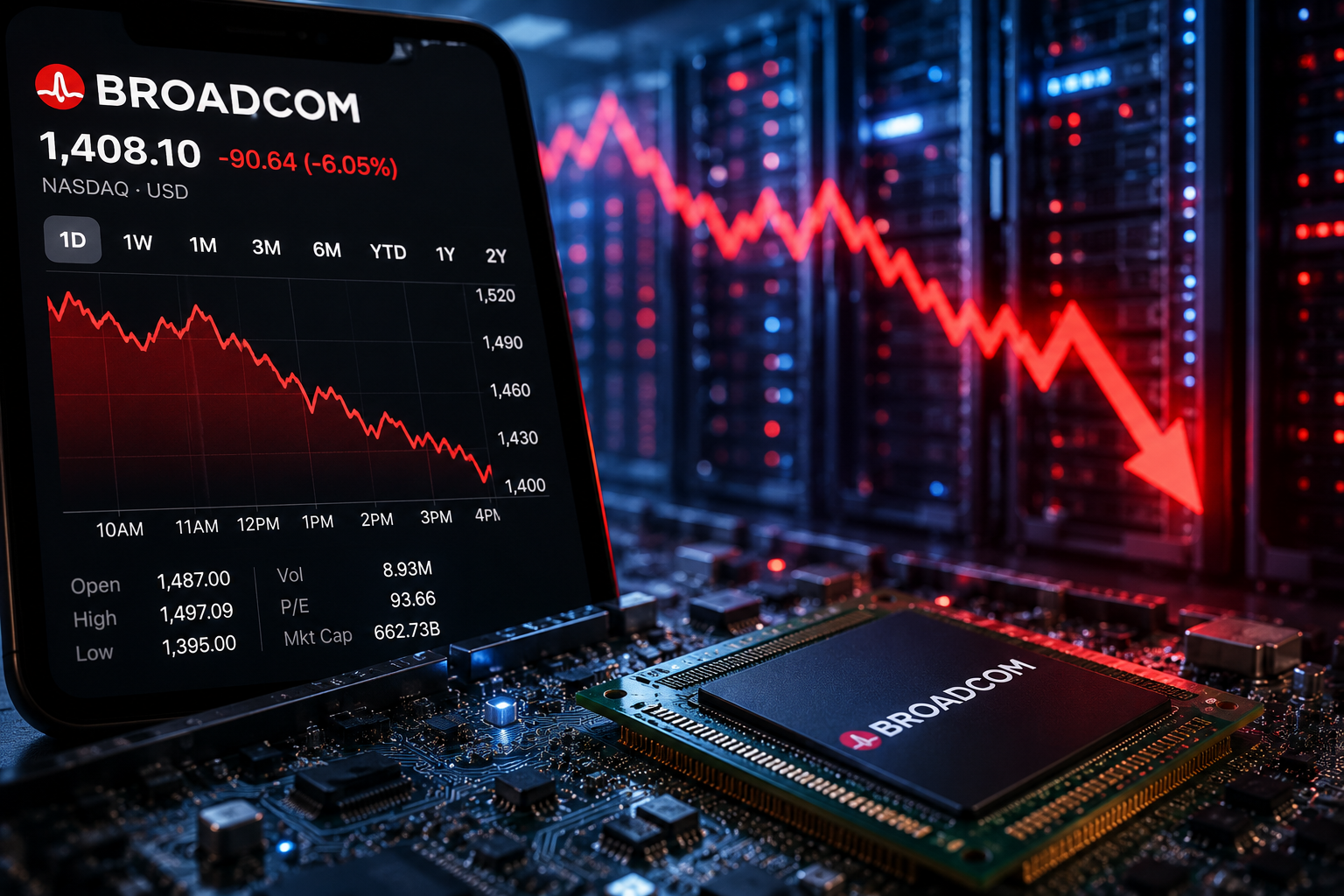
Broadcom’s latest earnings report sparked a sharp selloff in its shares after results failed to significantly surpass Wall Street’s lofty expectations. The decline rippled across the semiconductor sector, weighing on AI-related stocks and pressuring the Nasdaq. While the company continued to report strong AI-driven demand, investors appeared disappointed that the results were not exceptional enough to justify increasingly elevated valuations.
According to Reuters, Broadcom’s post-earnings decline highlights a critical shift occurring across financial markets. Investors remain bullish on artificial intelligence, but they are becoming increasingly selective. The era when simply mentioning AI could propel a stock higher may be fading. Going forward, companies will need to consistently deliver strong earnings growth, expanding margins, and measurable returns on AI investments to maintain investor confidence.
The AI Trade Faces Its First Real Test
Artificial intelligence has become the dominant market narrative of the decade.
Since the emergence of generative AI technologies, investors have poured hundreds of billions of dollars into companies involved in semiconductors, cloud computing, networking infrastructure, and data center construction. Major technology firms have announced unprecedented capital expenditure plans, while institutional investors have aggressively increased exposure to AI-related equities.
This enthusiasm has helped drive record highs across major market indexes.
The Nasdaq has significantly outperformed many other sectors, while semiconductor stocks have become some of the strongest performers in global markets. Investors have rewarded companies expected to benefit from AI infrastructure spending with premium valuations that often exceed historical norms.
Broadcom has been one of the biggest beneficiaries of this trend.
The company plays a critical role in the AI ecosystem by supplying networking chips, custom silicon solutions, connectivity technologies, and infrastructure components used in large-scale data centers. Demand from hyperscale cloud providers and AI developers has contributed significantly to Broadcom’s recent growth.
However, the latest earnings report demonstrates that investor expectations may have become extraordinarily high.
Strong results alone are no longer enough. Companies must now significantly exceed expectations to justify premium valuations.
Why Investors Reacted So Strongly
The market’s response to Broadcom’s earnings may seem surprising given the continued strength of AI demand.
The key issue was not necessarily the company’s performance but rather the gap between expectations and results.
Over the past year, investors have become accustomed to AI-related companies delivering extraordinary earnings surprises. Several leading semiconductor firms have repeatedly reported revenue growth far above analyst forecasts, reinforcing confidence in the AI investment cycle.
As a result, expectations have risen dramatically.
When investors assign premium valuations to stocks, future growth becomes heavily priced into share prices. Any indication that growth may be slowing—or simply not accelerating fast enough—can trigger significant volatility.
Broadcom’s results appeared to fall into that category.
The company continued to benefit from AI-related demand, but the market was looking for evidence that growth was accelerating even faster than anticipated. When that expectation was not fully met, investors responded by taking profits and reassessing valuations across the broader sector.
This reaction illustrates how sensitive the AI trade has become to earnings performance.
Why This Matters Beyond Broadcom
The significance of this development extends far beyond a single company.
Broadcom’s earnings serve as an important signal about how investors may evaluate AI-related companies moving forward. The market appears to be entering a new phase where execution matters more than narrative.
For much of the AI boom, investors focused primarily on future potential. Companies associated with artificial intelligence often enjoyed higher valuations based on anticipated growth rather than current financial performance.
That dynamic is beginning to change.
Institutional investors are increasingly asking tougher questions:
- Can AI investments generate sustainable revenue growth?
- Will profit margins expand alongside increased spending?
- How quickly can companies monetize AI infrastructure?
- Are current valuations justified by future earnings potential?
These questions are becoming central to investment decisions.
As a result, earnings reports are likely to play an even greater role in determining stock performance over the coming quarters.
The AI Infrastructure Boom Remains Intact
Despite the market’s reaction, there is little evidence that the broader AI investment cycle is weakening.
Technology companies continue announcing major investments in data centers, cloud infrastructure, and advanced computing systems. Industry forecasts from organizations such as McKinsey, Gartner, and major investment banks suggest that AI-related spending could continue expanding for years.
Demand for advanced semiconductors remains strong.
Cloud providers are increasing capacity, enterprises are accelerating AI adoption, and governments are investing in technological competitiveness. These trends continue supporting long-term growth opportunities across the semiconductor industry.
In fact, some analysts argue that periodic pullbacks may be healthy for the sector.
Rapid stock appreciation can create valuation imbalances that increase market risk. Short-term corrections often help reset expectations and establish more sustainable foundations for future gains.
For long-term investors, the distinction between a temporary valuation adjustment and a fundamental deterioration in business conditions is critical.
At present, the evidence suggests the AI growth story remains largely intact.
Future Trends to Watch
Several developments will likely determine the next phase of AI-related investing.
First, investors should closely monitor upcoming earnings reports from semiconductor companies, cloud providers, and networking infrastructure firms. These results will provide important insight into the health of AI spending across the industry.
Second, capital expenditure trends deserve attention.
Major technology companies have committed hundreds of billions of dollars toward AI infrastructure development. Investors will want evidence that these investments are generating meaningful returns and supporting revenue growth.
Third, competition within the semiconductor industry continues intensifying.
As demand for AI chips expands, new entrants and established players alike are racing to capture market share. Competitive dynamics could influence pricing, margins, and future profitability across the sector.
Finally, valuation discipline is becoming increasingly important.
Investors may begin favoring companies with proven execution records and predictable cash flows over businesses relying primarily on future growth projections.
This shift could create opportunities for selective investors willing to focus on fundamentals rather than market hype.
Why the Market’s Response Could Be Healthy
While short-term volatility often concerns investors, the market’s reaction to Broadcom’s earnings may ultimately strengthen the AI investment story.
Markets function most effectively when capital is allocated based on measurable performance rather than speculation. A greater emphasis on earnings quality, revenue growth, and profitability can help distinguish industry leaders from weaker competitors.
This process may create a more sustainable environment for long-term investment.
Rather than indiscriminately rewarding all AI-related stocks, investors appear increasingly focused on identifying companies capable of translating technological innovation into financial results.
That evolution is a natural part of every major investment cycle.
Key Investment Insight
Broadcom’s earnings-driven selloff highlights an important transition in the AI investment landscape. The artificial intelligence narrative remains one of the most powerful growth themes in global markets, but investors are becoming more discerning in how they allocate capital.
Future winners are likely to be companies that combine AI exposure with strong execution, accelerating earnings growth, expanding profitability, and clear competitive advantages. Investors should continue monitoring semiconductor suppliers, networking infrastructure providers, cloud computing firms, and data center operators, but valuation discipline and earnings quality will become increasingly important factors in stock selection.
For investors seeking deeper insights into technology, artificial intelligence, and the trends shaping financial markets, stay connected with MoneyNews.Today for daily analysis, actionable investment ideas, and coverage of the stories driving tomorrow’s opportunities.