
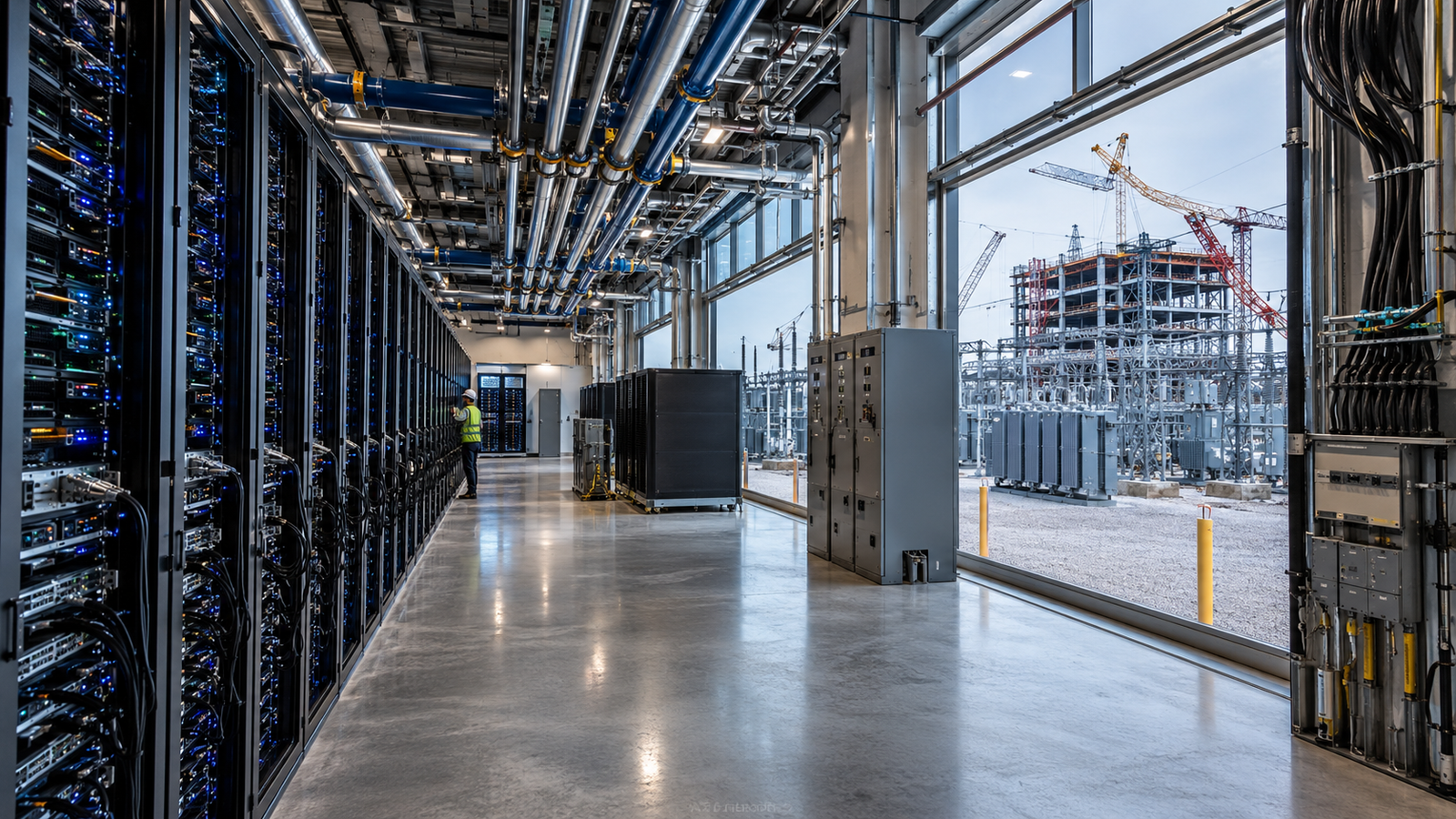
Artificial intelligence has become far more than a software revolution. It is now fueling one of the largest infrastructure investment cycles in modern economic history.
While investors have spent the past two years focusing on AI chipmakers and technology giants, a much broader transformation is unfolding beneath the surface. Billions of dollars are flowing into data centers, power generation facilities, electrical equipment, cooling systems, networking hardware, industrial real estate, and construction projects designed to support the next generation of AI applications.
This expanding wave of capital deployment is creating opportunities well beyond traditional technology companies. According to Reuters and Wall Street institutional research, the AI infrastructure buildout has evolved into a multi-industry investment theme that could reshape capital markets for years to come.
For investors, the implications are significant. The companies benefiting from artificial intelligence are no longer limited to software developers and semiconductor manufacturers. Increasingly, the winners include utilities, industrial suppliers, energy infrastructure providers, engineering firms, and real estate operators that form the backbone of the AI economy.
As capital continues pouring into AI infrastructure, understanding where money is flowing—and which industries stand to benefit—may become one of the most important investment themes of the decade.
The AI Revolution Requires More Than Software
Much of the excitement surrounding artificial intelligence has centered on advanced language models, autonomous systems, and generative AI platforms. However, these technologies depend on enormous physical infrastructure.
Every AI query, image generation request, or machine-learning model training session requires computing power, storage, networking capacity, and electricity.
This has created unprecedented demand for infrastructure investments across the economy.
According to research from McKinsey, generative AI could contribute between $2.6 trillion and $4.4 trillion annually to global economic output. Achieving that potential requires substantial investment in physical assets capable of supporting AI workloads.
Industry analysts estimate that hyperscale technology companies are expected to spend hundreds of billions of dollars annually on AI-related infrastructure over the coming years.
That spending is not limited to data centers alone.
The AI ecosystem increasingly depends on power grids, transmission networks, cooling technologies, fiber-optic connectivity, industrial construction projects, and advanced electrical equipment.
As a result, AI is becoming an infrastructure story as much as a technology story.
Data Centers Become the New Economic Engines
Few sectors illustrate the AI boom more clearly than data centers.
Major cloud providers and technology companies are aggressively expanding their data center footprints to meet surging demand for AI computing capacity.
Facilities that once primarily supported internet services are being redesigned to accommodate advanced AI training and inference workloads.
The scale is extraordinary.
Modern AI data centers consume significantly more electricity than traditional computing facilities. Some large AI-focused campuses require as much power as small cities, prompting substantial investments in energy generation and transmission infrastructure.
According to industry forecasts from IDC and various Wall Street research firms, global data center spending is expected to remain elevated throughout the decade as AI adoption accelerates.
For investors, this trend extends far beyond data center operators themselves.
Construction companies, engineering firms, electrical contractors, and industrial equipment manufacturers are all participating in this investment cycle.
The demand created by AI infrastructure is generating opportunities throughout the broader industrial economy.
Power Generation Emerges as a Critical Investment Theme
One of the most overlooked beneficiaries of the AI boom may be the energy sector.
Artificial intelligence requires enormous amounts of electricity.
As data center capacity expands, concerns about power availability are becoming increasingly important for both technology companies and investors.
Several major utilities have already reported growing demand from hyperscale data center customers. In some regions, AI-driven electricity consumption is expected to become a significant contributor to long-term energy demand growth.
This trend is attracting investor attention toward:
- Electric utilities
- Independent power producers
- Renewable energy developers
- Natural gas infrastructure operators
- Transmission and grid modernization companies
Wall Street analysts increasingly view energy infrastructure as a secondary AI beneficiary rather than a separate investment theme.
The relationship is straightforward: without reliable power, AI growth cannot continue at its current pace.
As a result, companies involved in energy generation and distribution may benefit from a multi-year increase in infrastructure spending.
Cooling Systems and Electrical Equipment Move Into the Spotlight
Artificial intelligence workloads generate enormous amounts of heat.
Managing that heat has become a major engineering challenge, creating opportunities for companies specializing in advanced cooling technologies.
Liquid cooling systems, thermal management solutions, and specialized HVAC technologies are experiencing rising demand as AI data centers become larger and more power-intensive.
Similarly, electrical equipment manufacturers are benefiting from increased infrastructure investment.
Transformers, switchgear, circuit protection systems, backup power solutions, and electrical distribution equipment are all essential components of AI facilities.
Many of these businesses historically received limited attention from growth-oriented investors. Today, they are increasingly viewed as strategic beneficiaries of one of the world’s fastest-growing industries.
This shift demonstrates how AI investment opportunities are expanding beyond traditional technology sectors.
Industrial REITs Gain Exposure to AI Growth
Real estate investment trusts are also emerging as unexpected beneficiaries of artificial intelligence.
Industrial REITs and specialized data center REITs provide critical facilities that support digital infrastructure expansion.
The growing demand for data center space has increased occupancy rates, supported rental growth, and encouraged new development projects across key technology markets.
While investors often associate AI with software companies, the physical infrastructure supporting AI requires substantial real estate investment.
This dynamic creates opportunities for property owners that can provide strategically located facilities with access to power, connectivity, and transportation networks.
As AI deployment accelerates, demand for these specialized assets could continue growing.
Why This Matters for Investors
The AI infrastructure boom highlights an important investment principle: transformational technologies often create opportunities far beyond their most visible participants.
During the internet expansion of the 1990s and early 2000s, investors who focused solely on consumer-facing technology companies missed significant gains in networking equipment, telecommunications infrastructure, and enterprise software.
A similar pattern may be emerging today.
While semiconductor manufacturers and AI software leaders remain important players, secondary beneficiaries are increasingly capturing investor attention.
The AI value chain now extends across:
- Utilities
- Energy infrastructure
- Industrial equipment
- Construction services
- Engineering firms
- Data center operators
- Industrial REITs
- Networking hardware providers
This diversification broadens the opportunity set available to investors seeking exposure to the AI megatrend.
Future Trends to Watch
Several developments could shape the next phase of AI infrastructure investment.
First, power availability is likely to become an increasingly important competitive advantage. Companies capable of delivering reliable energy solutions may benefit from rising demand.
Second, data center expansion is expected to remain a major source of capital expenditure across the technology sector.
Third, cooling technologies and energy efficiency solutions could become critical investment themes as AI workloads continue growing.
Finally, governments may increase support for infrastructure development to maintain competitiveness in the global AI race, creating additional opportunities for industrial and infrastructure-focused companies.
Investors should monitor capital spending trends, utility demand forecasts, data center construction activity, and infrastructure investment announcements as indicators of where AI-related growth is accelerating.
Key Investment Insight
The AI investment story is rapidly expanding beyond software and semiconductors. Investors seeking diversified exposure to artificial intelligence should consider the broader infrastructure ecosystem that makes AI possible.
Utilities, electrical equipment manufacturers, construction firms, industrial REITs, power producers, cooling technology providers, and networking infrastructure companies may represent some of the most compelling secondary beneficiaries of the ongoing AI boom.
As capital continues flowing into AI infrastructure, these industries could become increasingly important drivers of earnings growth and shareholder returns.
Stay informed with MoneyNews.Today for daily investor insights, market-moving developments, and in-depth analysis of the trends shaping tomorrow’s investment opportunities.




