
For nearly two years, artificial intelligence has been the engine driving Wall Street’s most powerful rally. Investors poured capital into semiconductor manufacturers, cloud computing giants, data-center operators, and AI infrastructure providers under the belief that a once-in-a-generation technology cycle was unfolding.
Now, that narrative is facing its toughest test yet.
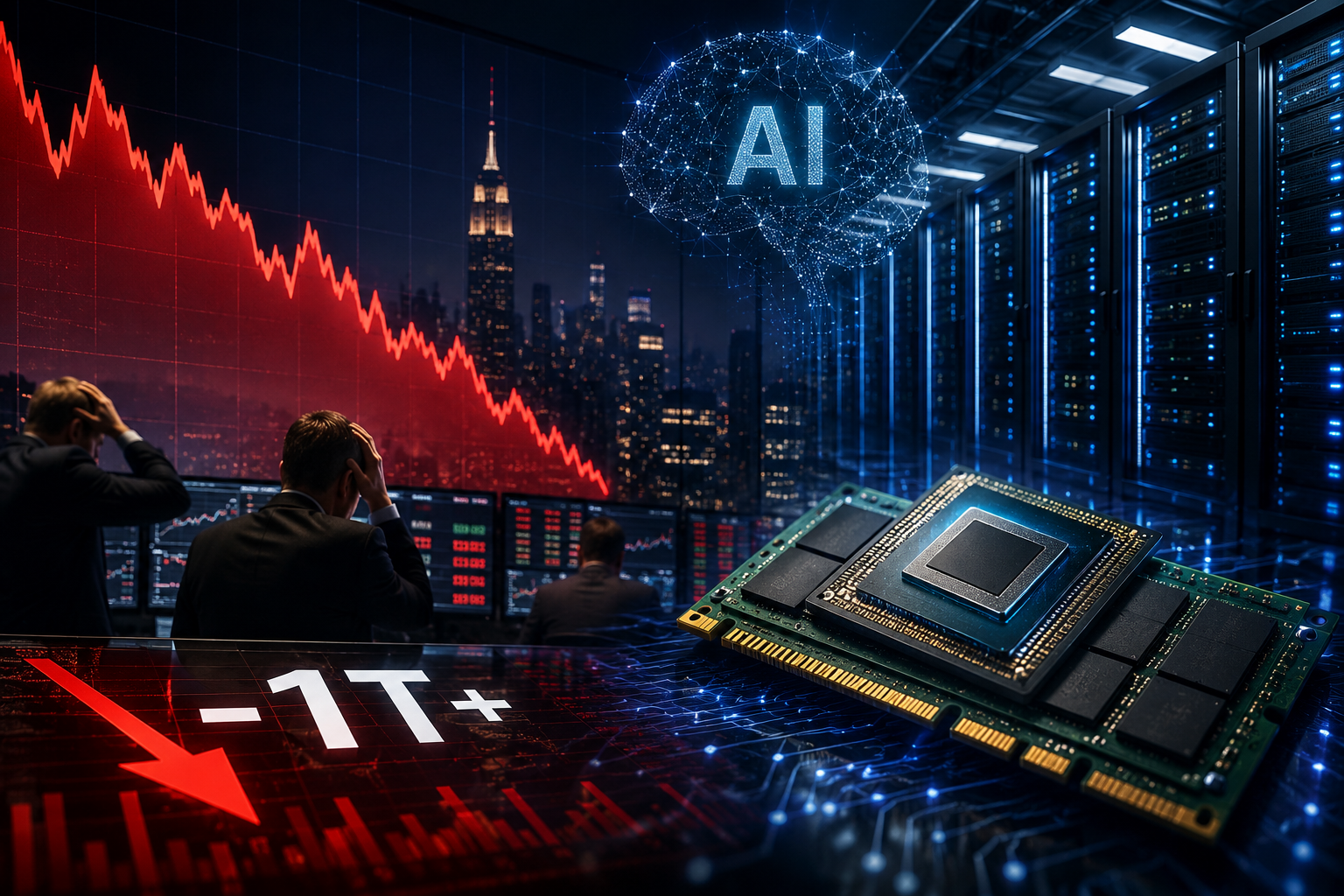
A sharp selloff in technology stocks has erased more than $1 trillion from the Nasdaq 100 in recent trading sessions, forcing investors to confront an increasingly important question: Can the massive spending fueling the AI revolution continue generating returns that justify current valuations?
The answer may begin to emerge with one of the most anticipated earnings reports of the year from Micron Technology. The memory-chip maker sits at the center of the AI infrastructure ecosystem, and its results could provide crucial insight into whether demand for AI hardware remains strong enough to sustain the next phase of the technology rally.
According to Reuters, Wall Street Journal reporting, and broader market commentary, investors are increasingly shifting their focus from AI enthusiasm to AI profitability. The transition marks a significant turning point for one of the market’s most influential investment themes.
For investors, the implications extend far beyond a single earnings report. The future direction of semiconductor stocks, technology valuations, and perhaps even the broader equity market could depend on what comes next.
The AI Trade Has Dominated Markets
Few investment themes have generated as much excitement as artificial intelligence.
The emergence of generative AI platforms, large language models, enterprise automation tools, and AI-powered software sparked an unprecedented wave of spending across the technology sector.
Major cloud providers and hyperscale data-center operators committed hundreds of billions of dollars to expanding AI infrastructure. Semiconductor companies became some of the largest beneficiaries as demand surged for advanced processors, high-bandwidth memory, networking equipment, and data-center hardware.
This spending boom transformed technology markets.
Companies connected to AI infrastructure delivered extraordinary stock performance, helping drive major indexes to record highs and pushing technology’s weighting within the S&P 500 to historically elevated levels.
For much of the rally, investors rewarded companies simply for increasing AI-related investments.
Today, that approach is beginning to change.
The Market Is Asking a Different Question
The first phase of the AI boom focused on potential.
Investors were willing to pay premium valuations because they believed AI would fundamentally reshape industries, boost productivity, and create new revenue streams.
The second phase is likely to focus on proof.
Can companies demonstrate measurable returns on billions of dollars in AI spending?
Can cloud providers monetize AI investments quickly enough to justify capital expenditures?
Can semiconductor companies maintain current growth rates as competition increases and infrastructure deployments mature?
These questions are increasingly driving investor decisions.
The recent selloff suggests that markets are becoming less interested in AI announcements and more interested in tangible financial results.
In other words, Wall Street is moving from “AI growth at any cost” to “show me the returns.”
Why Micron Has Become So Important
Micron Technology occupies a unique position within the AI ecosystem.
Modern AI systems require enormous amounts of memory to process and store data efficiently. As a result, demand for advanced memory solutions has become one of the most important drivers of AI infrastructure spending.
Micron’s high-bandwidth memory products are increasingly viewed as essential components in AI servers and advanced computing platforms.
Because of this, investors often view Micron as a barometer for broader AI demand.
Analysts will be closely watching several metrics when the company reports earnings:
AI Memory Demand
Strong demand for high-bandwidth memory would reinforce confidence in ongoing AI infrastructure investments.
Data-Center Spending
Investors want confirmation that hyperscale cloud providers continue aggressively expanding AI capacity.
Revenue Growth and Margins
Profitability remains a key measure of whether AI-related demand is translating into sustainable earnings growth.
Forward Guidance
Management’s outlook for future quarters may ultimately matter more than the results themselves.
A strong report could reignite enthusiasm across the semiconductor sector. A weaker-than-expected outlook could trigger further reassessment of AI-related valuations.
The Semiconductor Industry Is at a Crossroads
Micron’s earnings matter because they influence sentiment across the entire semiconductor landscape.
Several of the market’s most influential companies remain heavily tied to the AI infrastructure theme.
AI chip manufacturers continue benefiting from unprecedented demand for computing power. Networking providers are experiencing growth as data-center operators upgrade infrastructure. Memory suppliers are expanding production capacity to meet rising requirements.
However, expectations have become extraordinarily high.
Investors increasingly recognize that even exceptional growth may not be enough if valuations have already priced in years of future success.
The result is a market environment where execution matters more than ever.
Companies must now demonstrate not only growth but also profitability, operational efficiency, and sustainable competitive advantages.
Higher Interest Rates Are Adding Pressure
The technology sector’s challenges are not limited to AI spending concerns.
Investors are simultaneously navigating a more difficult macroeconomic environment.
Expectations for additional Federal Reserve tightening have increased in recent weeks, driving Treasury yields higher and strengthening the U.S. dollar.
Higher interest rates generally create challenges for growth stocks because future earnings become less valuable when discounted at higher rates.
This dynamic has amplified volatility across technology shares.
Even companies delivering strong operational performance can experience valuation pressure if investors become more cautious about future growth assumptions.
As a result, technology stocks are now facing two simultaneous tests:
- Can AI investments continue generating strong returns?
- Can those returns justify current valuations in a higher-rate environment?
The answers will likely determine the next phase of market performance.
Why This Matters for Investors
The significance of the current selloff extends beyond technology stocks.
AI has become one of the primary drivers of broader market gains. Many major indexes have relied heavily on a relatively small group of AI-related companies to generate returns.
If confidence in the AI infrastructure story weakens significantly, broader market sentiment could be affected.
Conversely, strong earnings and continued demand growth could help restore confidence and support another leg higher in technology shares.
This makes the current period particularly important for investors across multiple sectors.
Future Trends to Watch
Several developments could shape the next chapter of the AI investment story.
Enterprise AI Adoption
The next wave of growth may depend on businesses successfully integrating AI into operations and generating measurable productivity gains.
Data-Center Expansion
Continued investment from hyperscale cloud providers remains critical for semiconductor demand.
AI Monetization
Investors increasingly want evidence that AI products are generating sustainable revenue streams.
Competitive Dynamics
Growing competition across semiconductors, cloud computing, and AI software could influence margins and market share.
Federal Reserve Policy
Interest-rate expectations will continue affecting technology valuations and investor risk appetite.
Key Investment Insight
(Investor Takeaway)
The AI investment story is not ending—it is evolving.
The market’s focus is shifting away from announcements and toward measurable business outcomes. Investors should prioritize companies demonstrating clear AI monetization strategies, expanding margins, strong cash flow generation, and sustainable demand rather than simply highlighting large capital expenditure plans.
Micron’s earnings may provide one of the clearest signals yet about the health of the AI infrastructure trade. Strong results could reinforce confidence across semiconductors and AI-related industries. Weak guidance, however, could accelerate a broader valuation reset and force investors to reconsider growth assumptions throughout the technology sector.
The next phase of the AI revolution may belong not to the companies spending the most, but to the companies proving they can turn AI investments into lasting shareholder value.
Stay with MoneyNews.Today for daily investor insights, market-moving analysis, and the trends shaping technology, artificial intelligence, and the future of global investing.




