
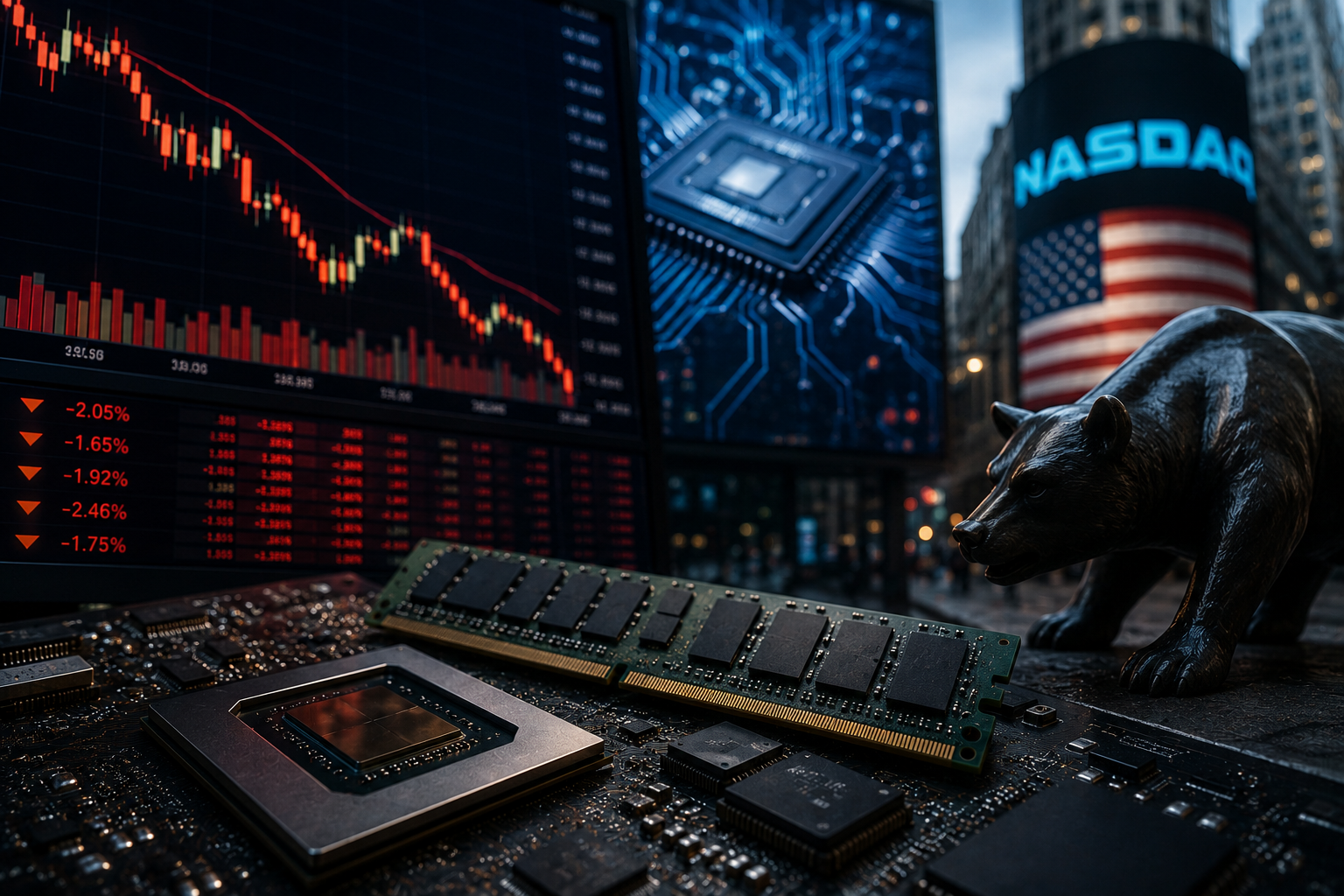
Just one day after a powerful AI-driven rally lifted technology stocks, Wall Street hit the brakes. U.S. stock futures turned lower on Friday as investors resumed selling semiconductor shares despite Micron Technology delivering another strong earnings report and reinforcing robust demand for artificial intelligence hardware. The swift reversal highlights a growing concern dominating financial markets: investors are no longer questioning whether AI demand exists—they are questioning whether current stock valuations already reflect years of future growth.
The renewed weakness in semiconductor stocks—including Nvidia, AMD, Intel, and Micron—comes at a pivotal moment for the broader market. After leading the Nasdaq higher for much of the AI boom, chipmakers now face heightened scrutiny as investors demand evidence that unprecedented capital spending on AI infrastructure will translate into sustainable earnings growth.
For investors, this shift marks an important evolution in market sentiment. The AI trade remains alive, but Wall Street is becoming increasingly selective about which companies deserve premium valuations.
A Strong Micron Report Wasn’t Enough to Sustain the Rally
Thursday’s optimism was fueled by Micron Technology, which reported another impressive quarter supported by surging demand for high-bandwidth memory (HBM), a critical component used in AI accelerators and advanced data centers.
According to Reuters, Micron also disclosed more than $22 billion in customer commitments, underscoring continued strong demand from hyperscale cloud providers building next-generation AI infrastructure.
Normally, such results would have extended the rally across semiconductor stocks.
Instead, investors used the strength as an opportunity to lock in profits.
By Friday morning, Nasdaq futures had turned lower while semiconductor shares resumed their decline, reflecting growing concerns that valuations across the AI sector have become increasingly difficult to justify without exceptional earnings growth.
The market’s reaction illustrates a broader transition from enthusiasm-driven investing toward fundamentals-driven investing.
Why Investors Are Becoming More Cautious
The AI investment theme remains one of the strongest structural growth stories in global markets, but expectations have risen dramatically over the past two years.
Companies such as Nvidia have experienced extraordinary share price appreciation as investors priced in years of anticipated AI-driven demand.
That success has also created higher expectations.
Institutional investors now expect not only strong revenue growth but also sustained margin expansion, disciplined capital allocation, and clear evidence that AI investments will produce meaningful long-term returns.
This explains why even positive earnings reports can trigger selling if investors believe expectations have become overly optimistic.
Rather than questioning AI adoption itself, markets are beginning to evaluate whether the industry’s largest winners can continue exceeding increasingly ambitious forecasts.
AI Spending Is No Longer the Only Story
One of the most significant changes in investor sentiment is the shift from focusing on AI infrastructure spending to evaluating AI profitability.
Major technology companies—including Microsoft, Amazon, Alphabet, and Meta Platforms—continue investing hundreds of billions of dollars in data centers, graphics processing units (GPUs), networking equipment, and custom AI chips.
These investments have fueled extraordinary demand across the semiconductor industry.
However, Wall Street is increasingly asking whether these enormous expenditures will generate sufficient returns through higher cloud revenue, enterprise software adoption, advertising growth, and productivity gains.
In other words, investors want proof that AI is becoming a profitable business—not simply an expensive technological race.
This evolution in market psychology is likely to influence technology valuations throughout the remainder of 2026.
Semiconductor Stocks Remain the Market’s Leadership Group
The semiconductor industry has become one of the most influential sectors within the broader U.S. equity market.
Companies including Nvidia, AMD, Broadcom, Intel, Qualcomm, Micron, and Taiwan Semiconductor Manufacturing Co. occupy central positions in the AI supply chain, providing processors, memory, networking hardware, and manufacturing capacity.
Their performance has also become increasingly important for the Nasdaq 100 and major technology-focused exchange-traded funds.
When semiconductor stocks rally, the broader technology sector often follows.
Conversely, sustained weakness among chipmakers has historically created pressure across software companies, cloud providers, and other high-growth technology businesses.
This interconnected relationship explains why investors are closely monitoring semiconductor performance as a leading indicator for the broader market.
Upcoming Earnings Could Determine the Market’s Direction
Attention is now shifting toward the next wave of quarterly earnings reports.
Investors will closely monitor results from Nvidia, Microsoft, Amazon, Alphabet, Meta Platforms, AMD, Intel, and other AI leaders for evidence that AI investments are generating measurable financial returns.
Key metrics likely to receive heightened scrutiny include:
- Revenue growth from AI-related products and services
- Gross margin trends
- Capital expenditure guidance
- Free cash flow generation
- Enterprise AI adoption
- Cloud computing demand
- Customer spending trends
Analysts believe these reports could determine whether the AI trade resumes its leadership role or enters a longer period of consolidation.
Companies capable of demonstrating strong monetization alongside continued investment may outperform peers that continue increasing spending without corresponding revenue growth.
Market Valuations Leave Little Room for Disappointment
One reason investors reacted cautiously despite Micron’s encouraging outlook is that valuations across much of the semiconductor sector remain elevated.
Following multiple years of exceptional gains, many AI-related companies trade at significant premiums relative to historical averages.
Premium valuations are not necessarily unjustified for high-growth businesses.
However, they reduce the market’s tolerance for earnings disappointments.
Even minor guidance revisions or slower-than-expected growth can trigger meaningful share price declines when expectations are exceptionally high.
This dynamic has become increasingly evident during recent earnings seasons across the technology sector.
Investors are rewarding companies that consistently exceed expectations while quickly reassessing those that fail to deliver.
Why This Matters for Investors
The recent weakness in semiconductor stocks should not be interpreted as a collapse of the AI investment thesis.
Instead, it reflects a natural transition as markets mature.
Early investment cycles are often driven by excitement surrounding new technologies.
Later stages typically reward companies capable of converting innovation into durable earnings growth and expanding cash flows.
Artificial intelligence continues to represent one of the largest long-term growth opportunities across technology, cloud computing, healthcare, industrial automation, cybersecurity, and enterprise software.
However, investors are becoming more disciplined in evaluating which companies possess sustainable competitive advantages.
That discipline may ultimately produce a healthier and more durable investment environment.
Future Trends to Watch
Several catalysts could shape the market over the coming months.
First, investors will closely monitor earnings from the largest AI beneficiaries for evidence of improving profitability.
Second, Federal Reserve policy and Treasury yields will continue influencing technology valuations, particularly for growth stocks.
Third, enterprise AI adoption rates will provide valuable insight into whether corporate customers are generating measurable returns from AI investments.
Finally, demand trends across GPUs, memory chips, networking equipment, and cloud infrastructure will remain essential indicators for the semiconductor industry’s long-term outlook.
Key Investment Insight
The AI revolution remains intact, but Wall Street is entering a new phase where execution matters more than optimism.
Investors should look beyond headline announcements about AI spending and instead focus on companies demonstrating accelerating revenue growth, expanding profit margins, disciplined capital allocation, and clear evidence that artificial intelligence is creating lasting shareholder value.
While semiconductor stocks remain central to the AI ecosystem, sustained leadership will likely belong to companies capable of translating technological innovation into measurable financial performance.
As earnings season unfolds, the market’s response may determine whether the Nasdaq resumes its upward trajectory or experiences a broader reassessment of high-growth technology valuations.
Stay with MoneyNews.Today for trusted daily investor insights, market-moving analysis, and comprehensive coverage of the trends shaping global financial markets.




