
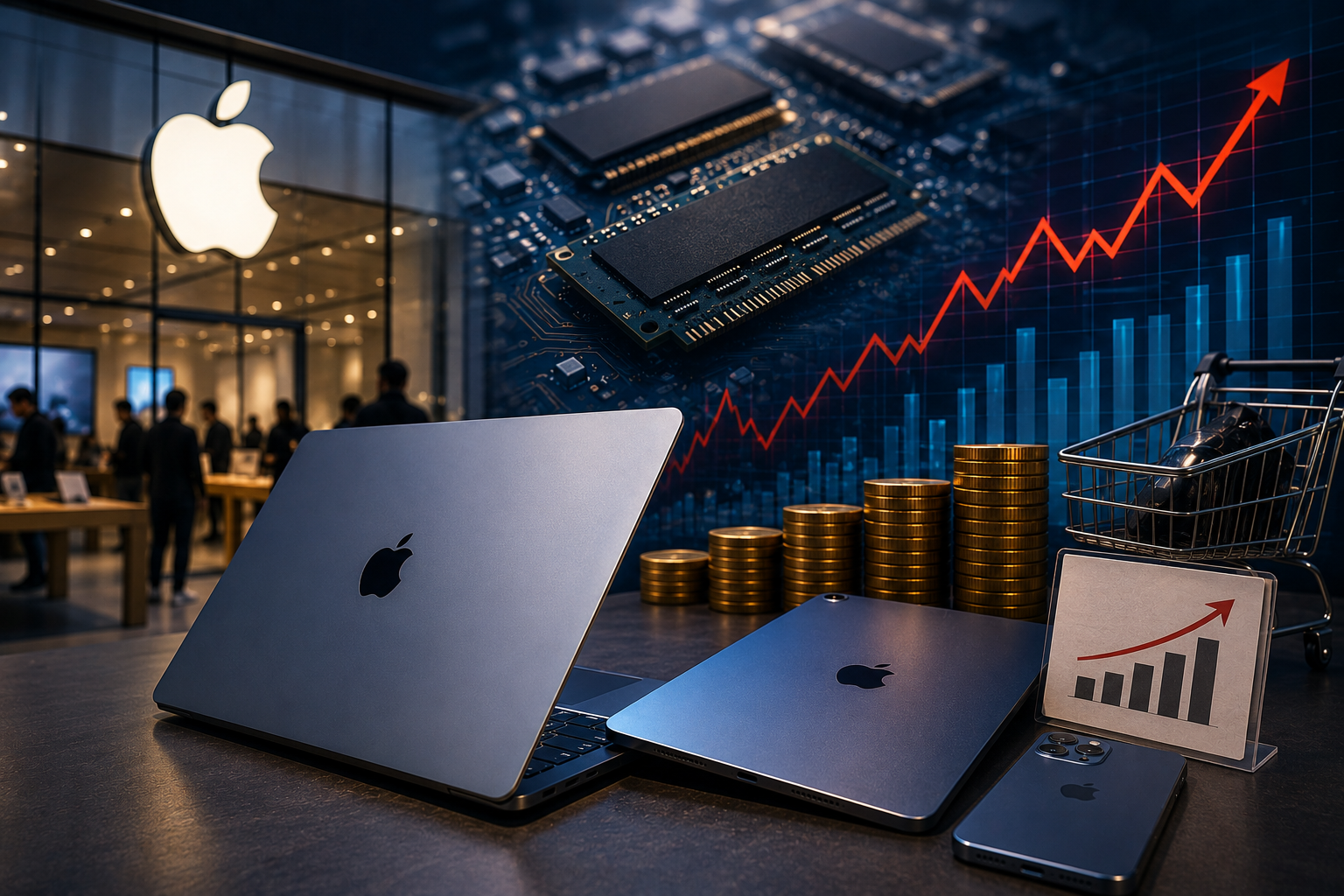
Artificial intelligence has become the biggest growth engine in the technology sector, but it is also beginning to reshape the industry’s cost structure. Apple’s latest decision to increase prices on select Mac and iPad models is the clearest indication yet that AI-driven demand for advanced memory and storage components is rippling throughout the global technology supply chain. For investors, the development raises an important question: could the AI boom itself become an inflationary force that pressures consumer demand while reshaping profit margins across the hardware industry?
The price adjustments arrive at a pivotal moment for technology markets. Semiconductor companies continue reporting strong demand for AI chips, memory manufacturers are enjoying improved pricing power, and hyperscale cloud providers are investing hundreds of billions of dollars in AI infrastructure. However, those same investments are increasing demand for high-performance components, creating supply constraints and raising costs for consumer electronics manufacturers.
According to Reuters, Apple’s latest pricing changes reflect higher memory and storage costs as AI-related demand continues to tighten component availability. The development has sparked a broader debate across Wall Street about whether technology companies can continue passing rising costs to consumers without weakening demand.
For investors, the implications extend far beyond Apple. The issue touches nearly every major hardware manufacturer and supplier in the technology ecosystem.
AI Demand Is Transforming the Technology Supply Chain
The surge in artificial intelligence investment has fundamentally changed demand across the semiconductor industry.
High-bandwidth memory (HBM), advanced DRAM, NAND flash storage, graphics processors, and AI accelerators have become some of the most sought-after components in the global technology market.
Companies building AI data centers—including Microsoft, Amazon, Alphabet, Meta Platforms, and Oracle—continue purchasing enormous quantities of advanced chips and memory to support generative AI services and cloud infrastructure.
This unprecedented demand has benefited semiconductor manufacturers such as Micron Technology, SK Hynix, Samsung Electronics, Nvidia, and Taiwan Semiconductor Manufacturing Co. (TSMC).
However, increased demand for premium components has also affected downstream manufacturers that rely on similar technologies for consumer products.
Apple’s latest pricing decisions illustrate how AI investment is beginning to influence pricing well beyond enterprise infrastructure.
Why Apple Increased Prices
Apple has traditionally maintained relatively stable pricing across its hardware portfolio while focusing on premium positioning and ecosystem integration.
This time, however, higher component costs—particularly for memory and storage—have prompted selective price increases on Macs and iPads.
Industry analysts note that AI-enabled devices increasingly require larger memory configurations and faster storage solutions to support advanced on-device machine learning capabilities.
At the same time, suppliers continue prioritizing high-margin AI server components as cloud providers aggressively expand data center capacity.
The combination of stronger enterprise demand and constrained supply has created upward pressure on component prices across the broader technology industry.
For Apple, passing part of those costs on to consumers may help preserve profitability.
The key question is whether customers will continue accepting higher prices in an increasingly competitive market.
Inflation Concerns Return to the Technology Sector
For much of the past decade, technology products generally became more powerful without experiencing significant price inflation.
AI may be changing that dynamic.
If higher semiconductor, memory, and storage costs persist, additional hardware manufacturers could face similar pricing decisions.
Companies producing laptops, tablets, smartphones, enterprise servers, networking equipment, and gaming hardware all depend on many of the same advanced semiconductor components.
Should input costs continue rising, manufacturers may have three primary options:
- Pass higher costs to consumers through price increases.
- Absorb the costs and accept lower profit margins.
- Redesign products to reduce reliance on premium components.
Each approach carries investment implications.
Higher consumer prices may slow unit sales, while lower margins could pressure earnings growth.
Memory Suppliers Continue Benefiting
While hardware manufacturers face margin pressure, memory producers remain among the largest beneficiaries of the AI investment cycle.
Micron Technology recently reinforced this narrative by reporting exceptionally strong AI-related demand and disclosing more than $22 billion in customer commitments.
Industry leaders SK Hynix and Samsung Electronics have similarly benefited from increasing demand for high-bandwidth memory used in AI accelerators.
Research firms including Gartner and IDC continue forecasting strong long-term growth for AI infrastructure spending as enterprises expand generative AI deployments.
As long as supply remains relatively constrained compared to demand, memory manufacturers may continue enjoying stronger pricing power than many downstream hardware companies.
For investors, this highlights an important distinction within the technology sector.
Not every company benefits equally from the AI boom.
Consumer Demand Will Be Closely Watched
One of the biggest uncertainties facing investors is whether consumers will continue purchasing premium devices at higher prices.
Historically, Apple has demonstrated remarkable pricing power, supported by strong brand loyalty, ecosystem integration, and premium product positioning.
However, broader economic conditions remain an important consideration.
Higher interest rates, persistent inflation in other sectors, and slowing discretionary spending could make consumers more price-sensitive.
If competing manufacturers also raise prices, overall demand for consumer electronics may moderate over time.
Conversely, if AI-powered features significantly improve user experiences, consumers may view higher prices as justified.
Future product cycles will provide valuable insight into how much pricing flexibility premium hardware manufacturers truly possess.
Why This Matters for Investors
Apple’s pricing decisions represent more than an isolated corporate action.
They offer an early glimpse into how AI-driven investment may reshape the economics of the broader technology industry.
The AI revolution is creating extraordinary demand throughout semiconductor supply chains.
Yet that demand is also contributing to higher input costs, forcing hardware manufacturers to balance profitability against consumer affordability.
Investors should therefore evaluate companies differently depending on their position within the technology ecosystem.
Semiconductor manufacturers and memory suppliers may continue benefiting from favorable supply-demand dynamics.
Consumer electronics companies, meanwhile, could face increasing pressure to maintain margins while preserving market share.
Understanding these differing dynamics may become increasingly important as AI investment continues accelerating.
Future Trends to Watch
Several developments will determine whether AI-related inflation becomes a lasting trend.
First, investors should monitor memory pricing and semiconductor supply as indicators of ongoing cost pressures.
Second, quarterly earnings from Apple, Dell Technologies, HP, Lenovo, and other hardware manufacturers will reveal whether higher component costs are affecting margins.
Third, demand for AI-enabled consumer devices will provide insight into whether customers remain willing to pay premium prices.
Finally, capital expenditure plans from hyperscale cloud providers—including Microsoft, Amazon, Alphabet, and Meta Platforms—will continue influencing demand for advanced semiconductors throughout the supply chain.
Key Investment Insight
The AI boom is creating winners and challenges across the technology sector.
Companies supplying advanced memory, storage, and semiconductor components may continue benefiting from sustained pricing power as AI infrastructure spending expands.
Hardware manufacturers, however, face a more complex environment where rising component costs must be balanced against consumer demand and competitive pricing.
For investors, understanding where companies sit within the AI supply chain will be critical. Businesses with strong pricing power, differentiated products, and efficient supply chain management are likely to be better positioned than those operating in highly competitive hardware markets with limited margin flexibility.
As AI adoption continues reshaping global technology markets, monitoring supply chain costs, pricing trends, and consumer demand may become just as important as following product launches and earnings reports.
Stay with MoneyNews.Today for trusted daily investor insights, market-moving analysis, and comprehensive coverage of the trends transforming technology, artificial intelligence, and global financial markets.




