
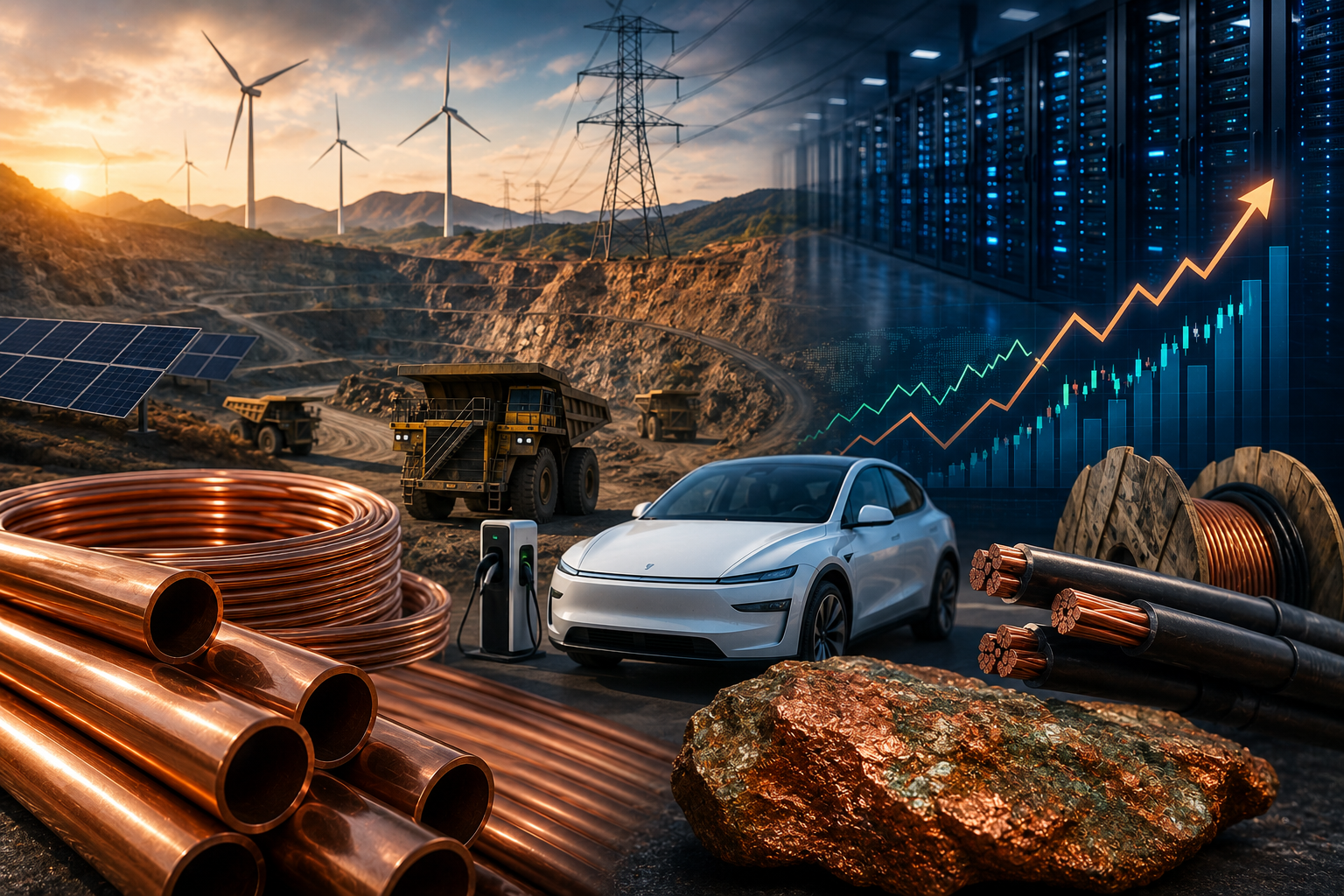
Artificial intelligence may be grabbing headlines for transforming software and semiconductors, but another industry is quietly becoming one of its biggest long-term beneficiaries: copper. From AI data centers and electric vehicles to renewable energy projects and modernized power grids, the global economy’s transition toward electrification is driving unprecedented demand for the metal often referred to as the “backbone of the energy transition.”
While copper prices have experienced periods of volatility amid changing economic expectations and geopolitical uncertainty, the long-term investment case remains increasingly compelling. According to Reuters and industry analysts, mining companies continue evaluating expansion projects as investors weigh rising production costs, permitting challenges, and the growing risk of structural supply shortages.
For investors, the message is becoming clearer: the future of artificial intelligence and clean energy may depend as much on access to critical minerals as it does on advances in computing technology.
AI and Electrification Are Reshaping Copper Demand
Copper has always been an essential industrial metal, but its strategic importance has expanded significantly over the past decade.
The rapid construction of AI data centers requires enormous amounts of copper for electrical wiring, transformers, cooling systems, networking infrastructure, and power distribution equipment.
At the same time, the global shift toward electric vehicles (EVs) continues increasing demand.
Electric vehicles typically require substantially more copper than traditional internal combustion engine vehicles due to their batteries, electric motors, charging systems, and power electronics.
Beyond transportation, governments and utilities worldwide are investing heavily in renewable energy generation, battery storage systems, transmission lines, and grid modernization.
Each of these projects depends heavily on copper.
Together, these structural trends are creating sustained long-term demand that extends well beyond traditional construction and manufacturing.
Supply Growth Is Struggling to Keep Pace
While demand continues rising, expanding copper production remains increasingly difficult.
Developing a new copper mine often requires more than a decade of exploration, environmental permitting, infrastructure development, financing, and construction.
Many of the world’s largest copper-producing regions also face political uncertainty, regulatory changes, labor disputes, water shortages, and rising operating costs.
According to Reuters, major mining companies continue evaluating expansion opportunities, but executives remain disciplined regarding capital allocation after previous commodity cycles demonstrated the risks of aggressive spending.
The result is a growing concern among analysts that future supply growth may lag behind accelerating demand.
Several research firms, including the International Energy Agency (IEA), S&P Global, and Wood Mackenzie, have warned that the energy transition could create significant copper supply deficits during the coming decade unless substantial new mining capacity is developed.
Major Miners Face Strategic Decisions
Some of the world’s largest mining companies are now at the center of the copper investment story.
Industry leaders including BHP, Rio Tinto, Freeport-McMoRan, Southern Copper, Teck Resources, Antofagasta, and First Quantum Minerals continue evaluating expansion projects, acquisitions, and exploration opportunities to strengthen long-term production.
However, expanding supply has become increasingly expensive.
Higher labor costs, inflation, environmental requirements, energy prices, and financing expenses have significantly increased the capital required to develop new mines.
At the same time, investors continue demanding disciplined spending and higher shareholder returns through dividends and share buybacks.
This creates a delicate balance.
Mining companies must invest sufficiently to capture future demand without overextending capital during periods of commodity price volatility.
Geopolitical Risks Add Another Layer of Complexity
Copper supply is also increasingly influenced by geopolitical developments.
Several major producing countries continue reviewing mining regulations, royalty structures, environmental policies, and foreign investment rules.
Political uncertainty can delay project approvals or increase development costs, limiting future production growth.
Supply chain diversification has become another priority for governments seeking greater access to critical minerals needed for national security, clean energy, and advanced manufacturing.
The United States, Canada, Australia, and several European nations continue supporting domestic critical mineral strategies aimed at reducing dependence on concentrated global supply chains.
These initiatives could influence future investment across the mining sector.
Why Copper Is Becoming a Strategic Metal
Historically, copper was viewed primarily as an industrial commodity closely tied to economic growth.
Today, it is increasingly considered a strategic resource.
Artificial intelligence requires enormous computing infrastructure powered by electricity.
Renewable energy depends on copper-intensive transmission systems.
Electric vehicles require significantly more copper than conventional automobiles.
Battery storage systems, charging infrastructure, industrial automation, and smart grids all contribute additional demand.
This diversification reduces reliance on any single end market while strengthening the metal’s long-term demand profile.
Many analysts now describe copper as one of the most important commodities supporting the global digital and energy transitions simultaneously.
Why This Matters for Investors
The current investment landscape presents both opportunities and risks.
Copper prices may continue experiencing short-term volatility due to global economic conditions, interest-rate expectations, currency fluctuations, and geopolitical developments.
However, the longer-term structural demand outlook appears increasingly favorable.
Investors should recognize that mining companies are not solely leveraged to commodity prices.
Project execution, reserve quality, production costs, jurisdictional risk, and capital allocation decisions remain equally important drivers of shareholder returns.
Companies capable of expanding production while maintaining financial discipline may be better positioned to benefit from the evolving supply-demand imbalance.
Meanwhile, businesses supplying mining equipment, automation technologies, engineering services, and infrastructure solutions could also benefit from increased industry investment.
Future Trends to Watch
Several developments are likely to shape the copper market during the remainder of the decade.
First, investors should monitor project approvals and permitting decisions for major expansion projects across key mining regions.
Second, capital expenditure plans from leading miners will provide insight into future production growth.
Third, AI infrastructure investment by hyperscale cloud providers—including Microsoft, Amazon, Alphabet, and Meta Platforms—will continue influencing long-term copper demand through data center expansion.
Fourth, global electric vehicle adoption rates and renewable energy investment will remain critical demand drivers.
Finally, government policies supporting domestic critical mineral production may reshape future investment opportunities in North America and other resource-rich regions.
Key Investment Insight
Copper’s investment case is increasingly supported by multiple long-term structural trends rather than a single commodity cycle.
Artificial intelligence, electrification, renewable energy, electric vehicles, and power grid modernization are collectively creating sustained demand that could outpace future supply growth for years to come.
While commodity prices will likely remain volatile, investors should focus on mining companies with high-quality assets, disciplined capital allocation, manageable production costs, and well-positioned development pipelines.
Monitoring project approvals, geopolitical developments, and supply expansion plans may provide valuable insight into which companies are best positioned to capitalize on the evolving copper market.
As global investment in AI and clean energy continues accelerating, copper is emerging as one of the most strategically important commodities of the decade.
Stay with MoneyNews.Today for trusted daily investor insights, market-moving analysis, and comprehensive coverage of the industries shaping the future of global investing.




