
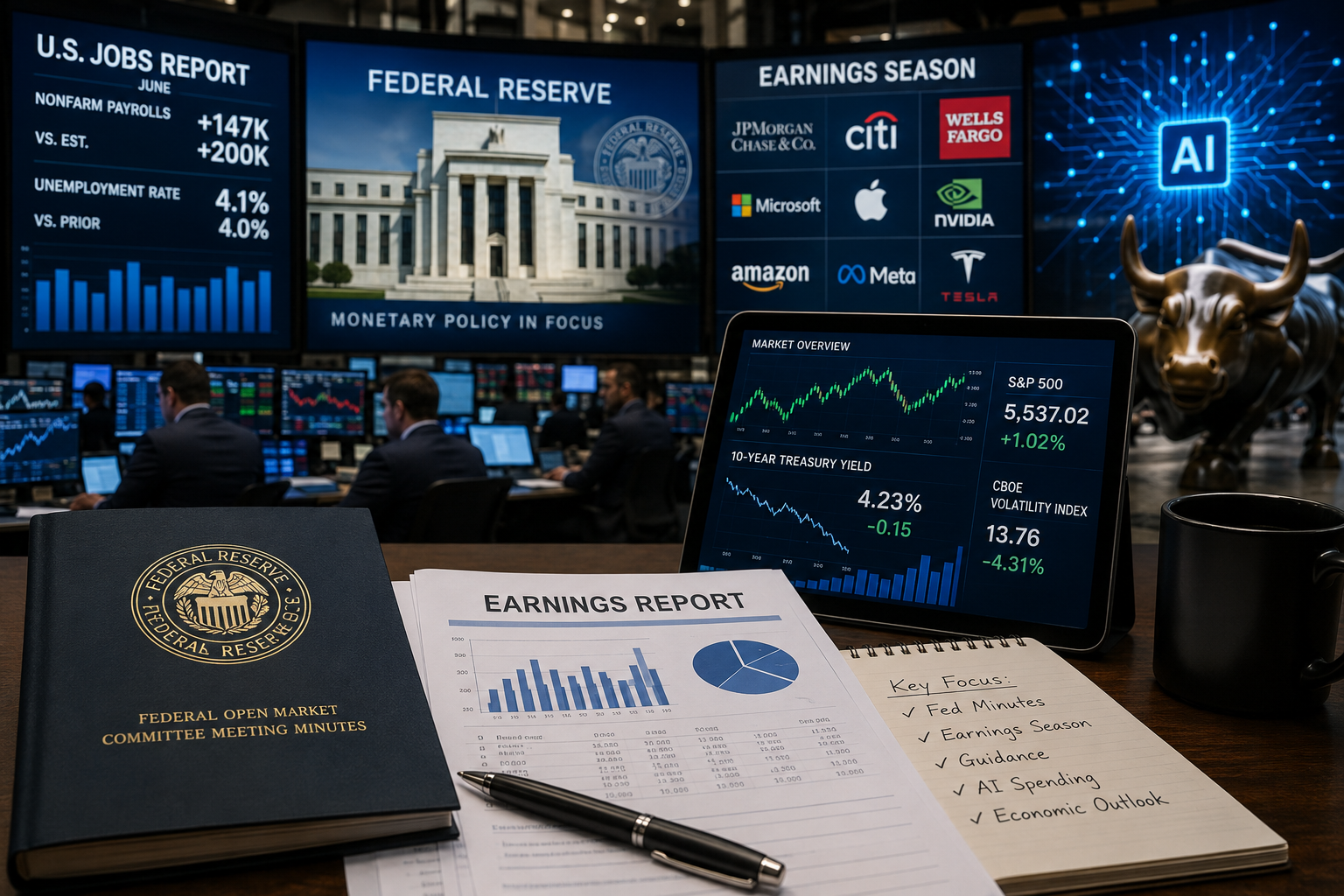
Wall Street heads into the new trading week with a renewed sense of optimism—but also heightened caution. A weaker-than-expected U.S. jobs report has eased fears that the Federal Reserve will need to keep interest rates higher for longer, prompting investors to reassess the outlook for equities, bonds, and other risk assets. While the softer labor market data provided a boost to investor sentiment, the market’s attention has quickly shifted to two events that could determine the direction of stocks through the rest of the summer: the release of the Federal Reserve’s meeting minutes and the start of the second-quarter earnings season.
The combination of monetary policy expectations and corporate earnings has historically been one of the most powerful drivers of market performance. This year is no exception. Following months of an AI-led rally concentrated in a handful of mega-cap technology companies, investors are now looking for confirmation that corporate America—and the broader U.S. economy—remain resilient enough to support further market gains.
The next several weeks could determine whether the bull market broadens beyond a select group of technology giants or whether concerns about slowing growth begin to weigh more heavily on investor sentiment.
A Softer Labor Market Changes the Conversation
The catalyst for the latest shift in market sentiment came from the June U.S. employment report, released on July 3, which indicated slower-than-expected job growth. While the labor market remains historically healthy, the latest figures suggest that hiring momentum is cooling after an extended period of strength.
For investors, this development carries important implications.
A moderating labor market reduces the likelihood that inflation will reaccelerate through wage pressures. That, in turn, lowers the probability that the Federal Reserve will need to implement additional interest rate hikes.
Financial markets reacted swiftly. Treasury yields declined, while equities and other risk assets strengthened as investors priced in a greater chance that the Fed may eventually begin easing monetary policy if inflation continues trending toward its target.
According to Reuters, the weaker jobs report has shifted investor attention away from concerns over additional tightening and toward evaluating whether the economy can achieve a “soft landing”—a scenario in which inflation slows without triggering a significant recession.
Why the Fed Minutes Matter
Although investors have welcomed signs of a cooling labor market, uncertainty surrounding Federal Reserve policy remains high.
The upcoming release of the Federal Open Market Committee (FOMC) meeting minutes is expected to provide valuable insight into policymakers’ thinking regarding inflation, labor market conditions, financial stability, and future interest rate decisions.
Unlike the post-meeting policy statement, the minutes offer a more detailed summary of discussions among Fed officials, often revealing differences in opinion about the appropriate path for monetary policy.
Investors will be watching closely for several key signals:
- Whether policymakers believe inflation risks remain elevated.
- How concerned officials are about slowing economic growth.
- Any discussion regarding the timing of potential rate cuts.
- The Fed’s assessment of labor market strength and financial conditions.
Because market expectations have shifted significantly following the latest jobs report, even subtle changes in the Fed’s language could trigger notable moves across equities, bonds, and currencies.
Earnings Season Becomes the Next Major Test
While monetary policy remains a key macro driver, corporate earnings will soon become the market’s primary focus.
Second-quarter earnings season is expected to begin in earnest over the coming weeks, with major banks traditionally reporting first before results expand across technology, healthcare, industrials, consumer companies, and energy.
This reporting season carries added significance because equity markets have been heavily supported by optimism surrounding artificial intelligence.
Large technology companies have generated much of the market’s gains over the past year, driven by substantial investments in AI infrastructure, cloud computing, and semiconductor demand.
The critical question facing investors is whether earnings strength will begin spreading across other sectors.
If companies outside mega-cap technology demonstrate improving profitability and optimistic outlooks, the market rally could broaden considerably.
If earnings disappoint, however, investors may become increasingly concerned that current valuations have moved ahead of corporate fundamentals.
Guidance May Matter More Than Earnings
Although headline earnings-per-share (EPS) figures often dominate financial headlines, many analysts believe forward guidance will be significantly more important during this reporting season.
Investors are increasingly interested in what executives expect over the next several quarters rather than simply reviewing historical financial performance.
Corporate management teams are expected to provide updates on several critical issues:
- Demand trends across major industries.
- The impact of artificial intelligence investments.
- Consumer spending patterns.
- Labor market conditions.
- Capital expenditure plans.
- Tariff and supply chain risks.
- Profit margin expectations.
Forward-looking commentary often shapes investor expectations far more than quarterly earnings results alone.
A company that exceeds EPS estimates but lowers future guidance may still experience share price declines, while firms with modest earnings beats accompanied by strong outlooks could outperform.
For investors, listening to earnings conference calls may prove just as valuable as reviewing financial statements.
AI Leadership Faces an Important Crossroads
Artificial intelligence remains one of the dominant themes driving global equity markets.
Companies involved in AI infrastructure—including semiconductor manufacturers, cloud computing providers, networking equipment suppliers, and hyperscale data center operators—continue investing aggressively despite economic uncertainty.
However, investors increasingly want evidence that these investments are translating into sustainable revenue growth and expanding profit margins.
The coming earnings season will provide one of the clearest opportunities yet for corporate executives to demonstrate measurable returns from AI spending.
Should AI-driven earnings continue exceeding expectations, technology leadership could remain intact.
Conversely, signs of slowing enterprise spending or weaker-than-expected monetization could encourage investors to rotate toward other sectors that benefit from improving macroeconomic conditions.
Sector Rotation Could Define the Second Half of 2026
One of the biggest questions facing Wall Street is whether leadership will broaden beyond mega-cap technology.
If interest rate expectations continue improving and economic growth remains stable, sectors such as financials, industrials, healthcare, consumer discretionary, and small-cap stocks could begin attracting additional investor interest.
Historically, broad-based market rallies have tended to be more durable than rallies concentrated within a handful of companies.
Market strategists are therefore watching earnings results closely for signs that corporate profit growth is expanding across the broader economy rather than remaining concentrated among AI leaders.
A successful broadening of earnings growth would strengthen confidence that the current bull market has additional room to run.
Why This Matters for Investors
The combination of softer economic data, evolving Federal Reserve expectations, and the beginning of earnings season creates one of the most important periods for investors this year.
Rather than relying solely on macroeconomic headlines, investors now have an opportunity to evaluate whether corporate America continues delivering the earnings growth necessary to justify current market valuations.
The next several weeks may determine whether optimism surrounding AI evolves into broader market leadership or whether slowing economic momentum begins weighing on investor confidence.
Understanding both macroeconomic developments and company-specific fundamentals will be essential for navigating market volatility.
Future Trends to Watch
Several developments are likely to shape equity markets through the remainder of the quarter:
- Federal Reserve meeting minutes and future policy communications.
- Inflation and employment reports influencing interest-rate expectations.
- Second-quarter earnings results across major sectors.
- Corporate guidance regarding AI spending and revenue growth.
- Treasury yield movements and bond market expectations.
- Signs of earnings expansion beyond mega-cap technology companies.
- Capital spending trends related to AI infrastructure and cloud computing.
Together, these indicators will help determine whether the market’s next advance becomes broader and more sustainable.
Key Investment Insight
While the weaker U.S. jobs report has improved expectations that the Federal Reserve may be approaching the end of its tightening cycle, investors should avoid focusing solely on interest-rate speculation. The more important test now lies in corporate earnings and executive guidance. Companies that demonstrate resilient demand, disciplined capital allocation, and tangible returns on AI investments are likely to attract investor attention, regardless of short-term macroeconomic volatility.
According to Reuters, markets have shifted their focus toward upcoming Federal Reserve meeting minutes and second-quarter earnings reports as investors seek confirmation that economic growth remains resilient. Additional insights from the Federal Reserve, upcoming corporate earnings releases, and future U.S. economic data will likely determine whether the AI-driven rally expands into a broader bull market during the second half of 2026.
For investors seeking timely market intelligence, in-depth analysis, and actionable insights across equities, artificial intelligence, macroeconomics, and global financial markets, stay connected with MoneyNews.Today—your trusted source for daily investor news and market analysis.




