
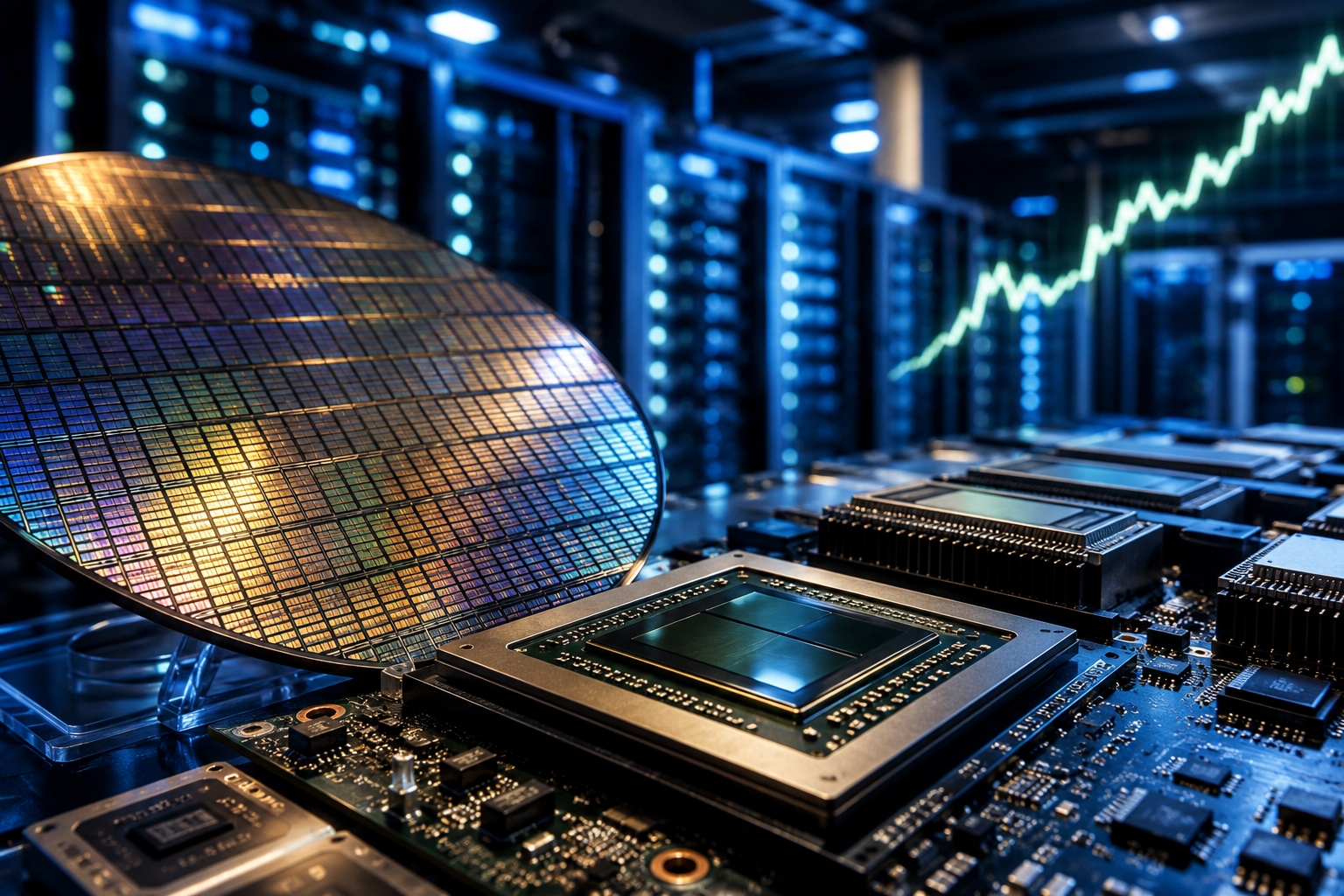
Artificial intelligence remains one of Wall Street’s most powerful investment themes, and Thursday’s market action reinforced that belief. After a sharp selloff earlier this week driven by escalating geopolitical tensions in the Middle East and broader market volatility, investors rotated back into semiconductor stocks, lifting shares of leading AI chipmakers and related suppliers.
The rebound reflects growing confidence that the long-term AI investment cycle remains intact despite short-term macroeconomic uncertainty. While geopolitical developments continue to influence risk sentiment, institutional investors appear increasingly focused on another catalyst that could define the remainder of 2026: corporate earnings and the sustainability of AI infrastructure spending.
For investors, the message is becoming clearer. The AI revolution is no longer driven solely by excitement surrounding generative AI applications—it is increasingly supported by unprecedented investments in computing infrastructure, advanced memory technologies, networking equipment, and hyperscale data centers.
Semiconductor Recovery Signals Renewed Investor Confidence
Technology stocks have experienced elevated volatility throughout the week as markets weighed geopolitical developments alongside expectations for Federal Reserve policy. Renewed tensions in the Middle East pushed investors toward defensive assets, while concerns over inflation and higher energy prices briefly pressured growth stocks.
However, semiconductor shares staged a notable recovery as investors returned to companies viewed as long-term beneficiaries of AI infrastructure spending.
Among the biggest beneficiaries were AI leaders including Nvidia, Broadcom, advanced memory manufacturers, networking suppliers, and companies serving hyperscale cloud providers.
The recovery suggests investors continue distinguishing between short-term macroeconomic risks and structural technology trends. Rather than abandoning AI-related investments, many portfolio managers appear to be using periods of weakness as opportunities to increase exposure to companies expected to benefit from years of expanding AI demand.
According to Reuters, the renewed buying reflects continued confidence that enterprise AI adoption and hyperscaler capital expenditures remain largely unchanged despite increased geopolitical uncertainty.
AI Infrastructure Spending Continues to Drive the Market
The foundation of today’s AI investment thesis extends well beyond chatbot applications.
Major cloud providers—including Microsoft, Amazon, Alphabet, and Meta Platforms—continue investing hundreds of billions of dollars into expanding AI infrastructure. These investments include advanced graphics processing units (GPUs), custom AI accelerators, networking hardware, high-bandwidth memory, cooling systems, and next-generation data centers.
Industry analysts expect AI infrastructure spending to remain one of the fastest-growing areas of enterprise technology investment through the remainder of the decade.
Research firms including Gartner and IDC continue forecasting double-digit annual growth in AI-related enterprise spending, while McKinsey & Company estimates that generative AI could contribute trillions of dollars annually to the global economy as adoption accelerates across nearly every major industry.
The semiconductor sector sits at the center of that transformation.
Unlike previous technology cycles driven primarily by consumer demand, the current AI expansion depends on enormous capital investments from hyperscale cloud providers, sovereign AI initiatives, governments, and enterprise customers modernizing their computing infrastructure.
This creates sustained demand across multiple semiconductor categories, including GPUs, CPUs, advanced memory, optical networking, power management, chip packaging, and semiconductor manufacturing equipment.
Why Investors Are Looking Beyond Geopolitical Headlines
Markets remain sensitive to developments surrounding geopolitical conflicts, particularly because rising oil prices can influence inflation expectations and future Federal Reserve policy decisions.
Higher energy prices often reduce investors’ appetite for growth-oriented sectors such as technology.
Yet Thursday’s semiconductor rebound illustrates an important distinction.
While geopolitical headlines can create significant short-term volatility, they have not materially altered expectations surrounding AI infrastructure investment.
Corporate technology budgets continue prioritizing AI deployment, and major cloud providers have shown little indication they intend to reduce planned capital expenditures.
Several Wall Street analysts have argued that AI infrastructure has become a strategic necessity rather than a discretionary technology investment.
That shift helps explain why institutional investors have repeatedly bought semiconductor stocks following market pullbacks throughout the past year.
Earnings Season May Become the Next Major Catalyst
Although optimism surrounding AI remains strong, investors recognize that valuations across many semiconductor companies remain elevated.
That places greater importance on the upcoming corporate earnings season.
Markets will closely monitor revenue growth, customer demand, capital expenditure guidance, gross margins, and future order backlogs from leading semiconductor companies.
Investors will also pay close attention to management commentary regarding:
- AI accelerator demand
- Enterprise AI adoption
- Cloud infrastructure expansion
- High-bandwidth memory supply
- Data center networking investments
- Future capital expenditure plans
Strong guidance would reinforce Wall Street’s belief that AI investment remains in its early stages.
Conversely, signs of slowing customer spending or weaker-than-expected AI demand could prompt additional volatility, particularly among companies trading at premium valuations.
Wall Street’s Long-Term AI Thesis Remains Intact
Despite periodic market corrections, the broader investment narrative surrounding artificial intelligence remains largely unchanged.
Unlike previous technology booms driven primarily by consumer enthusiasm, today’s AI expansion is supported by measurable increases in corporate capital investment.
Governments are investing in national AI infrastructure.
Cloud providers continue expanding data center capacity.
Enterprise customers are accelerating digital transformation initiatives.
Software developers increasingly integrate AI into business applications.
These trends create long-term demand across the semiconductor ecosystem.
Industry experts continue highlighting that AI requires significantly greater computing power than traditional software applications, increasing demand for advanced processors, memory, networking equipment, and specialized semiconductor technologies.
This structural shift supports the long-term outlook for companies supplying critical AI infrastructure.
Risks Investors Should Continue Monitoring
Despite improving sentiment, several risks could influence semiconductor performance during the second half of 2026.
Geopolitical tensions remain capable of disrupting global supply chains or increasing market volatility.
Trade restrictions involving advanced semiconductor technology could affect international demand.
Persistent inflation could delay Federal Reserve interest-rate reductions, placing additional pressure on higher-growth technology stocks.
Meanwhile, premium valuations leave limited room for disappointing earnings or slower-than-expected AI adoption.
Competition within AI chips is also intensifying as companies develop proprietary accelerators designed to reduce dependence on third-party hardware suppliers.
Investors should therefore balance long-term optimism with careful attention to company fundamentals, earnings quality, customer diversification, and valuation discipline.
Key Investment Insight
The recent rebound in semiconductor stocks reinforces that institutional investors continue viewing artificial intelligence as one of the market’s strongest long-term structural growth themes. While geopolitical developments may create short-term volatility, the broader investment case remains centered on expanding AI infrastructure spending, enterprise adoption, and sustained demand for advanced semiconductor technologies.
Rather than focusing solely on daily market swings, investors may benefit from monitoring quarterly earnings, capital expenditure trends among hyperscale cloud providers, semiconductor order backlogs, and developments in advanced memory and networking technologies. Companies capable of consistently delivering revenue growth alongside expanding AI-related demand are likely to remain at the forefront of investor attention as the AI investment cycle continues.
For more daily investor-focused market analysis, breaking financial news, and actionable insights across AI, technology, crypto, stock markets, emerging industries, politics, and commodities, continue following MoneyNews.Today—your trusted source for informed investing.




