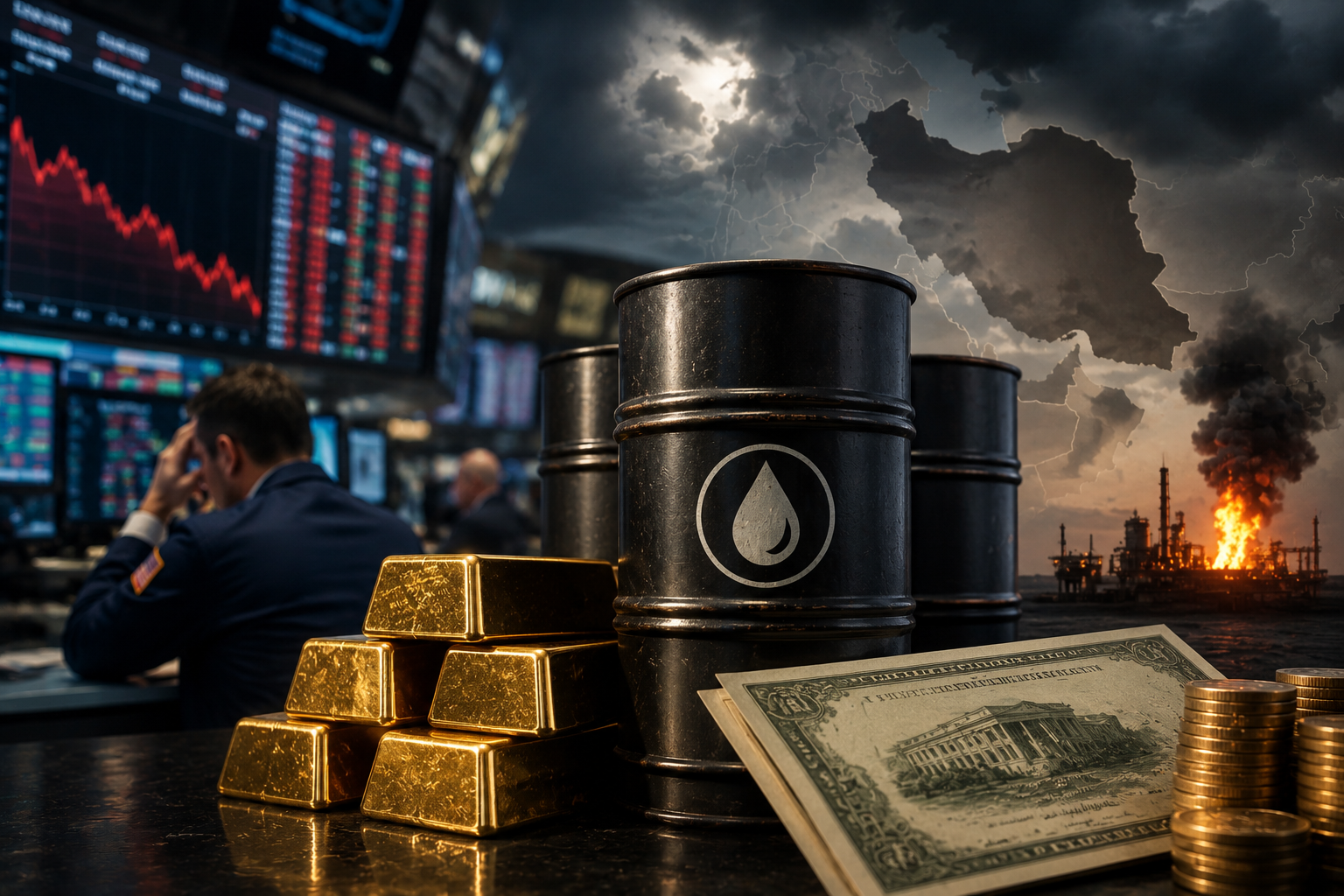
Global financial markets were jolted after President Donald Trump declared that the interim ceasefire agreement with Iran was effectively over, signaling that additional U.S. military action could be forthcoming. The remarks immediately reignited geopolitical concerns, sending oil prices higher, lifting demand for traditional safe-haven assets, and triggering another wave of volatility across global equity markets.
For investors, the timing could hardly be more significant. Markets were already entering one of the busiest periods of the quarter as second-quarter earnings season approached and expectations for Federal Reserve policy continued to evolve. Instead, geopolitical developments have once again become the dominant force driving short-term market sentiment, overshadowing corporate fundamentals and economic data.
The latest escalation highlights a reality investors have repeatedly faced in recent years: geopolitical shocks can rapidly alter the outlook for inflation, corporate profitability, interest rates, commodity prices, and global supply chains. As uncertainty rises, markets often shift their focus from company-specific performance to macroeconomic risk, making portfolio positioning increasingly important.
Markets React Swiftly to Escalating Tensions
Financial markets wasted little time responding to the latest developments.
According to Reuters, U.S. equities moved lower after President Trump’s comments increased fears that the conflict involving Iran could intensify beyond diplomatic negotiations. Investors reduced exposure to higher-risk assets while rotating toward sectors historically viewed as defensive during periods of geopolitical uncertainty.
Energy markets led the immediate reaction, with crude oil prices climbing as traders evaluated the possibility of supply disruptions across the Middle East. At the same time, gold prices strengthened, Treasury bonds attracted fresh demand, and volatility measures rose as investors reassessed near-term risks.
The reaction illustrates how geopolitical developments often influence financial markets faster than economic reports or corporate earnings.
While long-term investment themes such as artificial intelligence, infrastructure spending, and digital transformation remain intact, geopolitical events can temporarily dominate market behavior by increasing uncertainty across multiple asset classes.
Why Iran Matters to Global Energy Markets
Iran occupies a strategically important position within the global energy system.
Although international sanctions have affected Iranian oil exports for years, the country remains a significant producer within one of the world’s most critical energy-producing regions.
Perhaps even more important is Iran’s proximity to the Strait of Hormuz, one of the world’s busiest maritime oil transportation routes.
A substantial portion of globally traded crude oil and liquefied natural gas passes through the narrow waterway each day.
Any escalation capable of threatening shipping activity or regional energy infrastructure immediately raises concerns regarding global supply availability.
Higher crude oil prices can quickly influence inflation expectations by increasing transportation costs, manufacturing expenses, airline fuel costs, and consumer energy prices.
For investors, this creates ripple effects extending well beyond the energy sector.
Inflation Concerns Return to the Spotlight
One of the market’s biggest concerns following the latest geopolitical developments is the potential impact on inflation.
Throughout 2026, investors have closely monitored signs that inflation was gradually moderating, increasing expectations that the Federal Reserve could begin easing monetary policy later this year.
However, sustained increases in oil prices could complicate that outlook.
Energy represents an important component of both producer and consumer inflation measures.
If crude prices remain elevated for an extended period, higher transportation and production costs could spread across multiple industries, slowing progress toward the Federal Reserve’s inflation objectives.
Economists frequently describe this phenomenon as “cost-push inflation,” where higher input costs eventually affect consumer prices.
Should inflation remain stubbornly elevated, policymakers may decide to maintain restrictive interest rates longer than markets currently anticipate.
That possibility explains why investors closely monitor both geopolitical developments and energy markets alongside inflation data.
Sector Winners and Losers Begin to Emerge
Periods of geopolitical uncertainty rarely affect every industry equally.
Several sectors historically outperform when global tensions rise.
Energy companies generally benefit from stronger crude oil prices, particularly integrated producers, exploration firms, and oilfield service companies.
Defense contractors may also attract investor attention as governments increase military spending and modernize defense capabilities.
Gold producers frequently outperform when precious metals prices rise due to increased demand for safe-haven assets.
Cybersecurity companies can also experience stronger demand as governments and businesses strengthen digital infrastructure during periods of geopolitical instability.
On the other hand, several industries may face greater challenges.
Airlines and transportation companies often experience higher operating costs because of rising fuel prices.
Consumer discretionary businesses may encounter weaker spending if inflation reduces household purchasing power.
Industrials and manufacturers dependent on global supply chains could also face disruptions should regional tensions affect international trade.
Technology stocks, particularly high-growth companies with elevated valuations, sometimes experience increased volatility if investors shift capital toward defensive sectors.
Supply Chains Remain a Critical Market Risk
Beyond energy markets, investors are increasingly concerned about potential disruptions to global supply chains.
Although many multinational companies diversified operations following the supply chain challenges experienced earlier in the decade, geopolitical instability continues to present logistical risks.
Industries relying on international shipping, semiconductor manufacturing, industrial equipment, chemicals, automotive production, and advanced manufacturing remain particularly sensitive to transportation disruptions and higher freight costs.
Companies with diversified supplier networks, strong inventory management, and domestic manufacturing capabilities may prove more resilient if geopolitical uncertainty persists.
This trend has encouraged many corporations to continue investing in regional manufacturing capacity and supply chain resilience.
Government initiatives such as the U.S. CHIPS and Science Act have further accelerated domestic investment in strategically important industries.
Federal Reserve Policy Faces New Challenges
The Federal Reserve now finds itself balancing multiple competing economic forces.
On one hand, slower global growth could support future interest-rate reductions by reducing demand-driven inflation.
On the other hand, higher oil prices and geopolitical uncertainty could generate renewed inflationary pressure, making policymakers more cautious.
According to economists cited by Reuters and Bloomberg, commodity-driven inflation presents one of the more complex challenges for central banks because monetary policy cannot directly increase energy supply.
Investors will therefore closely monitor upcoming inflation reports, Federal Reserve communications, and labor market data for clues regarding future policy decisions.
Interest-rate expectations remain one of the most important drivers of equity valuations, particularly for growth-oriented sectors such as technology and artificial intelligence.
Future Trends Investors Should Watch
Several developments are likely to determine market direction over the coming weeks.
First, diplomatic negotiations involving Iran and regional allies will remain the primary geopolitical focus.
Second, crude oil prices will provide valuable insight into how markets assess the likelihood of prolonged supply disruptions.
Third, corporate earnings season will reveal whether higher energy costs or geopolitical uncertainty are beginning to affect business confidence, consumer demand, and capital investment.
Fourth, inflation data and Federal Reserve commentary will help determine whether monetary policy expectations require adjustment.
Finally, market volatility indicators—including the CBOE Volatility Index (VIX)—will continue serving as useful gauges of investor sentiment.
Together, these developments will likely shape financial markets throughout the remainder of the summer.
Key Investment Insight
The latest escalation involving Iran demonstrates how quickly geopolitical events can reshape financial markets, even when underlying economic conditions remain relatively stable. While long-term investment themes such as artificial intelligence, digital infrastructure, and industrial modernization continue driving structural growth, short-term market direction is increasingly being influenced by geopolitical developments, commodity prices, and inflation expectations.
Investors should closely monitor crude oil prices, defense-sector performance, precious metals, inflation data, Treasury yields, Federal Reserve communications, and corporate earnings guidance to evaluate how geopolitical uncertainty is affecting broader market conditions. Maintaining diversified portfolios with exposure to both defensive sectors and long-term growth opportunities may help reduce risk while preserving participation in future market upside.
Stay ahead of the markets with MoneyNews.Today for trusted daily coverage of politics, stock markets, technology, artificial intelligence, crypto, commodities, and the global events shaping tomorrow’s investment landscape.