
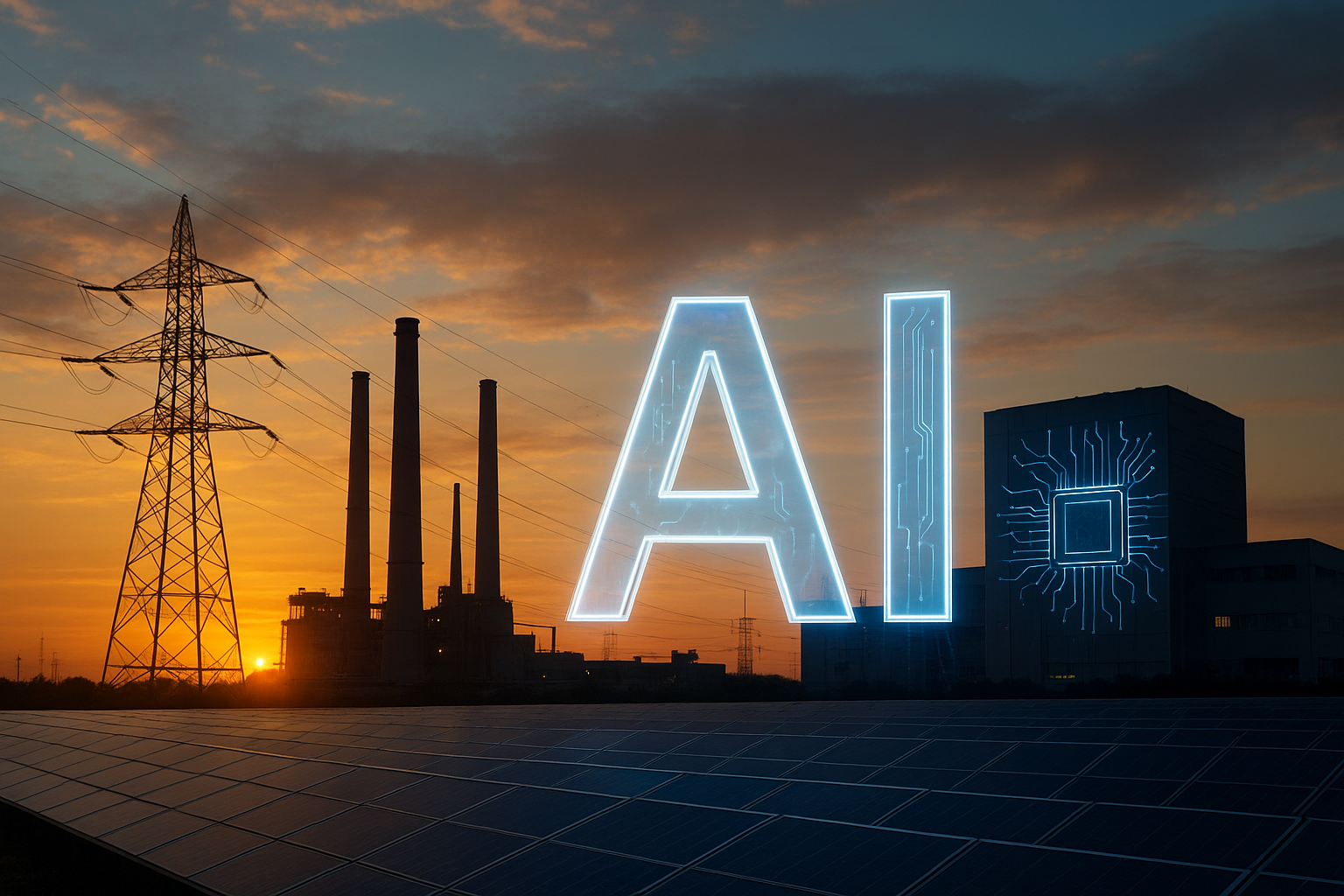
Artificial intelligence is no longer a niche experiment confined to Silicon Valley startups — it’s becoming the backbone of the global industrial economy. From South Korea’s newly announced AI “factory” co-developed by NVIDIA and Hyundai Motor Group to record-breaking investment flows into data centers, AI infrastructure has entered its next phase: physical scale. As Reuters reports, the “great AI build-out” shows no sign of slowing, with governments, manufacturers, and tech giants racing to capture a share of what many call the defining industrial revolution of the decade.
The New Industrial AI Revolution
While 2023 and 2024 were marked by generative AI hype and soaring valuations, 2025 is shaping up to be the year AI becomes concrete — literally. Across Asia, North America, and Europe, billions of dollars are being poured into AI-specific factories, chip foundries, and power-intensive data hubs. South Korea recently committed over $3 billion to develop a new AI complex in partnership with NVIDIA, Hyundai, and SK Telecom, according to FinTech Futures and Reuters. Similar moves are underway in the United States, where Amazon, Microsoft, and Google have collectively announced more than $60 billion in AI infrastructure spending this year alone.
This massive expansion is fueled by demand for compute capacity, as models continue to balloon in size and sophistication. The global AI market is expected to exceed $1.8 trillion by 2030, according to McKinsey’s latest forecast, with industrial and manufacturing applications leading the next growth wave. That’s a shift investors cannot afford to ignore.
Why This Matters for Investors
The transition from “AI as software” to “AI as infrastructure” represents a structural shift in where value will be created. Companies that supply the building blocks — semiconductors, energy solutions, automation systems, and industrial cloud integration — are poised to be the biggest beneficiaries.
NVIDIA ($NVDA), the undisputed leader in AI chips, continues to dominate the high-end GPU market, but emerging competition from AMD ($AMD), Intel ($INTC), and TSMC ($TSM) suggests a maturing ecosystem. Meanwhile, industrial automation leaders like Siemens ($SIEGY) and ABB ($ABB) are integrating AI into manufacturing and robotics, driving efficiency gains and productivity growth across sectors from automotive to logistics.
However, valuations in some segments remain stretched. AI-focused tech ETFs are up more than 45% year-to-date, while traditional industrials are just starting to re-rate. This divergence may signal both opportunity and caution — early-stage investors must weigh long-term growth potential against short-term froth.
Power, Policy, and Production: The Real Constraints
The AI revolution’s next bottleneck isn’t data or talent — it’s power. Massive data centers and AI factories are energy-intensive, prompting utilities and governments to rethink grid capacity and renewable integration. Analysts at Bloomberg Intelligence estimate that global AI power demand could rise 160% by 2030, requiring major capital investment in clean energy and transmission networks.
This is drawing a new class of investor attention: infrastructure and energy funds. Companies positioned at the intersection of AI and energy — from NextEra Energy ($NEE) in renewables to Schneider Electric ($SBGSY) in power management — could see sustained demand as the world builds the physical backbone of AI.
Future Trends to Watch
- Industrial AI Integration: Expect rapid deployment of AI systems in manufacturing, logistics, and mobility. Investors should monitor partnerships between AI developers and industrial players.
- Semiconductor Expansion: Chip fabrication capacity is expanding in the U.S., South Korea, and Japan. This could reduce dependency on China and diversify global supply chains.
- Regulatory and Geopolitical Headwinds: Export controls on AI chips — particularly between the U.S. and China — may create volatility but also opportunities for regional tech champions.
- AI-Energy Convergence: Power-hungry AI infrastructure will accelerate demand for clean energy and advanced cooling systems, creating a multi-sector investment nexus.
Key Investment Insight
For investors, the takeaway is clear: AI has entered its industrial era. Focus less on speculative “AI story stocks” and more on companies with tangible exposure to infrastructure, hardware, and applied industrial AI. Diversification across sectors — chips, energy, automation, and manufacturing — will be critical as capital shifts from digital platforms to physical systems.
The global AI build-out may be capital-intensive, but it’s also durable — underpinned by sovereign funding, enterprise adoption, and structural demand for efficiency. Investors positioned early in this hardware-to-infrastructure cycle stand to gain the most as the AI economy cements its place in global productivity.
Stay tuned with MoneyNews.Today for daily insights and in-depth analysis that help investors navigate the evolving landscape of AI, markets, and emerging technologies.




