
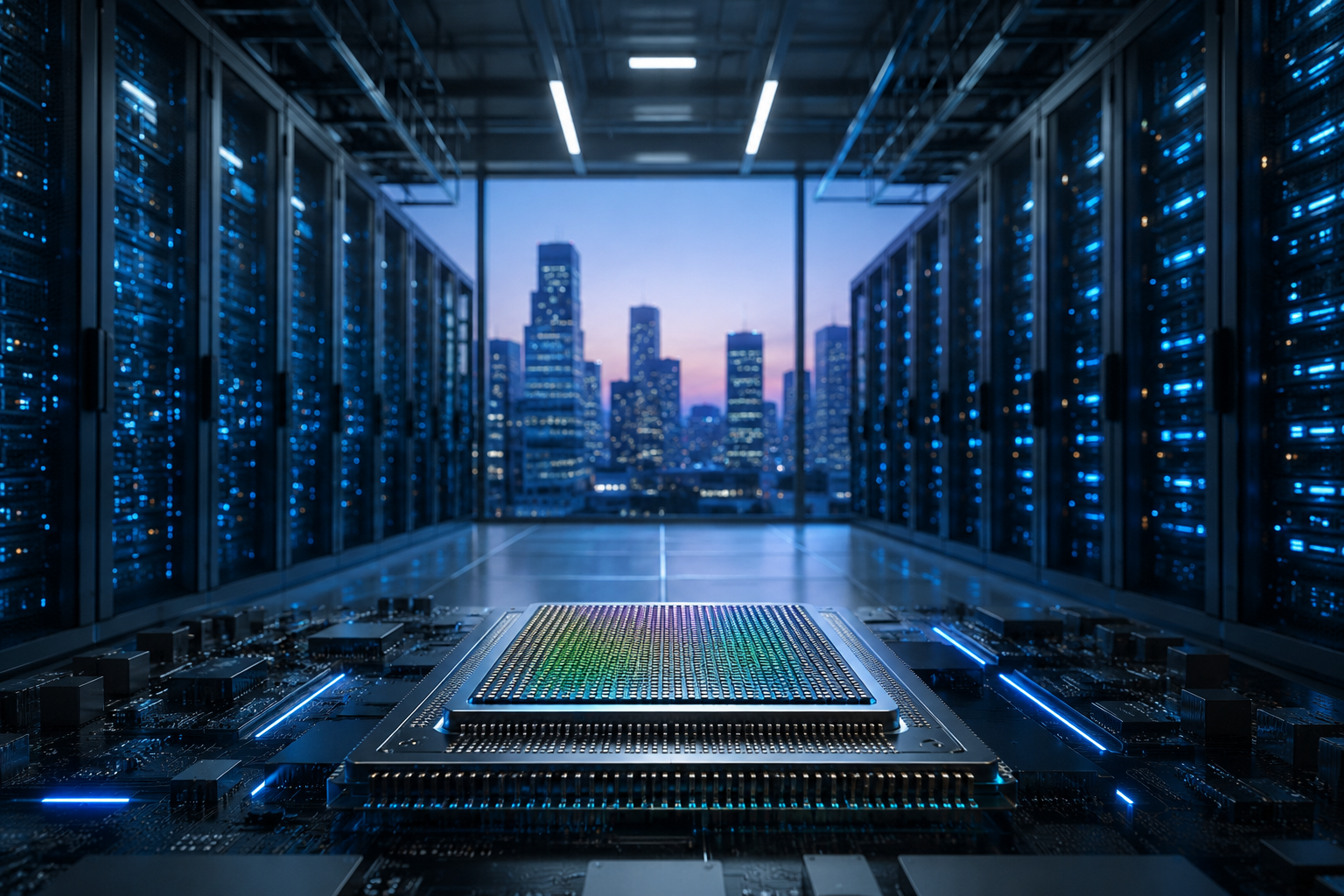
The artificial intelligence infrastructure race just moved from chip shortages to balance-sheet warfare. Google and Blackstone are forming a new U.S.-based AI cloud company designed to offer Google Cloud’s Tensor Processing Units, or TPUs, as a compute-as-a-service platform, with Blackstone committing an initial $5 billion in equity and plans to bring 500 megawatts of capacity online in 2027. For investors, this is not just another AI partnership. It is a direct challenge to the Nvidia-centered GPU cloud economy that has powered much of the AI trade over the past two years.
The venture arrives at a critical moment. Demand for AI compute remains intense, data-center capacity is constrained, power availability has become a strategic asset, and investors are increasingly asking whether Nvidia-linked infrastructure providers can sustain premium valuations if hyperscalers commercialize their own chips more aggressively. Blackstone’s role also signals that private capital is no longer merely financing data centers; it is becoming an active architect of AI infrastructure platforms.
Why This Deal Matters Now
According to Blackstone’s announcement, the new company will offer data-center capacity, operations, networking, and Google Cloud TPUs as a compute-as-a-service product. The structure combines Google’s custom AI silicon and software stack with Blackstone’s infrastructure capital and data-center development expertise. Blackstone said the venture is intended to scale “significantly over time,” while financial press reports indicate the effort could ultimately support much larger compute investments beyond the initial equity commitment.
That matters because AI demand is increasingly limited by physical infrastructure rather than model ambition. The bottleneck is no longer just access to chips. It is access to land, power, cooling, networking, capital, and reliable delivery schedules. A 500-megawatt deployment is substantial in AI data-center terms, especially when dedicated to high-performance AI workloads. For comparison, CoreWeave recently reported that it had surpassed 1 gigawatt of active power and had a revenue backlog of nearly $100 billion as of March 31, 2026, showing how aggressively the market is valuing contracted AI compute capacity.
This is why investors should view the Google-Blackstone venture as a strategic infrastructure event, not simply a technology launch. The market is beginning to reprice companies based on who controls AI compute supply chains.
The Nvidia Question
Nvidia remains the dominant force in AI infrastructure. Its fiscal 2026 results underscored that strength: the company reported record quarterly revenue of $68.1 billion in the fourth quarter, with Data Center revenue of $62.3 billion, up sharply from the prior year. Earlier, Nvidia’s third-quarter fiscal 2026 report showed Data Center revenue of $51.2 billion, and CEO Jensen Huang said Blackwell sales were “off the charts.”
Those numbers explain why Nvidia has become the benchmark for the AI trade. But the Google-Blackstone venture highlights a key risk: the largest buyers of AI compute do not want to remain fully dependent on one supplier or one ecosystem. Google’s TPUs are not new, but the decision to commercialize them through a dedicated cloud company backed by private capital raises the stakes.
The threat is not that TPUs instantly replace Nvidia GPUs across the market. Nvidia’s CUDA ecosystem, networking stack, developer base, and GPU availability remain major competitive advantages. The more realistic investor concern is margin and multiple pressure. If customers gain more credible alternatives for training and inference workloads, GPU cloud pricing could become more competitive over time. That could affect neocloud providers that rely heavily on Nvidia-based capacity and are valued on the assumption of persistent compute scarcity.
Google’s Strategic Shift: From Internal Chip to External Platform
Google has spent years developing TPUs for its own workloads. The current move suggests a more aggressive commercial strategy: turning proprietary silicon into a broader infrastructure platform. At Cloud Next 2026, Google introduced its eighth-generation TPU lineup, including TPU 8t for frontier-model training and TPU 8i for inference and reinforcement learning. Google described the systems as part of its AI Hypercomputer architecture, combining hardware, software, and networking for the full AI lifecycle.
That distinction matters for investors because the AI workload mix is changing. The first phase of the AI boom centered on training giant models. The next phase may be dominated by inference, agentic AI, reinforcement learning, and enterprise deployment. If inference workloads become more specialized and cost-sensitive, purpose-built chips such as TPUs could gain share where they offer better performance-per-dollar or energy efficiency.
Google is therefore not merely competing with Nvidia on chip performance. It is competing on system design, cloud integration, software orchestration, and total cost of ownership. For Alphabet investors, the opportunity is to expand Google Cloud’s relevance in AI while monetizing custom silicon more broadly. For Nvidia investors, the issue is whether proprietary hyperscaler chips become a meaningful headwind to future growth rates.
Why Blackstone Is in the Middle of the AI Trade
Blackstone’s involvement is equally important. The firm has become one of the most visible institutional investors in data centers and AI infrastructure. By backing this venture with $5 billion in equity, Blackstone is positioning itself near the center of the AI capital stack: data centers, power access, cloud infrastructure, and enterprise compute demand.
The private-equity and infrastructure angle is important because AI data centers require enormous upfront capital. These projects often need long-dated contracts, power agreements, construction expertise, and financing structures that look more like infrastructure development than traditional software growth investing. Blackstone’s participation validates the idea that AI infrastructure is becoming a durable asset class, not a temporary capex cycle.
It also creates a potential template for future deals. If private capital can help hyperscalers scale proprietary silicon clouds, investors may see more partnerships between asset managers, chip designers, cloud platforms, utilities, and data-center operators.
Market Impact: Winners, Losers, and Watchlist Names
The immediate market read-through is mixed. Barron’s reported that the deal pressured shares of Nvidia-linked neocloud names such as CoreWeave and Nebius, while Alphabet and Blackstone saw modest positive reactions. The move tells investors that markets are beginning to distinguish between companies that own differentiated AI infrastructure and companies that lease, finance, or resell scarce GPU capacity.
Potential beneficiaries include Alphabet, Blackstone, data-center developers, grid infrastructure providers, power generation companies, cooling technology suppliers, and networking vendors. The broader AI power chain remains one of the most important second-order investment themes. A 500-megawatt deployment requires more than chips; it requires electricity, interconnection, backup power, thermal management, fiber, and operational reliability.
Potentially exposed companies include GPU-dependent neoclouds and AI infrastructure firms whose valuations depend on Nvidia supply scarcity remaining extreme. Nvidia itself is not necessarily a loser in the near term. Demand remains enormous, and Google continues to work with Nvidia in other cloud infrastructure areas. But investors should monitor whether hyperscaler custom silicon begins to cap long-term GPU pricing power or reduce the market’s willingness to assign Nvidia monopoly-like multiples.
Key Investment Insight
The most actionable takeaway is that the AI trade is moving from “buy the chip leader” to “map the compute supply chain.” Investors should track four areas: custom silicon adoption, AI data-center power capacity, cloud compute pricing, and backlog quality at neocloud providers.
For Alphabet, the deal strengthens the bull case that Google can monetize AI beyond search and software by turning TPUs into external infrastructure. For Blackstone, it reinforces the firm’s role as a major institutional conduit into AI-linked real assets. For Nvidia, the story is a warning sign rather than an immediate thesis-breaker: competition is broadening, but demand still exceeds available supply in many segments.
The highest-risk area may be GPU-only infrastructure valuations. If Google-backed TPUs create a credible alternative compute market by 2027, investors may start applying lower multiples to providers that lack proprietary silicon, differentiated software, or long-term contracted power advantages.
What Investors Should Watch Next
The first milestone is customer adoption. Investors should look for anchor tenants, enterprise AI customers, model-lab commitments, and contract duration. The second is execution: whether the venture can bring 500 megawatts online in 2027 on time and on budget. The third is pricing: if TPU compute is offered at a material cost advantage, the competitive implications could widen quickly.
The fourth is energy. AI infrastructure is increasingly a power story. Companies with access to reliable electricity, grid interconnection, and scalable sites could become as important as chip suppliers in the next phase of AI investing.
The Google-Blackstone TPU cloud venture is one of the clearest signals yet that AI infrastructure is becoming a vertically integrated, capital-intensive race. Nvidia remains the leader, but the market is no longer a one-lane highway. For investors, the winners may be those who understand not just who makes the chips, but who controls the full stack behind the AI economy.
Stay with MoneyNews.Today for daily investor-focused coverage of the market trends, technology shifts, and capital flows shaping tomorrow’s portfolios.




