
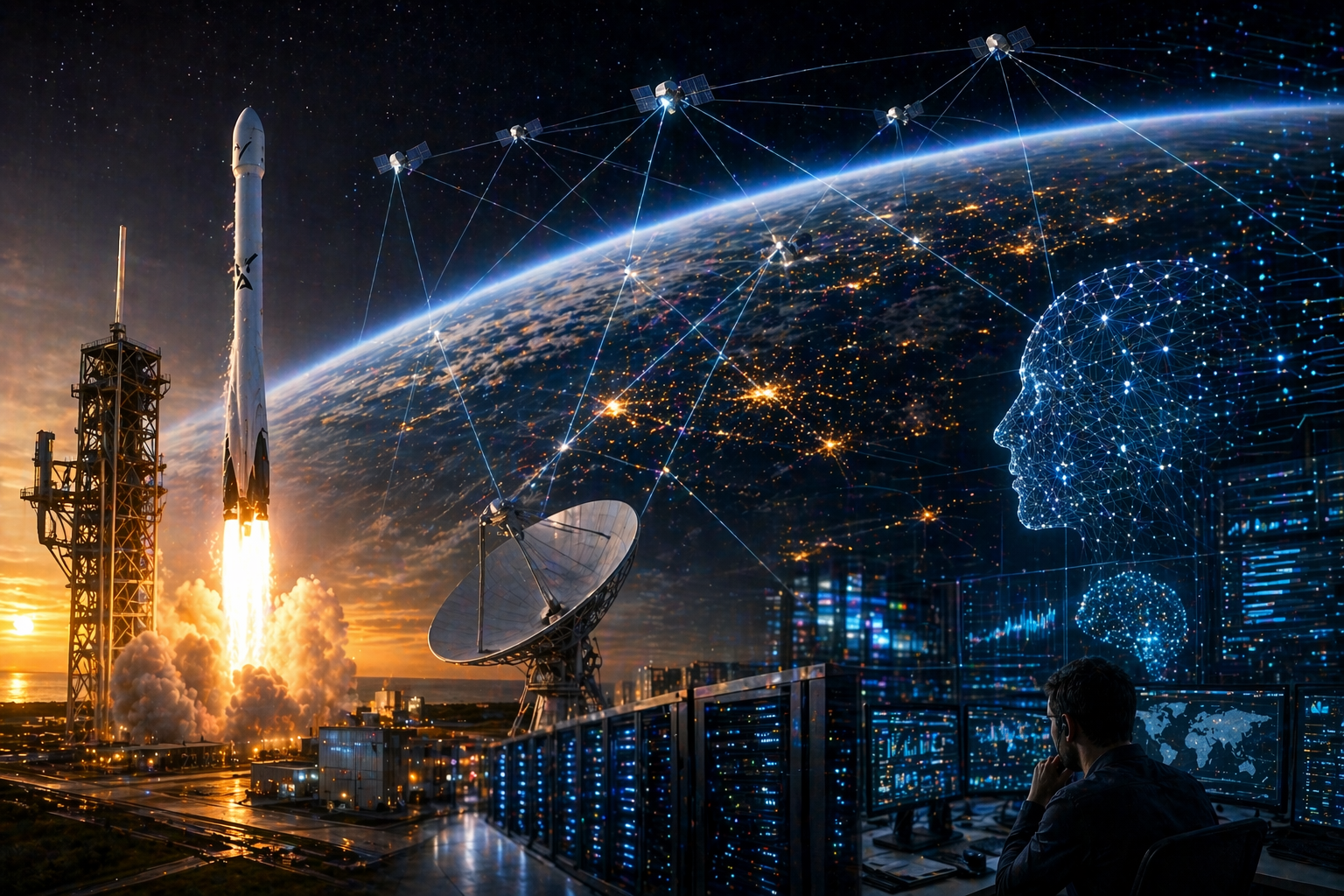
A quiet but powerful transformation is reshaping the boundaries of modern industry. What was once a clear separation between aerospace, telecommunications, and artificial intelligence is rapidly dissolving into a single interconnected ecosystem.
At the center of this shift is SpaceX, which is increasingly positioning itself not just as a space exploration company, but as a data and AI infrastructure player. Its expanding focus on AI-driven systems and computing capabilities reflects a broader structural change across global markets—where industries are converging around data, intelligence, and real-time connectivity.
According to Reuters (April 23, 2026), SpaceX is accelerating investment into AI-related hardware and infrastructure as it prepares for a more vertically integrated role in next-generation digital ecosystems. This move underscores a larger investor reality: emerging industries are no longer standalone growth stories—they are becoming deeply AI-adjacent.
The Rise of the Converged Economy
The traditional classification of industries—space, telecom, cloud, and software—is becoming increasingly outdated.
Today, the most valuable companies are those that operate at the intersection of multiple high-growth domains:
- Space infrastructure
- High-speed data transmission
- Artificial intelligence systems
- Cloud computing networks
SpaceX’s evolving strategy reflects this convergence. By integrating AI capabilities into its infrastructure and satellite systems, the company is positioning itself as a critical node in the global data economy.
This trend is not isolated. Across the market, firms are racing to embed AI into their core operations, effectively turning every industry into a data-driven industry.
Why Space, Data, and AI Are Colliding
The convergence of these sectors is being driven by three structural forces:
1. Exploding Data Demand
Global data creation continues to accelerate at exponential rates. Satellite networks, autonomous systems, and connected devices are generating vast amounts of real-time information that require advanced processing and AI interpretation.
2. AI Infrastructure Requirements
Modern AI systems require massive computing power, distributed networks, and ultra-low latency communication—areas where space-based and cloud infrastructure intersect.
3. Global Connectivity Expansion
Satellite internet and low-orbit networks are reshaping global connectivity, particularly in underserved regions. This creates new markets for AI-driven services that rely on constant data flow.
SpaceX, through its satellite network expansion, is uniquely positioned at the center of this ecosystem.
Why This Matters for Investors
The implications of this convergence extend far beyond the aerospace sector.
1. Industry Boundaries Are Breaking Down
The distinction between “space companies” and “tech companies” is becoming less meaningful. Instead, investors must evaluate firms based on their role in the broader AI-driven data economy.
2. New Investment Categories Are Emerging
Traditional sector classifications may fail to capture the true growth drivers of the next decade. Companies operating at the intersection of AI, infrastructure, and connectivity are emerging as a distinct investment category.
3. Infrastructure Is Becoming Strategic
Control over data infrastructure—whether terrestrial or orbital—is becoming as important as software innovation itself.
4. Capital Is Rotating Toward Ecosystem Builders
Investors are increasingly favoring companies that build foundational systems rather than isolated applications.
SpaceX and the AI Infrastructure Layer
SpaceX’s expansion into AI is not simply about software—it is about infrastructure control.
By integrating AI into its satellite and communication systems, the company is moving toward a vertically integrated model where:
- Satellites collect data
- AI systems process and analyze it in real time
- Cloud infrastructure distributes insights globally
This creates a closed-loop ecosystem that spans space, data transmission, and artificial intelligence.
Reuters reports that this strategy is being closely watched by institutional investors, particularly as the company explores future financing and potential IPO-related developments.
If successful, SpaceX could become one of the first companies to fully integrate space-based infrastructure with AI-driven analytics at scale.
Credible Market Signals
Several major financial and research institutions are already highlighting this convergence trend:
- Reuters (April 23, 2026): Reports SpaceX’s increasing focus on AI hardware and infrastructure expansion
- McKinsey & Company: Notes that convergence between AI, telecom, and aerospace is creating “next-generation infrastructure platforms”
- Morgan Stanley: Identifies space-based data networks as a potential multi-trillion-dollar market over the long term
- Bloomberg: Highlights rising investor interest in companies operating across multiple high-growth technology verticals
Together, these signals point to a fundamental restructuring of how industries are defined and valued.
Future Trends to Watch
1. Space-Based Data Networks
Satellite constellations capable of supporting AI workloads could become a critical layer of global infrastructure.
2. AI-Driven Connectivity
Real-time AI processing at the edge (including satellites and remote systems) will become increasingly important.
3. Cross-Sector M&A Activity
Expect increased mergers and partnerships between aerospace, telecom, and AI companies.
4. Expansion of Orbital Computing
The concept of computing beyond Earth-based data centers is gaining traction as latency and bandwidth demands increase.
Actionable Investment Insight
For investors, the convergence of space, data, and AI creates both opportunity and complexity.
- Look Beyond Traditional Sector Labels: Companies like SpaceX demonstrate that future growth may come from hybrid business models.
- Focus on Infrastructure Over Applications: Firms enabling connectivity, computation, and data flow may outperform pure software plays.
- Monitor Private Market Leaders: Many of the most important players in this space remain private or pre-IPO.
- Track AI + Connectivity Integration: The most valuable companies will likely be those that combine AI with real-world infrastructure networks.
- Diversify Across Converging Sectors: Exposure to aerospace, telecom, and AI infrastructure can provide balanced participation in this trend.
The key takeaway: the next major investment cycle is not just about artificial intelligence—it is about the infrastructure that enables intelligence to operate globally and in real time.
A New Industrial Framework Is Emerging
The SpaceX AI pivot is more than a corporate strategy shift—it is a signal of a broader transformation in how industries evolve. The separation between space, data, and AI is dissolving, replaced by an interconnected system where value is created through integration rather than isolation.
For investors, this represents a fundamental rethinking of sector classification and growth opportunities. The companies that define the next decade will likely be those that operate across multiple layers of this emerging ecosystem.
As these boundaries continue to blur, staying ahead of convergence trends will be essential.
Stay informed with MoneyNews.Today for daily insights into the forces reshaping global markets and emerging investment opportunities.




