
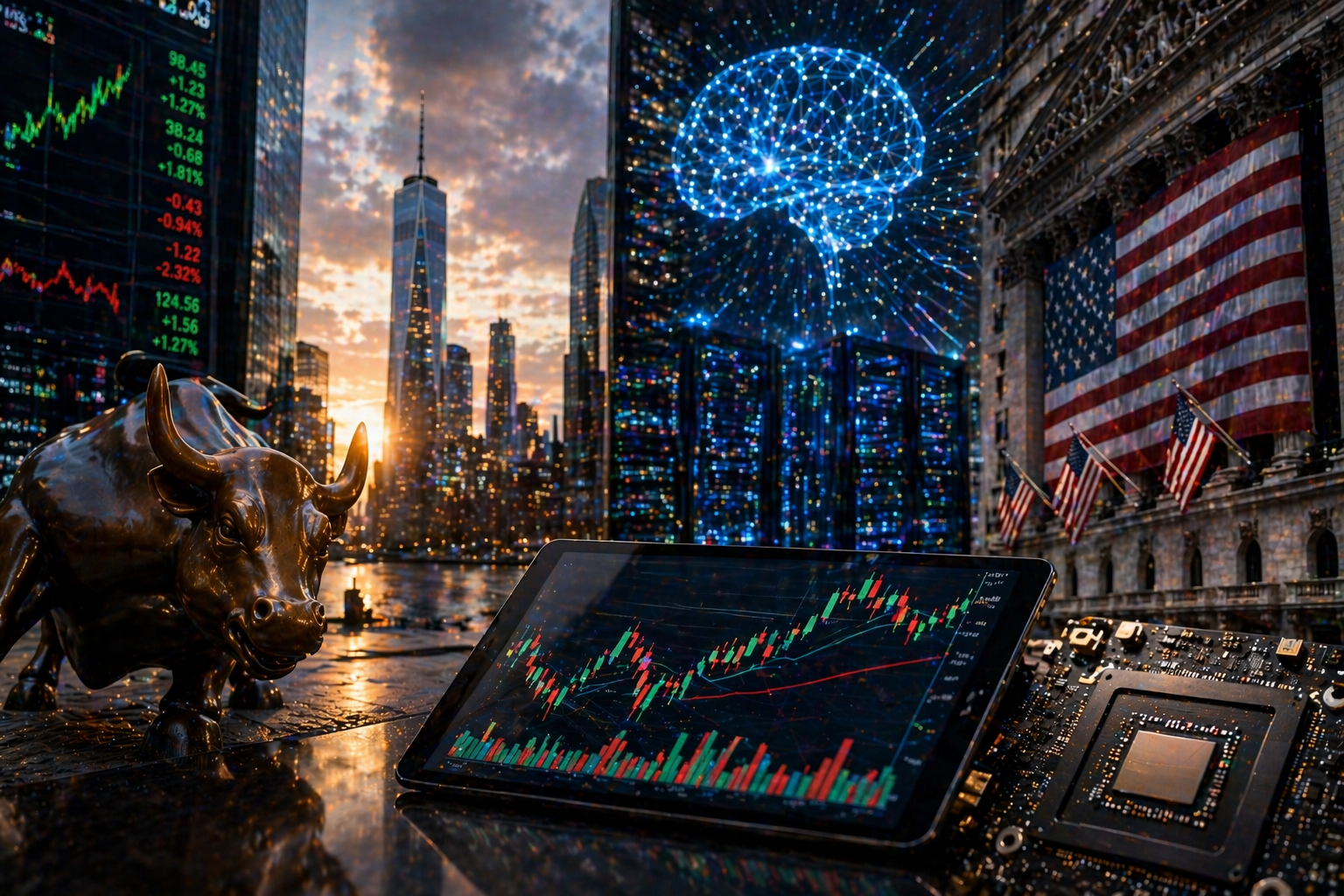
Markets are delivering a familiar but increasingly fragile message: growth optimism is strong enough—at least for now—to outweigh geopolitical anxiety.
Despite rising global tensions and persistent macro uncertainty, U.S. equities continue to trade with notable resilience. According to Bloomberg and CNBC (April 2026), major indices remain supported by robust earnings expectations, particularly those tied to artificial intelligence adoption across industries.
Yet beneath the surface, market leadership is becoming increasingly concentrated. The result is a market that looks stable on the index level but is narrow, AI-dependent, and highly sensitive to shifts in sentiment.
AI Is Carrying the Market Narrative
The defining feature of the current equity environment is clear: AI is doing the heavy lifting.
Companies at the center of the AI ecosystem continue to drive outsized performance, including NVIDIA Corporation, Microsoft Corporation, and Alphabet Inc.. These firms are benefiting from:
- Explosive demand for AI infrastructure
- Enterprise adoption of generative AI tools
- Continued expansion of cloud computing services
This AI-driven momentum has helped offset concerns around global instability, interest rates, and uneven economic data.
Tech-heavy indices such as the Nasdaq have outperformed broader benchmarks, reinforcing the idea that AI remains the dominant driver of equity returns in 2026.
However, this leadership is not evenly distributed. A small group of mega-cap companies is responsible for a disproportionate share of market gains.
Why This Matters for Investors
The current market structure presents both opportunity and risk.
On the surface, equities appear stable. But in reality, market breadth remains narrow, meaning fewer stocks are driving overall index performance.
This creates several important implications:
- Portfolios heavily exposed to mega-cap tech may be over-concentrated
- Non-tech sectors may lag despite broader economic recovery
- Market volatility could increase if AI sentiment shifts
For investors, this environment requires a more nuanced approach to allocation—balancing exposure to AI growth while avoiding overdependence on a small group of leaders.
Geopolitical Risk Is Still in the Background
While AI optimism dominates headlines, geopolitical risks continue to influence investor behavior.
Ongoing tensions in key regions have contributed to:
- Increased volatility in commodities and energy markets
- Periodic risk-off sentiment in equities
- Heightened demand for defensive positioning
Historically, such conditions would typically trigger broader market declines. However, the current cycle is different.
According to CNBC, investors are increasingly differentiating between short-term geopolitical risks and long-term structural growth themes, particularly in technology.
This shift has allowed equities to remain resilient even as macro uncertainty persists.
Earnings Strength Anchors Market Stability
Another key pillar supporting equities is earnings performance—especially within the technology sector.
Analysts continue to project strong earnings growth driven by:
- AI infrastructure investment
- Cloud computing expansion
- Productivity gains from automation
Companies like Microsoft Corporation and Alphabet Inc. are expected to see continued benefits from enterprise AI adoption, while NVIDIA Corporation remains central to the hardware side of the ecosystem.
These earnings expectations are critical. They provide the fundamental support behind elevated valuations and help justify ongoing investor enthusiasm.
The Risk of Narrow Leadership
One of the most important—and underappreciated—features of today’s market is extreme concentration risk.
A small group of large-cap technology companies is driving a significant portion of index returns. While this has supported performance, it also creates vulnerability.
If leadership narrows further or if AI-driven expectations are even slightly disappointed, markets could experience:
- Sharp corrections in index-heavyweights
- Increased volatility across sectors
- Rapid shifts in sentiment
This makes diversification more important than it has been in previous cycles.
Future Trends to Watch
As markets continue to balance AI optimism with macro uncertainty, several key trends will shape direction:
1. Market Breadth Expansion (or Lack Thereof)
A broadening rally beyond mega-cap tech would signal healthier market dynamics. Continued concentration would suggest fragility.
2. AI Monetization Cycle
Investors will increasingly focus on whether AI investments translate into sustained revenue and profit growth.
3. Interest Rate Path
Policy decisions by the Federal Reserve will remain a critical driver of equity valuations, particularly for growth stocks.
4. Geopolitical Developments
Escalating tensions could reintroduce volatility, particularly in energy-sensitive and global trade-exposed sectors.
The Global Context Behind U.S. Market Strength
Despite regional risks, U.S. equities continue to attract global capital.
This is largely due to:
- Dominance of U.S. tech companies in AI
- Strong earnings visibility
- Deep and liquid capital markets
According to Bloomberg, U.S. markets remain the primary beneficiaries of global AI investment flows, reinforcing their relative strength compared to other regions.
However, this dominance also increases reliance on a narrow set of sectors—particularly technology and communications.
Investor Positioning in a Concentrated Market
In this environment, investors face a balancing act:
- Participate in AI-driven growth
- Avoid overexposure to a small number of stocks
- Maintain resilience against macro shocks
Strategic considerations include:
- Diversifying beyond mega-cap technology
- Identifying secondary AI beneficiaries (semiconductors, energy, infrastructure)
- Incorporating defensive assets where appropriate
- Monitoring valuation risk in high-growth sectors
The key is not to avoid AI exposure—but to broaden how that exposure is constructed.
Key Investment Insight
The most important takeaway for investors is clear: market leadership remains narrow and AI-driven.
This creates a dual reality:
- Strong upside potential driven by AI innovation
- Elevated risk from concentration and macro sensitivity
Actionable strategies include:
- Maintaining exposure to AI leaders and infrastructure providers
- Expanding diversification into non-mega-cap sectors
- Monitoring macro indicators such as rates and geopolitical risk
- Reassessing portfolio balance as market leadership evolves
In short, participation in the AI trend remains essential—but concentration risk cannot be ignored.
A Market Defined by Dual Forces
Today’s equity market is defined by tension between two powerful forces: AI-driven optimism and persistent macro uncertainty.
For now, optimism is winning. But the balance remains fragile.
As long as AI continues to deliver strong earnings growth and investment momentum, equities are likely to remain supported. However, shifts in sentiment, policy, or global risk conditions could quickly reshape market dynamics.
For investors, staying flexible and informed will be key to navigating this evolving landscape.
Stay with MoneyNews.Today for daily, in-depth insights into the trends shaping global markets and the investment opportunities that matter most.




