
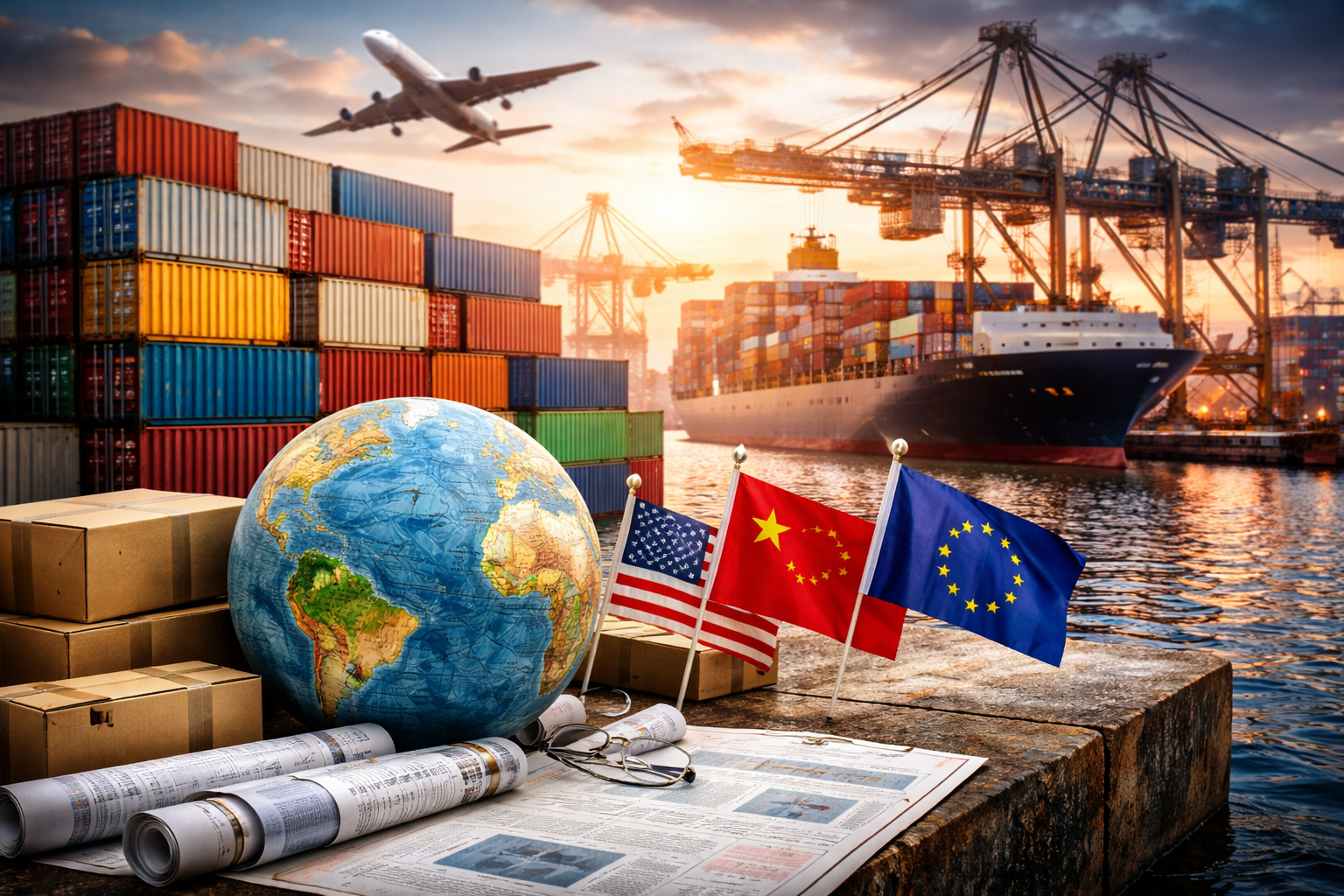
As 2025 draws to a close, investors are bracing for a global trade environment that looks increasingly fragile. From renewed tariff threats to geopolitical realignments and supply-chain reengineering, the rules that once underpinned decades of predictable trade flows are being rewritten. A recent Bloomberg analysis suggests that these pressures are not transitory—and could define market dynamics well into 2026.
For investors, trade policy is no longer a background macro variable. It is fast becoming a frontline risk factor with direct implications for equities, currencies, commodities, and capital allocation decisions worldwide.
A Shifting Trade Landscape Investors Can’t Ignore
Global trade volumes have yet to fully regain their pre-pandemic growth trajectory, and policymakers appear more willing than ever to deploy tariffs and trade barriers as economic and strategic tools. Bloomberg notes that the coming year will likely see continued friction across major trade corridors, particularly involving the United States, China, and Europe.
While the analysis is global in scope, U.S. and Canadian policy choices loom large. Washington’s evolving stance on strategic industries—from clean energy to semiconductors—has introduced uncertainty for exporters and multinational firms. Meanwhile, Canada is recalibrating its export strategies to balance U.S. dependency with deeper ties to Europe and Asia, a shift that could reshape capital flows and sector performance.
Why This Matters for Investors
Trade uncertainty often translates into market volatility, and history shows that prolonged policy ambiguity can suppress corporate investment and earnings visibility. According to data frequently cited by Bloomberg Economics and the World Trade Organization, periods of escalating trade tensions tend to coincide with slower global growth and heightened currency swings.
For equity investors, this means greater dispersion in returns. Companies with diversified supply chains and pricing power may outperform, while firms exposed to tariff-sensitive inputs or single-market dependencies could face margin pressure. Fixed-income investors, meanwhile, must contend with how trade disruptions influence inflation expectations and central bank policy responses.
Currency markets are also in play. Trade imbalances and tariff shifts can materially impact exchange rates, affecting multinational earnings and cross-border investment returns.
The Supply Chain Reset Continues
One of the most significant themes highlighted by Bloomberg is the ongoing reconfiguration of global supply chains. “Friend-shoring” and “near-shoring” strategies—already underway—are expected to accelerate in 2026 as companies seek resilience over cost efficiency.
North America stands to benefit selectively. U.S. industrial firms tied to infrastructure, defense, and domestic manufacturing incentives may see sustained demand. Canada’s role as a stable supplier of critical resources and intermediate goods positions it favorably in certain trade scenarios, particularly as geopolitical risk reshapes sourcing decisions.
However, these shifts are not without cost. Building redundant supply chains requires capital, time, and operational complexity—factors that can weigh on short-term profitability even as they enhance long-term stability.
Policy Risk Meets Market Reality
Investors are increasingly forced to price in political risk alongside traditional fundamentals. Trade policy decisions—often driven by domestic political considerations—can move markets abruptly. Bloomberg’s analysis underscores that tariff announcements, export controls, or retaliatory measures can trigger rapid sector rotation, particularly in manufacturing, technology hardware, and commodities.
This environment rewards vigilance. Monitoring policy signals from Washington, Ottawa, Brussels, and Beijing has become essential for anticipating market inflection points. Analysts at major investment banks have repeatedly emphasized that geopolitical awareness is now a core investment competency, not a niche concern.
Future Trends to Watch
Looking ahead to 2026, several themes merit close attention:
- Tariff trajectories: Any escalation or rollback could materially affect sector performance.
- Currency volatility: Trade-driven shifts may create both risks and opportunities in FX markets.
- Sector rotation: Industrials, defense, energy, and critical materials may benefit from trade realignment, while consumer goods and export-heavy manufacturers could face headwinds.
- Policy coordination—or lack thereof: Diverging national strategies may amplify uncertainty.
Key Investment Insight
Periods of trade turbulence often favor flexibility and diversification. Investors may benefit from balancing exposure between domestically focused companies and global leaders with resilient supply chains. Watching tariff developments, currency movements, and policy signals can help identify both defensive plays and opportunistic entry points as markets adjust to a more fragmented trade system.
With global trade entering a more volatile phase, staying informed is no longer optional—it’s a strategic advantage. MoneyNews.Today will continue to track the policy shifts, economic signals, and market implications shaping the investment landscape, delivering clear and timely insights for investors navigating an increasingly complex world.




