
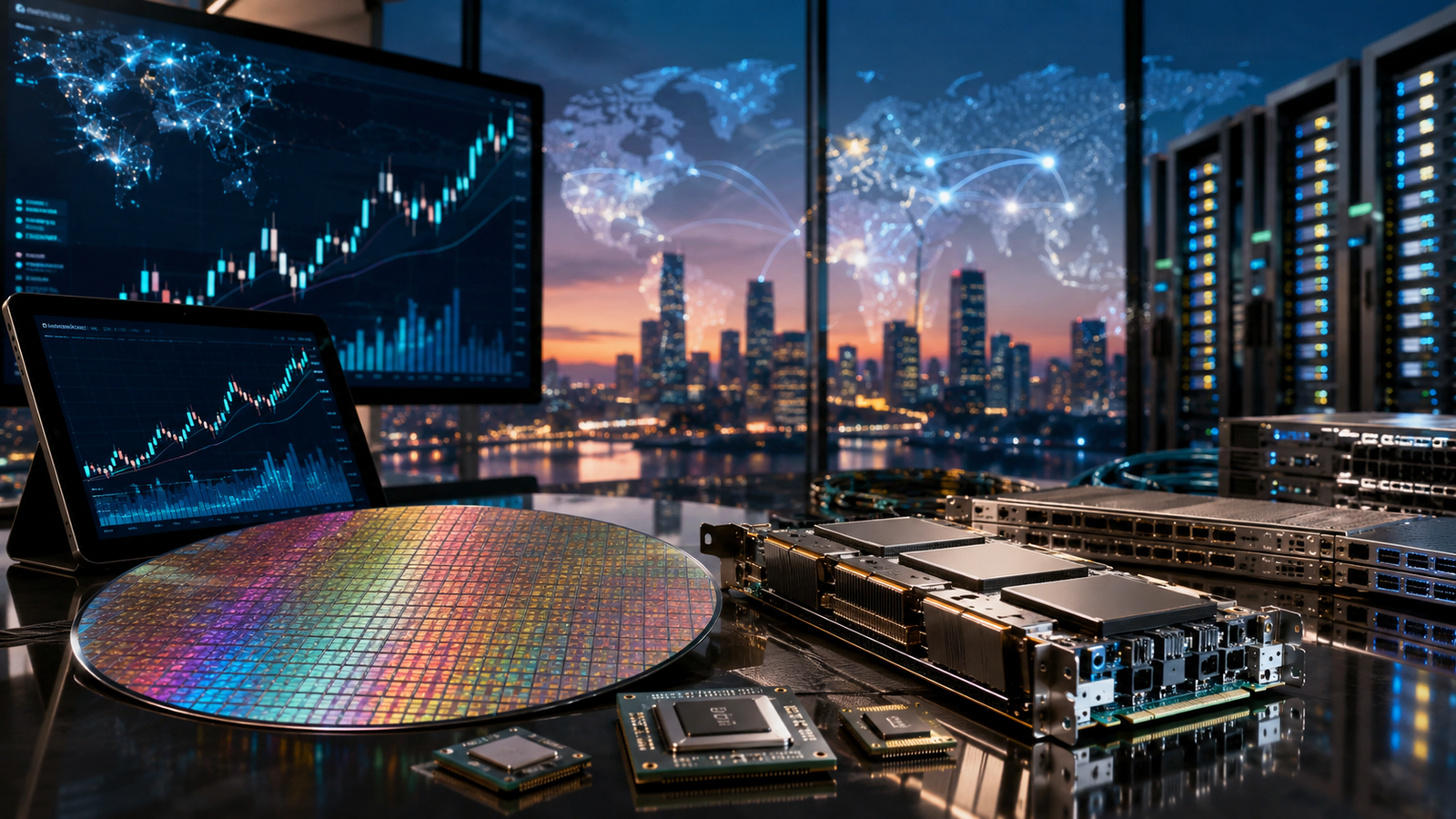
The artificial intelligence boom is no longer confined to Silicon Valley. It has become a global market force powerful enough to move entire stock exchanges, reshape capital spending priorities, and redefine the future of the technology sector.
On May 7, 2026, semiconductor stocks surged worldwide as investors doubled down on one of the market’s strongest themes: AI infrastructure. Japan’s Nikkei climbed to fresh record highs, SoftBank shares jumped nearly 20%, and chip-related companies across the United States, Asia, and Europe rallied sharply following strong earnings and aggressive spending forecasts tied to artificial intelligence expansion.
According to Reuters and MarketWatch, investors are increasingly rotating capital into companies connected to the rapidly expanding AI ecosystem, including semiconductor manufacturers, networking firms, server providers, memory chip producers, cooling infrastructure companies, and data-center suppliers.
The message from Wall Street and global markets is becoming increasingly clear: AI infrastructure has evolved into one of the most important investment cycles of the decade.
For investors, the implications extend far beyond Nvidia alone. The next phase of the AI rally is broadening across the entire technology supply chain.
AI Infrastructure Spending Is Reshaping Global Markets
The current semiconductor rally reflects a fundamental transformation happening across the global economy.
Artificial intelligence requires massive computing power. Every generative AI model, enterprise automation platform, chatbot, recommendation engine, and machine-learning application depends on advanced semiconductors and large-scale computing infrastructure.
As a result, governments and corporations are pouring unprecedented amounts of money into AI-related hardware.
Cloud giants including Microsoft, Amazon, Google, and Meta continue expanding data-center investments to support AI deployment. Enterprise spending on AI servers and accelerated computing systems is climbing rapidly, while hyperscale cloud providers race to secure enough chip supply to meet growing demand.
According to McKinsey estimates released earlier this year, global AI infrastructure spending could exceed $6 trillion over the next decade when factoring in semiconductors, cloud infrastructure, power systems, networking, and data-center expansion.
That spending wave is now driving one of the largest technology investment booms since the rise of the internet.
The market reaction on May 7 highlighted how global the trend has become.
Japan’s Nikkei surged to new highs as SoftBank rallied sharply amid renewed optimism surrounding AI-related investments. Semiconductor equipment manufacturers, chip foundries, and networking companies also posted strong gains across Asian markets.
Meanwhile, U.S. technology stocks continued climbing after strong earnings and bullish outlooks from AI-linked companies reinforced investor confidence in long-term demand growth.
Nvidia May Have Started the Rally — But the Market Is Expanding Beyond GPUs
Nvidia remains the dominant symbol of the AI revolution, but investors are increasingly looking beyond graphics processing units (GPUs) toward the broader infrastructure ecosystem supporting artificial intelligence.
This shift is becoming one of the most important developments in technology investing.
As AI adoption accelerates, demand is rising across multiple sectors, including:
- Networking infrastructure
- High-bandwidth memory (HBM)
- AI servers
- Data-center cooling systems
- Optical interconnects
- Semiconductor manufacturing equipment
- Power management systems
- Storage infrastructure
Companies involved in these areas are beginning to attract significant investor attention as markets recognize that AI growth requires far more than just advanced processors.
For example, networking providers are benefiting from the enormous data-transfer requirements associated with AI training clusters. Memory-chip manufacturers are seeing increased demand for specialized high-performance memory solutions critical for AI workloads.
At the same time, data-center cooling has emerged as an increasingly important investment theme.
AI computing consumes enormous amounts of electricity and generates significant heat. As hyperscale data centers expand, companies involved in cooling technology, liquid cooling systems, and power infrastructure are becoming essential components of the AI supply chain.
According to Goldman Sachs analysts, AI-related electricity demand could increase dramatically over the next several years, creating secondary investment opportunities in utilities, energy infrastructure, and industrial technology firms.
This broadening ecosystem is helping sustain the current rally across multiple technology subsectors rather than concentrating gains in only a handful of mega-cap stocks.
Why Global Investors Are Racing Into Semiconductor Stocks
The semiconductor industry has effectively become the backbone of the AI economy.
Advanced chips are now viewed not only as commercial products but as strategic economic assets tied directly to national competitiveness, technological leadership, and geopolitical influence.
Governments worldwide are increasing support for domestic semiconductor production through subsidies, tax incentives, and industrial policy initiatives.
The United States continues implementing major semiconductor investment programs through the CHIPS Act, while China, Japan, South Korea, and Europe are aggressively expanding domestic manufacturing capacity.
This geopolitical race is helping create a powerful long-term demand environment for semiconductor companies.
According to Bloomberg Intelligence, AI-related semiconductor demand could exceed $400 billion annually before the end of the decade. That figure includes GPUs, AI accelerators, memory chips, networking systems, and custom AI hardware designed for enterprise and cloud deployment.
Institutional investors are responding accordingly.
Technology-focused hedge funds and large asset managers have significantly increased exposure to AI infrastructure names throughout 2026. Semiconductor ETFs and AI-themed investment products have also attracted strong inflows as investors seek exposure to the long-term growth narrative.
The current rally reflects growing confidence that AI infrastructure spending may remain resilient even amid broader economic uncertainty.
Risks Investors Should Not Ignore
Despite the enthusiasm surrounding AI infrastructure, investors should recognize that the sector still faces meaningful risks.
Valuations across many semiconductor and AI-related companies have expanded rapidly over the past year. Some analysts have warned that expectations for future growth may already be extremely aggressive.
If enterprise AI adoption slows, capital spending weakens, or economic conditions deteriorate, highly valued technology stocks could face sharp volatility.
Supply-chain risks also remain important.
Geopolitical tensions involving the United States and China continue influencing semiconductor trade policy, export restrictions, and advanced chip manufacturing access. Any escalation could disrupt global supply chains or impact earnings expectations for multinational technology firms.
Competition is another major factor.
While Nvidia currently dominates the AI accelerator market, competitors including AMD, Intel, Broadcom, and several custom-chip developers are aggressively investing to gain market share.
At the same time, hyperscale cloud providers are increasingly designing their own AI chips internally, potentially reshaping portions of the semiconductor landscape over time.
For investors, understanding which companies possess durable competitive advantages may become increasingly important as the AI market matures.
Future Trends Investors Should Watch
Several major themes are likely to shape the next phase of the semiconductor and AI infrastructure cycle:
1. AI Data-Center Expansion
Global hyperscale data-center growth is expected to remain one of the largest drivers of semiconductor demand over the next decade.
2. Networking and Connectivity Growth
AI workloads require faster networking systems, optical technologies, and low-latency infrastructure.
3. Power and Cooling Infrastructure
Electricity demand from AI computing is creating new investment opportunities in utilities, energy systems, and thermal management technology.
4. Custom AI Chips
Cloud providers and enterprise firms are increasingly developing proprietary AI chips tailored to specific workloads.
5. Geopolitical Semiconductor Policy
Government support, export restrictions, and supply-chain localization efforts may continue reshaping the competitive landscape.
Key Investment Insight
The global AI infrastructure cycle remains one of the strongest and most influential investment trends in financial markets today.
While Nvidia helped ignite the AI boom, the market is increasingly recognizing that artificial intelligence requires a vast ecosystem of supporting technologies. Networking firms, memory suppliers, server manufacturers, cooling-system providers, semiconductor equipment makers, and data-center infrastructure companies are all emerging as critical beneficiaries.
For investors, this broadening opportunity set may create multiple ways to gain exposure to long-term AI growth beyond the largest mega-cap technology names.
However, elevated valuations, geopolitical risks, and growing competition also mean selectivity will become increasingly important.
The companies best positioned to provide scalable, energy-efficient, and mission-critical AI infrastructure may ultimately become the next generation of market leaders.
Stay ahead of the world’s biggest technology and market trends with MoneyNews.Today, your trusted source for daily investor insights and financial analysis.




