
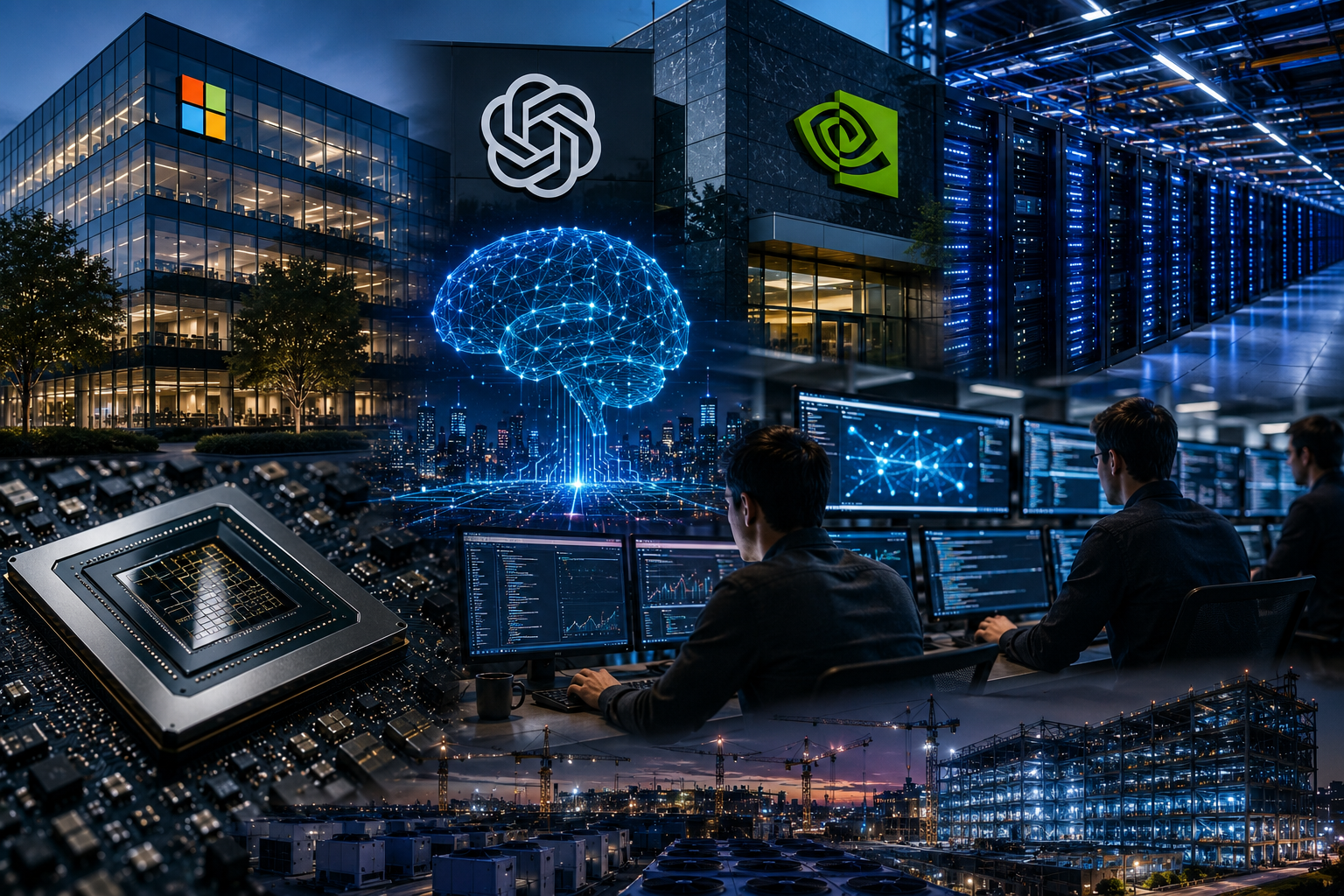
The global artificial intelligence race is no longer just a competition between software models — it has evolved into a full-scale infrastructure war involving cloud computing, semiconductors, enterprise software, energy systems, and some of the largest capital-spending programs in technology history.
On May 27, 2026, investor attention intensified around reports that U.S. funds are increasingly positioning for potential future IPOs tied to OpenAI and SpaceX, according to Reuters coverage. At the same time, technology giants including Microsoft Corporation, NVIDIA Corporation, Alphabet Inc., Amazon.com Inc., and Meta Platforms Inc. continue dramatically increasing AI-related spending as the battle for AI leadership accelerates globally.
The market’s focus has shifted beyond simply identifying the best AI chatbot or software platform. Investors are now evaluating which companies control the foundational infrastructure powering the next generation of artificial intelligence — from advanced semiconductors and hyperscale cloud systems to enterprise AI deployment networks and energy-intensive data centers.
For investors, the AI infrastructure race may represent one of the largest and most transformative technology investment cycles since the rise of the internet.
AI Has Become the New Technology Arms Race
Artificial intelligence is increasingly being treated as both an economic revolution and a strategic geopolitical asset.
Governments and corporations alike recognize that leadership in AI could shape future dominance across productivity, defense, cybersecurity, healthcare, finance, manufacturing, and global digital infrastructure. As a result, spending on AI infrastructure has exploded across both public and private markets.
The race is being driven by three interconnected layers:
- Advanced semiconductor development
- Hyperscale cloud infrastructure
- Enterprise AI deployment and integration
NVIDIA remains at the center of the semiconductor layer, supplying the high-performance GPUs and AI accelerators powering most large-scale AI systems. Microsoft has emerged as one of the leading cloud and enterprise AI players through its partnership with OpenAI and aggressive expansion of Azure AI services.
Meanwhile, OpenAI itself has become symbolic of the broader AI boom, with investor speculation around a future IPO continuing to build momentum.
The scale of capital flowing into this ecosystem is unprecedented.
Major hyperscalers are collectively spending hundreds of billions of dollars annually on data centers, AI chips, networking infrastructure, cooling systems, and electricity generation. According to industry analysts at McKinsey and Goldman Sachs, AI infrastructure spending could ultimately surpass previous cloud-computing cycles because of the enormous computational requirements associated with large language models and enterprise AI systems.
For Wall Street, AI is no longer viewed as a niche technology trend. It is increasingly seen as the foundation of the next global computing era.
OpenAI’s Influence Continues Expanding
OpenAI remains one of the most closely watched companies in global technology markets despite still being privately held.
The company’s partnership with Microsoft fundamentally reshaped the AI industry by accelerating the commercialization of generative AI across enterprise software, search, productivity tools, and cloud services. Since the launch of ChatGPT, OpenAI has become a central force driving enterprise AI adoption worldwide.
Reports surrounding potential future IPO activity tied to OpenAI have generated enormous investor interest because many institutional investors view the company as one of the defining technology firms of the decade.
OpenAI’s growing influence extends well beyond consumer AI applications.
The company is helping drive:
- Enterprise AI integration
- AI software ecosystems
- Cloud-computing demand
- Semiconductor spending
- Data-center expansion
- AI cybersecurity development
- Advanced computing infrastructure
As enterprises continue integrating AI into workflows, customer support, software development, and operational automation, OpenAI’s technology ecosystem is becoming increasingly embedded within corporate infrastructure.
This is one reason investors are closely watching how private-market AI valuations evolve over the coming years.
Microsoft Is Positioning Itself as the Enterprise AI Leader
Among publicly traded companies, Microsoft has arguably emerged as one of the strongest beneficiaries of the AI boom.
The company’s investment in OpenAI and integration of AI across Azure, Microsoft 365, GitHub, and enterprise productivity platforms has positioned it at the center of corporate AI adoption.
Importantly, Microsoft’s strategy extends beyond software.
The company is aggressively expanding AI infrastructure capacity through:
- New hyperscale data centers
- Proprietary AI chips
- Advanced networking systems
- Enterprise AI copilots
- Cloud-computing expansion
According to Reuters and broader technology-industry reporting, Microsoft’s AI infrastructure spending continues accelerating as competition intensifies with Amazon Web Services and Google Cloud.
The enterprise opportunity remains enormous.
Deloitte and PwC surveys indicate that corporations across industries are rapidly increasing AI budgets to improve productivity, automate workflows, reduce operational costs, and enhance customer engagement.
Microsoft’s position as both a cloud leader and enterprise software provider gives it unique leverage within this transition.
Nvidia Continues Dominating the Semiconductor Battlefield
While many companies are competing in AI software and cloud infrastructure, NVIDIA remains the dominant force powering the underlying computational layer.
The company’s GPUs continue serving as the backbone for AI training and inference workloads across hyperscalers, startups, governments, and enterprise deployments worldwide.
Demand for NVIDIA’s advanced AI chips has remained exceptionally strong because large AI models require enormous computational resources. The company’s dominance has helped drive one of the largest market-capitalization expansions in modern financial history.
However, competition is intensifying.
Major technology firms including Microsoft, Amazon, Alphabet, and Meta are all developing proprietary AI chips aimed at reducing dependence on NVIDIA’s hardware ecosystem. At the same time, semiconductor challengers such as AMD and several emerging AI-chip startups are attempting to gain market share.
Despite that competition, NVIDIA’s software ecosystem, developer tools, and manufacturing partnerships continue giving the company substantial advantages.
The broader implication for investors is that semiconductors have become strategic infrastructure assets rather than merely cyclical technology products.
The AI Infrastructure Boom Is Expanding Across Multiple Industries
One of the most important developments in 2026 is that the AI trade is broadening far beyond traditional software companies.
The AI infrastructure race is creating opportunities across:
- Semiconductor manufacturing
- Memory-chip production
- Data-center REITs
- Optical networking
- Cooling systems
- Utilities and power infrastructure
- Cybersecurity
- Industrial automation
- Energy generation
AI data centers require enormous electricity consumption, advanced cooling technologies, and high-speed networking systems. This has triggered rising investor interest in utilities, nuclear-energy providers, copper producers, and infrastructure firms supporting the broader AI ecosystem.
According to Goldman Sachs estimates, AI-related electricity demand could rise dramatically over the next decade, creating major opportunities across grid modernization and energy infrastructure markets.
This convergence between technology, industrial infrastructure, and energy systems may become one of the defining investment themes of the decade.
IPO Markets Could Reignite Around AI Leaders
Another increasingly important trend is the possibility that AI-related IPO activity could reaccelerate after several years of relatively weak public-market listings.
Investor anticipation surrounding potential OpenAI and SpaceX IPOs reflects broader optimism that the next generation of transformative technology companies may eventually enter public markets.
The IPO environment matters because public listings often serve as catalysts for renewed sector enthusiasm, venture-capital activity, and broader investor participation.
Private-market AI valuations have surged dramatically over the past several years, and many institutional investors are eager for additional exposure to high-growth AI infrastructure leaders.
If major AI companies eventually pursue IPOs, it could reshape capital flows across both public and private technology markets.
Risks Investors Should Watch
Despite the extraordinary enthusiasm surrounding AI infrastructure, risks remain substantial.
Valuation concerns continue growing across many AI-related companies, particularly within semiconductors and hyperscale infrastructure plays. Investors are increasingly debating whether future earnings growth can justify current market multiples.
Competition is also intensifying rapidly.
Large technology companies are racing to develop proprietary AI chips, software ecosystems, and cloud services, potentially pressuring margins over time. Regulatory scrutiny surrounding AI safety, data usage, antitrust concerns, and energy consumption could also create future challenges.
Geopolitical risks remain another major factor. Semiconductor supply chains remain heavily dependent on Taiwan and broader Asian manufacturing networks, creating vulnerabilities tied to U.S.-China tensions.
Investors should also remain cautious about speculative excess within private AI markets and emerging startup ecosystems.
Key Investment Insight
The AI infrastructure race is evolving into one of the largest global technology investment cycles in decades.
Investors should closely monitor:
- AI-related capital expenditure trends
- Enterprise AI adoption rates
- Semiconductor demand and supply chains
- Hyperscale cloud infrastructure spending
- Data-center and energy infrastructure growth
- Potential AI-related IPO activity
- Private-market AI valuations
- AI semiconductor challengers and ecosystem providers
The next wave of technology-market leadership may increasingly emerge from companies enabling the physical and digital infrastructure powering artificial intelligence rather than only the most visible consumer-facing AI applications.
As AI becomes embedded across enterprise systems, cloud platforms, and industrial infrastructure, investors who understand the broader ecosystem dynamics may be best positioned to identify long-term opportunities.
Stay with MoneyNews.Today for more daily investor insights covering artificial intelligence, semiconductors, enterprise technology, cloud computing, and the trends reshaping global markets.




