
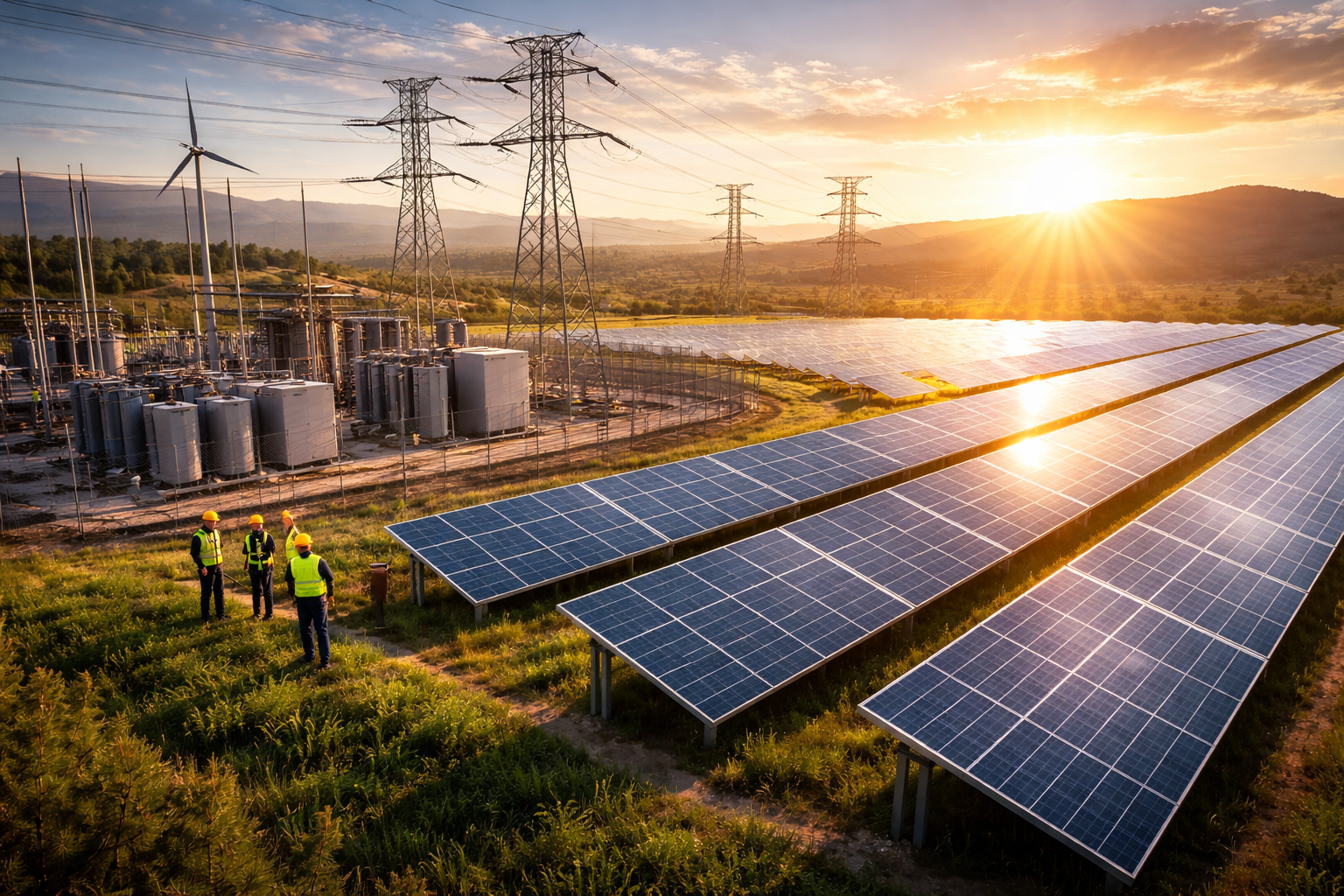
Grid access — not panel efficiency — is increasingly the defining bottleneck in North America’s clean energy buildout. And this week, a small but strategically significant breakthrough in Alberta is drawing investor attention.
According to a release reported by Access Newswire, Revolve Renewable Power Corp. announced it has achieved a key interconnection milestone for its 15.7-megawatt Bright Meadows solar project in Alberta. The development moves the project into a critical phase that accelerates its path toward revenue-generating electricity sales.
For renewable energy investors, interconnection progress is more than a regulatory checkbox. It’s the difference between a concept and a cash-flowing asset.
As governments push grid modernization and corporations ramp up decarbonization commitments, infrastructure execution is becoming the most important metric in clean-tech valuation models.
The Interconnection Bottleneck: Why It Matters
Renewable energy projects often face years-long delays due to permitting, supply-chain issues, and — most critically — grid interconnection queues. Across both the United States and Canada, developers are competing for limited transmission capacity.
According to data from the U.S. Department of Energy and cited by BloombergNEF, hundreds of gigawatts of renewable projects remain stuck in interconnection backlogs. Similar constraints exist in Canadian provinces, particularly in regions experiencing rapid renewable growth.
That’s why Revolve Renewable Power’s milestone at the Bright Meadows project is notable.
The 15.7 MW Alberta solar facility is now advancing through a key grid integration phase, bringing it closer to commercial operation. Once connected and operational, the project transitions from capital expenditure mode to revenue production — fundamentally altering its risk profile.
For investors, that transition can be value-defining.
Alberta: A Strategic Renewable Hub
Alberta has emerged as one of Canada’s most dynamic renewable energy markets. While historically associated with oil and gas production, the province has increasingly attracted wind and solar investment due to favorable land availability and competitive electricity markets.
According to the Canadian Renewable Energy Association (CanREA), Alberta has led Canada in new wind and solar installations in recent years. Market-driven power purchase agreements (PPAs) and corporate demand for clean energy have fueled development.
The Bright Meadows project sits within that broader structural shift.
As global energy majors diversify portfolios and corporations pursue ESG targets, Alberta’s grid is undergoing modernization. Transmission upgrades and integration frameworks are expanding, though not without challenges.
Projects that successfully navigate interconnection hurdles stand to benefit from first-mover advantages in constrained grids.
Why This Matters for Investors
1. Revenue Visibility Improves Valuation Certainty
Interconnection milestones signal de-risking.
Before grid access, renewable projects face regulatory uncertainty and timeline risk. After securing interconnection, the path to cash flow becomes clearer, improving financing terms and enhancing valuation transparency.
Infrastructure investors often assign higher multiples to operational or near-operational assets compared to early-stage developments.
2. Clean Energy Deployment Remains Structurally Supported
North America’s clean-energy transition continues to accelerate. The U.S. Inflation Reduction Act and Canada’s federal clean investment tax credits have provided long-term policy tailwinds.
According to McKinsey & Company, global energy transition investments surpassed $1 trillion annually in recent years, with grid infrastructure receiving a growing share of capital allocation.
Solar and wind deployment is no longer purely subsidy-driven — it is increasingly cost-competitive.
Projects like Bright Meadows illustrate how smaller developers are contributing to the distributed energy expansion underway across the continent.
3. Grid Modernization Is the Next Growth Wave
The renewable story is evolving from generation capacity to grid infrastructure.
Investors are shifting focus toward:
- Transmission and distribution upgrades
- Battery storage integration
- Smart grid technologies
- Hybrid renewable-storage facilities
Interconnection progress reflects alignment between generation growth and transmission capability. Companies positioned at this intersection could benefit disproportionately as governments prioritize reliability and resilience.
Execution Risk vs. Structural Opportunity
While the milestone is positive, investors must weigh execution risk.
Renewable developers face:
- Construction cost variability
- Interest-rate sensitivity
- Supply-chain fluctuations
- Policy adjustments at provincial and federal levels
Higher borrowing costs in recent years have pressured capital-intensive sectors like clean energy. However, recent signs of stabilization in interest-rate expectations may improve financing conditions for infrastructure projects.
Analysts cited by Bloomberg have noted that renewable equities tend to outperform when long-term yields stabilize or decline, given their reliance on project financing.
If rate volatility subsides, capital flows into renewables could accelerate.
Corporate Demand Strengthens the Case
Beyond policy support, corporate energy procurement is driving demand.
Major technology firms, manufacturing companies, and data center operators continue to sign long-term renewable energy contracts to meet sustainability commitments and secure predictable power costs.
Alberta’s competitive power market structure makes it attractive for corporate PPAs.
As artificial intelligence and data center expansion increase electricity consumption across North America, renewable generation capacity must scale accordingly. Solar projects like Bright Meadows contribute incremental capacity to meet that demand.
The intersection of AI growth and clean power development is becoming one of the most compelling investment themes of the decade.
Future Trends to Watch
Expansion of Transmission Capacity
Federal and provincial governments are prioritizing grid investments. Transmission approvals and funding announcements could unlock stalled renewable pipelines.
Storage Integration
Battery storage paired with solar enhances grid reliability and project economics. Developers integrating storage components may capture higher long-term value.
Consolidation in the Sector
Smaller renewable developers reaching operational milestones often become acquisition targets for larger utilities or infrastructure funds seeking de-risked assets.
Policy Stability
While clean-energy incentives remain robust, investors should monitor regulatory developments that may affect provincial markets.
Key Investment Insight
Renewable infrastructure progress signals more than incremental capacity — it reflects structural momentum in North America’s energy transition.
Investors should:
- Focus on developers advancing projects toward operational status.
- Monitor interconnection approvals as leading indicators of execution strength.
- Evaluate balance sheets for resilience against interest-rate volatility.
- Consider exposure to grid modernization plays alongside generation assets.
As clean-energy deployment expands, value creation increasingly depends on execution and infrastructure alignment rather than purely announced capacity.
Projects that move from planning to power production offer a clearer pathway to cash flow and potential valuation uplift.
The Bigger Picture: Energy Transition in Action
The Bright Meadows milestone is a microcosm of a larger shift underway.
North America’s energy landscape is evolving rapidly. Renewable generation is no longer a niche allocation — it is becoming foundational to economic growth, industrial competitiveness, and corporate strategy.
Interconnection progress may not generate headlines like multi-billion-dollar AI investments, but it represents tangible infrastructure advancement.
For investors seeking exposure to long-duration structural growth themes, clean energy remains compelling — particularly when projects cross critical development thresholds.
Momentum in grid modernization and renewable deployment suggests the sector’s growth trajectory is far from complete.
Stay informed with MoneyNews.Today for daily investor insights into emerging industries, infrastructure trends, and the forces reshaping global markets.




