
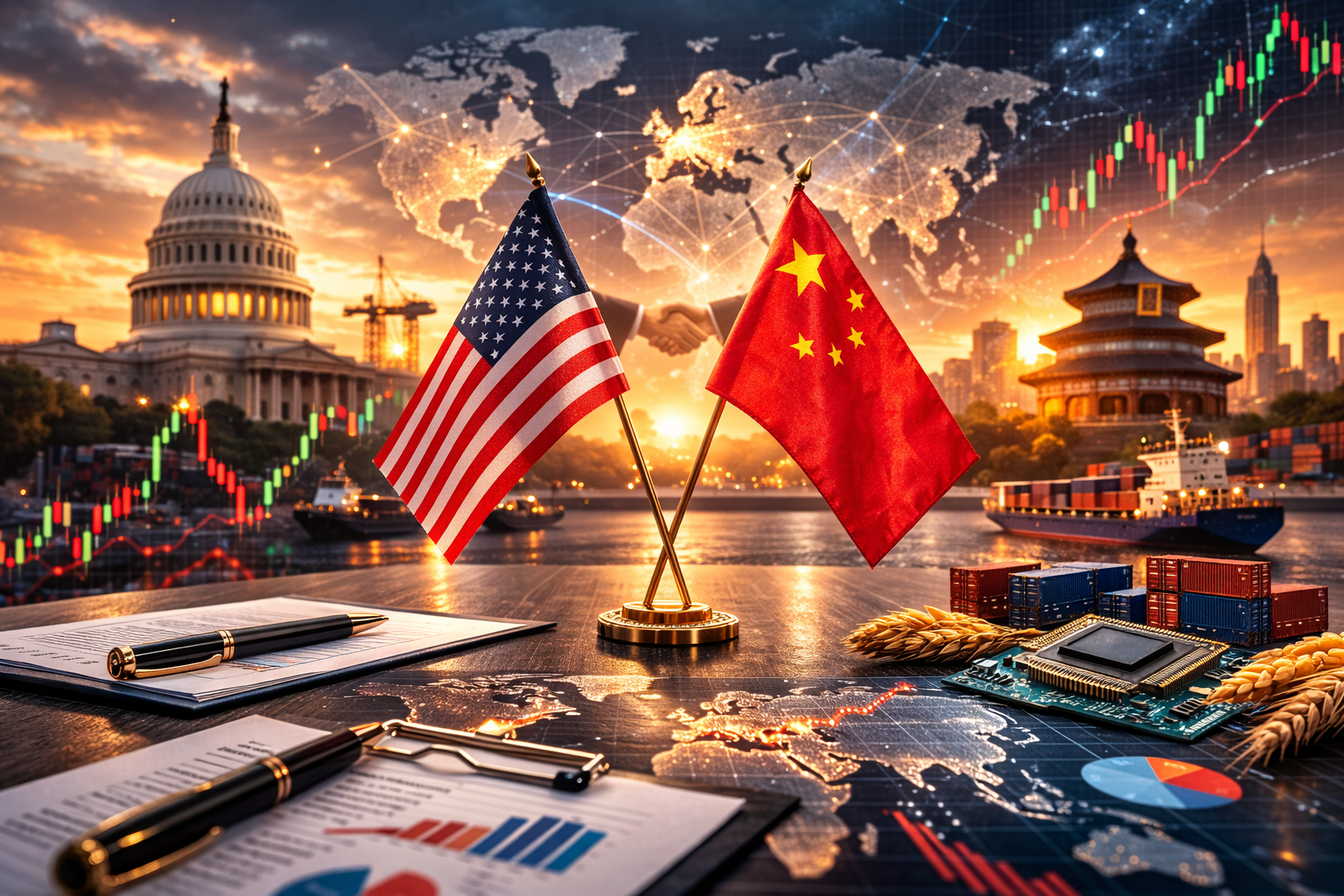
Global markets are once again turning their attention to Washington and Beijing.
After months of simmering tariff tensions, export controls, and political rhetoric, senior U.S. and Chinese trade officials are scheduled to meet in mid-March, according to Reuters, paving the way for a broader summit later this month between U.S. President Donald Trump and Chinese President Xi Jinping.
For investors, this isn’t just another diplomatic headline. It’s a potential inflection point for global equities, multinational earnings, commodity flows, and supply chain stability. At a time when AI export controls, semiconductor restrictions, and geopolitical fragmentation have already injected volatility into markets, the prospect of renewed dialogue between the world’s two largest economies could reshape risk premiums across multiple sectors.
Here’s what investors need to know.
A Fragile Relationship at a Critical Moment
According to Reuters, the upcoming trade meeting is expected to focus on commercial issues including potential aircraft sales, agricultural purchases, and broader trade commitments. The talks will serve as a precursor to a potential Trump-Xi summit later this month — a meeting that could signal either de-escalation or further hardening of economic stances.
U.S.–China trade flows remain deeply intertwined despite years of tariff battles. U.S. Census Bureau data shows China continues to rank among America’s largest trading partners, while U.S. exports of agricultural products, energy, and aircraft remain strategically significant to American producers.
The backdrop is complex:
- Tariffs imposed in previous trade disputes remain partially in place.
- U.S. export restrictions on advanced semiconductors and AI chips have tightened.
- China has responded with restrictions on certain critical minerals and strategic industries.
Markets have grown accustomed to headline risk. But any tangible progress — even incremental — could shift sentiment rapidly.
Why This Matters for Investors
1. Industrial & Aerospace Exposure
A key area reportedly under discussion is aircraft sales, particularly involving Boeing.
China has historically been one of Boeing’s largest growth markets. Delays, regulatory reviews, and geopolitical friction have disrupted deliveries in recent years. If trade talks reopen pathways for confirmed orders or delivery clearances, aerospace stocks could benefit.
For investors, this represents more than a single-company story:
- Suppliers across the aerospace value chain could see order visibility improve.
- Industrials ETFs with global exposure may reprice on improved trade expectations.
- Capital expenditure trends in aviation could regain momentum.
Even modest progress on aircraft purchases would be interpreted as a symbolic thaw in relations.
2. Agriculture & Commodity Markets
Agricultural purchases are another focal point. During prior trade agreements, China committed to large-scale purchases of U.S. soybeans, corn, and pork products.
Any renewed commitment could:
- Support U.S. farm incomes.
- Stabilize agricultural commodity futures.
- Boost companies tied to fertilizers, farm equipment, and grain trading.
Commodities markets are especially sensitive to trade policy. Agricultural volatility in past trade disputes demonstrated how quickly supply chains can reprice based on diplomatic signals.
Investors with exposure to agricultural ETFs, fertilizer producers, and rural-focused lenders should monitor developments closely.
3. Broader Equity Market Sentiment
U.S.–China relations increasingly influence overall market risk appetite.
According to research from institutions such as the Peterson Institute for International Economics and commentary from major investment banks cited by Reuters, geopolitical risk premiums have become a measurable factor in equity valuations.
When trade tensions escalate:
- Defensive sectors tend to outperform.
- Treasury yields may fall on safe-haven demand.
- The U.S. dollar can strengthen.
Conversely, signs of détente often trigger:
- Risk-on rotation into cyclicals.
- Industrial and materials rallies.
- Emerging market equity rebounds.
Given current elevated market sensitivity to macro headlines — including inflation data, Federal Reserve policy expectations, and AI sector volatility — this meeting adds another potential catalyst.
The Technology Overhang
While the current talks reportedly emphasize commercial commitments, the elephant in the room remains technology restrictions.
The U.S. has tightened export controls on advanced AI chips and semiconductor manufacturing equipment. These measures directly impact companies like:
- Nvidia
- Advanced Micro Devices
- Intel
China, for its part, has increased scrutiny over critical mineral exports and domestic tech champions.
Even if agricultural or aerospace agreements progress, structural competition in AI and advanced computing is unlikely to disappear.
For investors, this means:
- Trade progress may boost sentiment without fully removing sector-specific restrictions.
- Semiconductor stocks could still face regulatory headwinds.
- Supply chain diversification strategies (Mexico, Southeast Asia, domestic reshoring) remain long-term themes.
Markets may welcome incremental cooperation, but strategic decoupling in sensitive technologies is likely to persist.
Currency & Fixed Income Implications
Trade talks can ripple through currency markets as well.
Improved U.S.–China relations often reduce global growth uncertainty, supporting commodity-linked currencies and emerging markets. Conversely, breakdowns in negotiations typically boost the U.S. dollar as a safe-haven asset.
Bond markets also react quickly:
- Reduced trade friction may support higher Treasury yields if growth expectations improve.
- Escalation could increase demand for government bonds, compressing yields.
With Federal Reserve policy still a dominant macro force, trade diplomacy adds another layer of complexity for fixed-income investors.
Future Trends to Watch
As negotiations unfold, investors should focus on three critical signals:
1. Concrete Commitments vs. Symbolic Dialogue
Markets respond far more strongly to signed agreements and purchase orders than to general diplomatic statements.
2. Language Around Tariffs
Any discussion of tariff reductions or suspension would likely move markets significantly.
3. Technology Policy Clarity
Investors should watch for indications that export controls will either expand or stabilize. Even maintaining the status quo could be interpreted as a win if fears of escalation recede.
Key Investment Insight
Renewed U.S.–China dialogue reduces immediate tail risk but does not eliminate structural rivalry.
Investors may consider:
- Monitoring industrial and aerospace names for order momentum.
- Watching agricultural commodity pricing for confirmation of large-scale purchases.
- Maintaining diversified exposure across sectors to hedge geopolitical uncertainty.
- Tracking semiconductor policy developments closely before making concentrated bets.
In the near term, markets may trade on headlines. Over the longer horizon, durable investment trends — AI infrastructure, supply chain realignment, energy security — will remain central regardless of diplomatic fluctuations.
Trade negotiations between the United States and China have repeatedly proven capable of moving global markets within hours.
The upcoming meeting between senior trade officials — and the potential Trump-Xi summit to follow — arrives at a time when investors are already navigating AI-driven volatility, shifting Fed expectations, and fragile global growth dynamics.
Whether these talks produce tangible commercial commitments or merely reset the tone, the implications will extend well beyond bilateral trade figures.
For investors, vigilance is key. Diplomatic progress could spark rallies in cyclical sectors, while renewed friction could reintroduce defensive positioning and supply chain stress.
Stay ahead of market-moving geopolitical developments and daily investor intelligence with MoneyNews.Today — your trusted source for actionable financial insight in an increasingly complex global economy.




