
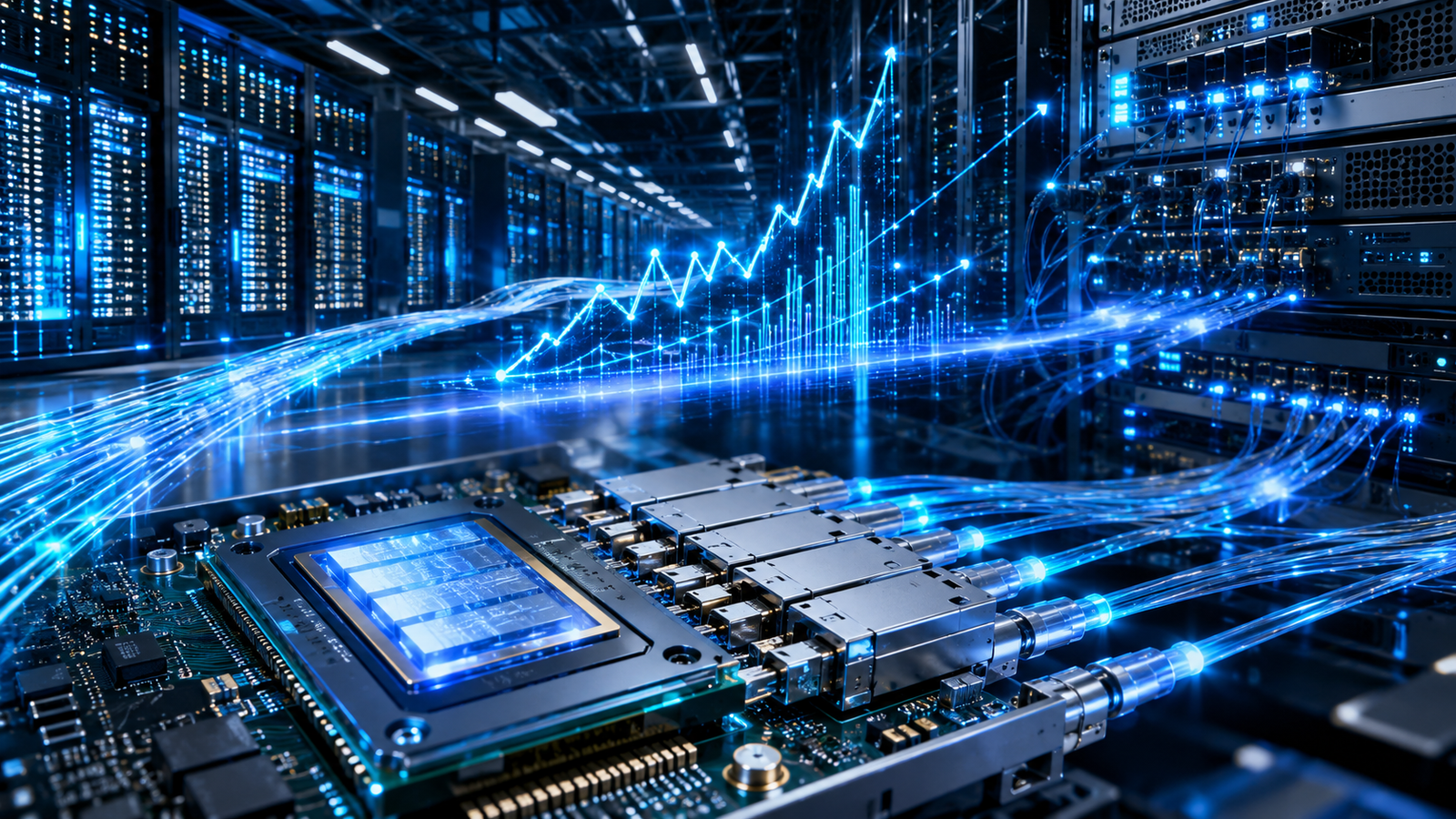
Wall Street’s artificial intelligence rally is entering a new phase — and this time, it is not just about GPUs and mega-cap technology stocks. Investors are increasingly turning their attention toward one of the fastest-growing and least understood segments of the AI infrastructure boom: photonics and optical networking.
Shares of photonics and optical connectivity companies surged after Lumentum Holdings joined the Nasdaq-100 Index, reinforcing growing investor confidence in the long-term demand for AI networking infrastructure. According to Reuters and MarketScreener, the move reflects a broader shift in market focus as hyperscale AI data centers require faster, more energy-efficient communication systems capable of handling enormous amounts of data.
For years, Nvidia dominated the AI investment narrative because of its leadership in AI chips. But as generative AI systems become larger and more complex, the industry is discovering that processing power alone is not enough. AI infrastructure also depends on ultra-fast networking systems capable of moving massive volumes of data between GPUs, servers, storage platforms, and cloud environments.
That technological shift is placing photonics — the science of transmitting information using light — at the center of one of the most important emerging investment opportunities in the AI economy.
AI Data Centers Are Creating a Networking Revolution
The explosive growth of generative AI has fundamentally changed how data centers are built.
Modern AI systems require thousands of interconnected GPUs operating simultaneously across hyperscale computing clusters. Training and running frontier AI models demand unprecedented levels of data transfer speed, bandwidth, and energy efficiency.
Traditional electrical interconnects are increasingly struggling to keep pace with these demands.
That is where optical networking and photonic technologies are becoming critical.
Photonics systems use light rather than electrical signals to transmit information, allowing for dramatically faster communication speeds while reducing heat generation and power consumption. This makes photonics especially valuable for AI infrastructure, where energy efficiency and low latency are becoming increasingly important.
According to industry research from McKinsey and Dell’Oro Group, AI-related network traffic is expected to grow exponentially throughout the decade as enterprises and cloud providers continue expanding AI workloads.
This has created strong investor interest in companies involved in:
- Optical transceivers
- Silicon photonics
- Fiber-optic networking
- AI interconnect systems
- Data-center switching infrastructure
- High-speed communication hardware
As hyperscalers race to expand AI capacity, networking bottlenecks are becoming one of the biggest challenges facing the industry.
Lumentum’s Nasdaq-100 Entry Signals Institutional Confidence
Investor attention intensified after Lumentum officially joined the Nasdaq-100 Index, a move widely interpreted as validation of the growing importance of optical networking in the AI ecosystem.
The Nasdaq-100 includes many of the world’s largest and most influential technology companies. Inclusion often increases institutional ownership because index funds and ETFs tracking the Nasdaq-100 must allocate capital toward newly added members.
For photonics investors, the inclusion represents more than just a symbolic milestone.
It signals that Wall Street increasingly views optical networking as a core component of future AI infrastructure rather than a niche telecommunications segment.
Lumentum specializes in optical and photonic products used across cloud networking, telecommunications, 3D sensing, and AI-related infrastructure. The company has benefited from rising demand for high-speed optical connectivity systems tied to AI data-center expansion.
Analysts cited by Reuters noted that the market is beginning to recognize photonics as one of the most important “second-wave AI” opportunities beyond semiconductors.
That narrative is attracting growing interest from institutional investors seeking exposure to AI growth areas outside the already crowded GPU trade.
Silicon Photonics Could Transform AI Infrastructure
One of the most important emerging trends within the sector is silicon photonics.
Silicon photonics integrates optical communication capabilities directly into semiconductor chips, enabling faster and more energy-efficient data transfer between processors and computing systems.
Major technology companies including Intel, Nvidia, Cisco, Broadcom, and Taiwan Semiconductor Manufacturing Company are all investing heavily in silicon photonics research and development.
The technology is viewed as a potential solution to one of AI’s biggest long-term problems: power consumption.
AI data centers consume enormous amounts of electricity, and networking systems are becoming a growing contributor to that energy demand. Silicon photonics may significantly improve efficiency by reducing power losses associated with traditional electrical interconnects.
According to industry estimates from LightCounting and various semiconductor analysts, the market for AI optical networking hardware could expand dramatically over the next several years as AI clusters scale toward millions of interconnected processors.
For investors, this creates opportunities not only in photonics manufacturers but also across semiconductor packaging, networking equipment, and AI infrastructure providers.
Nvidia’s Influence Extends Beyond GPUs
Nvidia remains one of the central forces driving the photonics boom.
While the company is best known for AI GPUs, Nvidia has increasingly emphasized networking infrastructure as a key component of its long-term AI strategy. The company’s acquisitions and partnerships involving high-speed networking, InfiniBand technology, and optical connectivity have positioned it as a major player in the broader AI infrastructure ecosystem.
CEO Jensen Huang has repeatedly described AI infrastructure as one of the largest industrial buildouts in modern history.
That infrastructure expansion includes far more than processors alone.
AI systems require:
- Massive data-center expansion
- Advanced networking hardware
- Fiber-optic communication systems
- Cooling infrastructure
- Energy-efficient interconnects
- High-performance storage solutions
As a result, investors are increasingly broadening their AI investment focus beyond semiconductor leaders toward companies supporting the underlying infrastructure ecosystem.
This trend is helping drive momentum across optical networking firms, cloud infrastructure providers, and data-center equipment manufacturers.
Why Photonics Is Becoming a “Second-Wave AI” Opportunity
The first phase of the AI rally largely centered around companies building the computational foundation for artificial intelligence — particularly GPU manufacturers and cloud hyperscalers.
The second phase is increasingly focused on enabling technologies that make large-scale AI deployment possible.
Photonics sits directly within that category.
As AI systems continue scaling, networking performance is becoming just as important as raw computing power. Even the fastest AI chips become less effective if data cannot move efficiently between systems.
That reality is creating a structural demand trend for optical networking technologies.
Several investment banks and research firms have recently identified photonics as one of the most underappreciated AI investment themes.
Goldman Sachs analysts recently highlighted optical interconnects and networking infrastructure as critical beneficiaries of accelerating AI capital expenditures. Meanwhile, McKinsey research suggests that AI infrastructure spending could expand into trillions of dollars globally over the next decade.
The increasing convergence between semiconductors, networking, and photonics is reshaping how investors evaluate AI-related opportunities.
Future Trends Investors Should Watch
Several major developments are likely to shape the photonics sector throughout the remainder of 2026 and beyond.
First, hyperscale AI spending trends remain critical. Continued investment from Microsoft, Amazon, Google, Meta Platforms, and Oracle could drive sustained demand for optical networking infrastructure.
Second, investors should monitor advancements in silicon photonics technology. Breakthroughs in integration efficiency and manufacturing scalability could significantly expand adoption.
Third, power consumption is becoming one of AI’s biggest long-term challenges. Companies offering energy-efficient networking and interconnect solutions may become increasingly valuable as AI infrastructure scales.
Fourth, geopolitical and supply-chain dynamics may influence semiconductor and networking infrastructure markets. Governments are prioritizing domestic AI infrastructure and advanced manufacturing capabilities.
Finally, consolidation within the photonics industry could accelerate as larger technology firms seek to secure networking capabilities through acquisitions and partnerships.
Key Investment Insight
Photonics is rapidly emerging as one of the most important “second-wave AI” investment opportunities. As AI data centers grow larger and more complex, demand for high-speed optical networking and energy-efficient connectivity solutions is accelerating across the technology sector.
For investors, the opportunity extends far beyond traditional GPU makers. Optical networking firms, silicon photonics developers, fiber-optic infrastructure providers, and AI interconnect specialists may all benefit from the next phase of AI infrastructure expansion.
At the same time, competition within the sector is intensifying, and technological innovation remains critical. Investors should closely monitor hyperscale spending trends, semiconductor integration advances, and power-efficiency breakthroughs shaping the future of AI networking.
The AI economy is evolving rapidly, and the companies enabling faster, smarter, and more efficient connectivity may become some of the biggest winners of the next technology cycle. Follow MoneyNews.Today for daily investor insights, emerging industry analysis, and market-moving developments shaping the future of AI infrastructure investing.




